Tactical Analysis: Real Madrid vs Borrusia Monchengladbach
By Sakhumuzi Mpofu
The last week of Champions league football was certainly very dramatic as various groups such as D and H came right down to the wire and Group B, consisting of Gladbach, Madrid Shaktar and Inter was certainly no different,as leading up to the final group games all teams could’ve possibly qualified for the round of 16 depending on the results. This led to a very high stakes game between Monchengladbach and Madrid as Madrid needed to win to qualify, and Gladbach needed a positive result in their game unless it remained goalless at the San Siro, which it ultimately did.
1st half
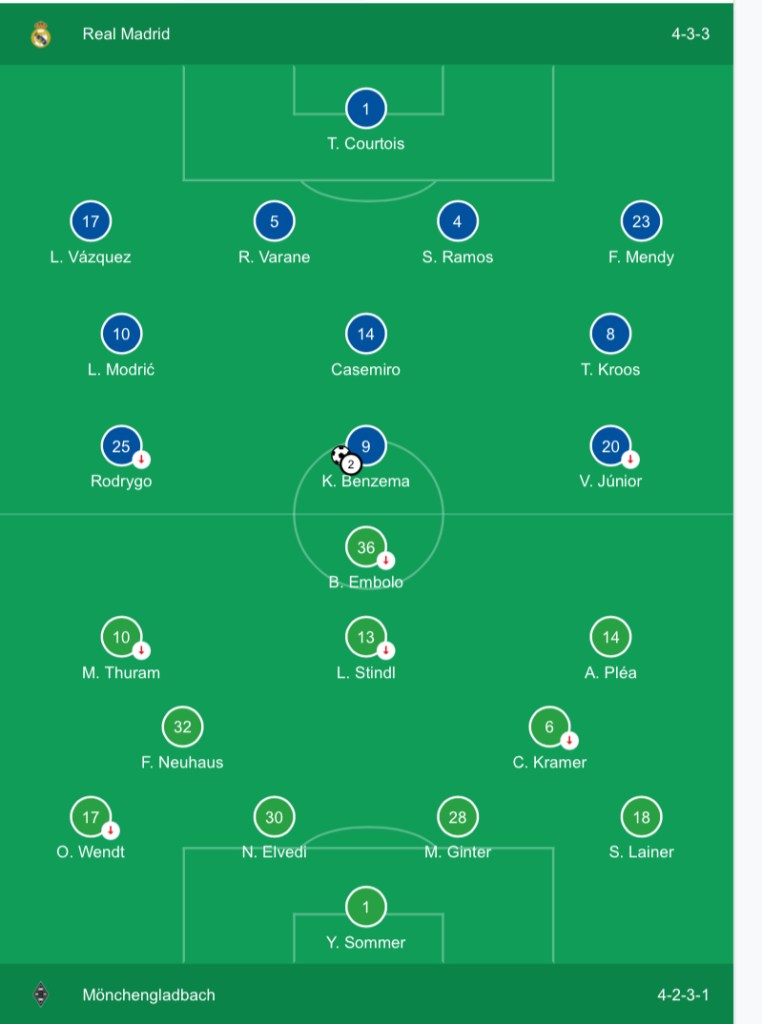
In order to gain a positive result, Real Madrid lined up in a 4-3-3 formation while Gladbach lined up in a 4-2 -3-1.
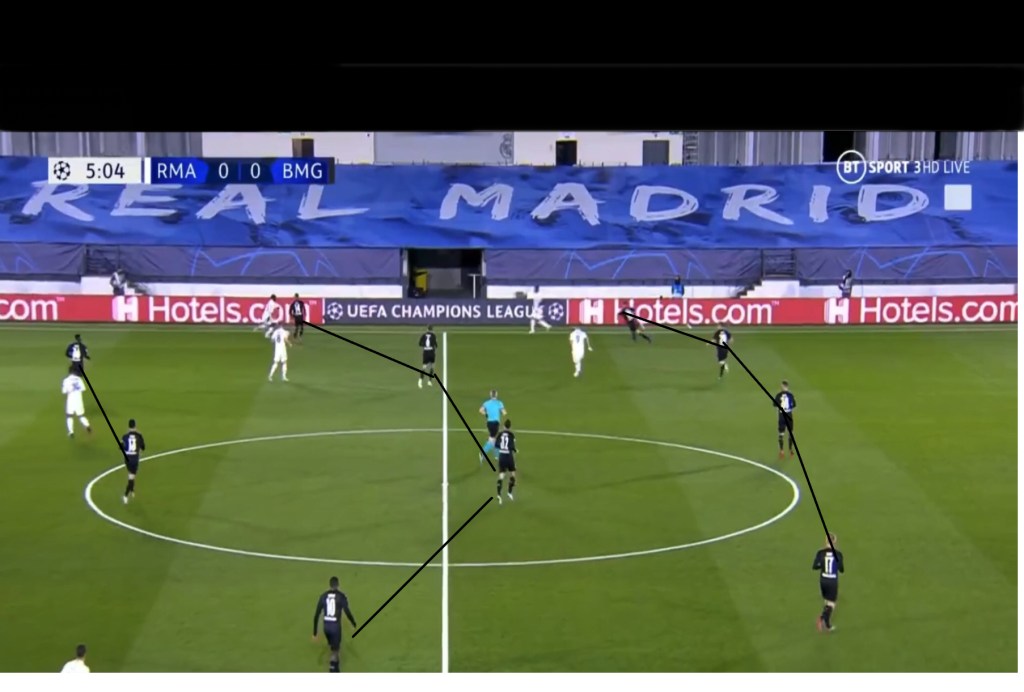
Gladbachs’s 4-2-3-1 turned into a 4-4-2 out of possession as they did against Inter Milan in the previous week. Initially Gladbach had a relatively “passive” approach in defense against the Spaniards as they formed a mid-block with some elements of position oriented zonal marking as well as man oriented zonal marking
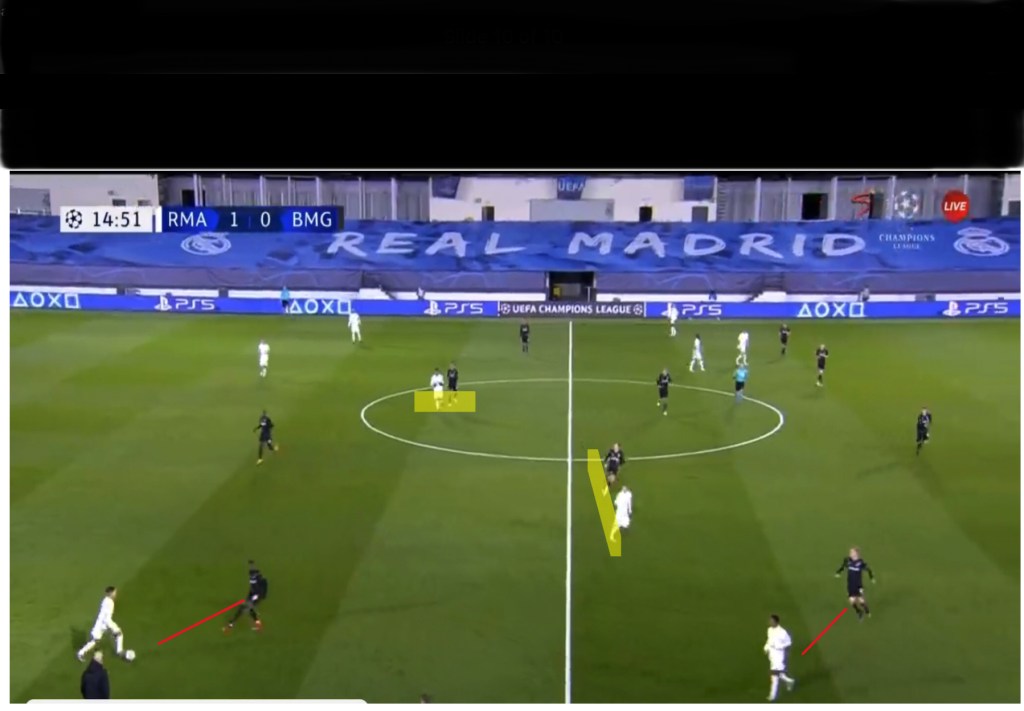
Gladbach aimed to prevent progression through their midfield,so as a result forced Madrid to play the ball out wide. When the ball was played out to the touch line Gladbach’s press would intensify, with the full-backs applying pressure from behind the wingers and either Plea or Thurman applying pressure to the ball carrier on the touch line. Once the ball was played out wide, one of the front two(either Embolo or Stindl) would drop and occupy Casemiro, reducing the options for the ball carrier, forcing him to play down the line. This occurred throughout the rest of the first half and even resulted in Gladbach’s best chance of the game but Real Madrid were positioned well and managed to bypass Gladbach’s press regularly.
Real Madrid in build up
Throughout the 1st half Kroos could be seen regularly dropping in either between the back two of Ramos and Varane or to the left of the CB pairing, while Modric dropped to the right of the pairing on occasion, forming a back three. This allowed them to the circulate the ball with ease at the back as they had a numerical advantage against Gladbach’s front two.
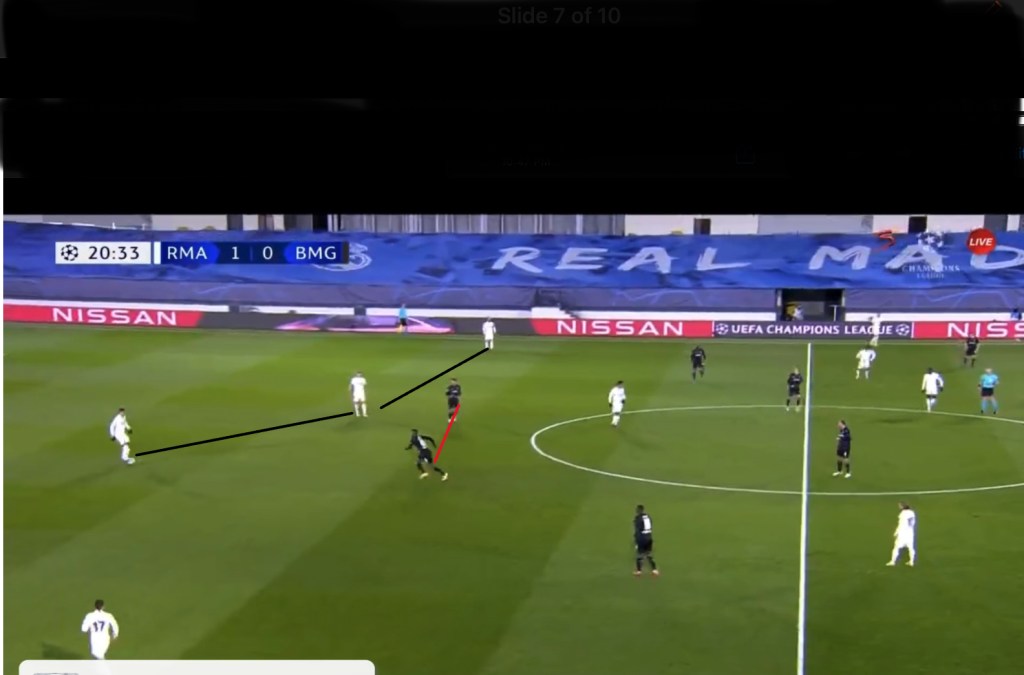
Madrid would circulate the ball from right to left at the back before switching the play(usually from left to right) as by moving the ball towards the left hand side, Gladbach’s 4-4-2 would shift across, leaving space for Vazquez to push up and provide width alongside Rodrygo.
Madrid would focus a large portion of their attacks down the right hand side during the first half which resulted in both of their goals coming from the right hand side. Madrid aimed to take advantage of Marcus Thuram’s lack of defensive awareness and failure to track his runner, Vazquez. Luka Modric would move from central positions into the half space and create a 3v3 on the wing,however, even though there was numerical equality, Modric Vazquez and Rodrygo were positionally superior.
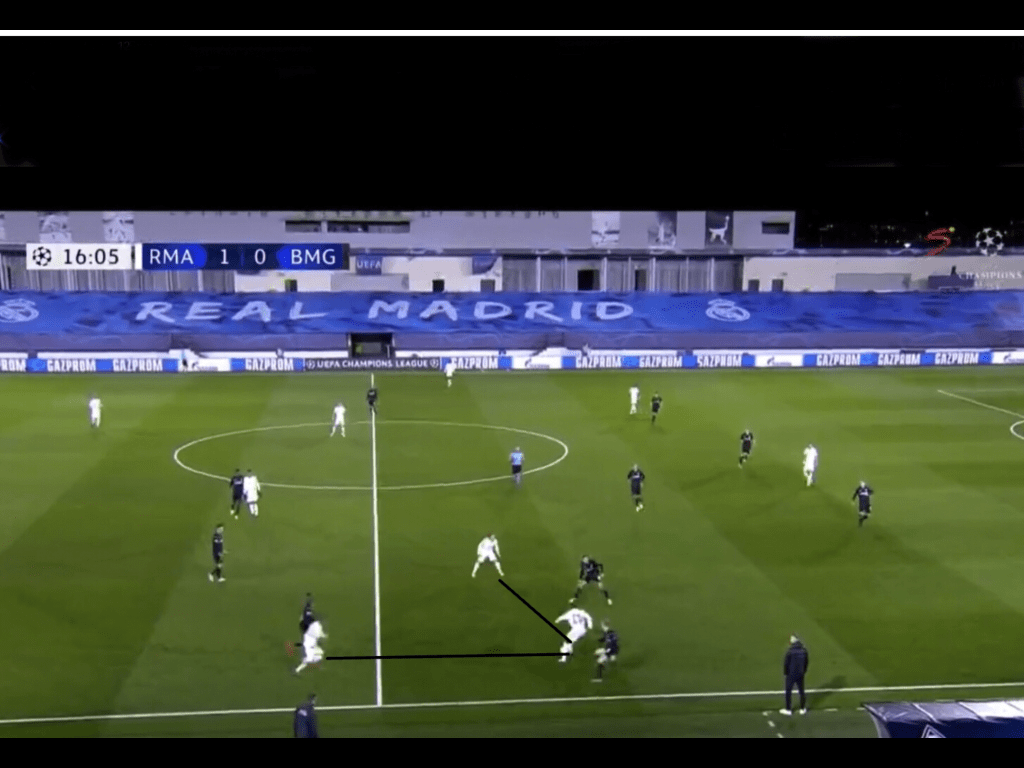
Vazquez plays the ball to Rodrygo who manages to take a touch and turn and find Modric. Who due his position slightly away from Neuhaus enables him to play a pass to an advancing Vazquez, with Thurman failing to track his run. This was done often in the first half and in a number of different variations.
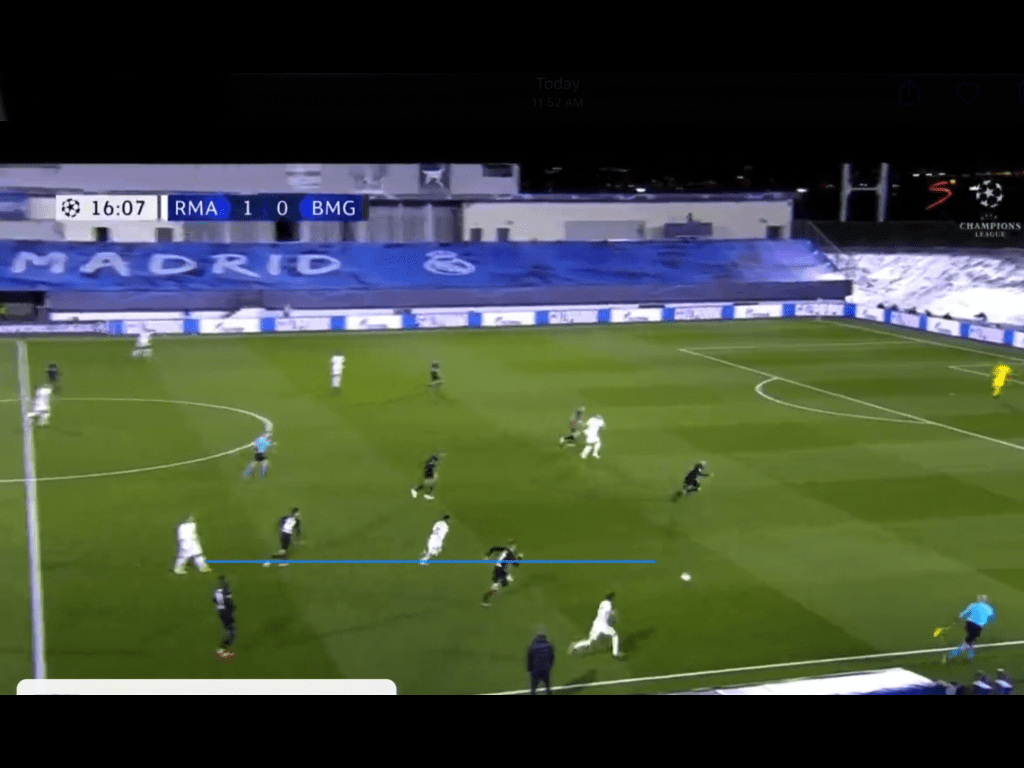
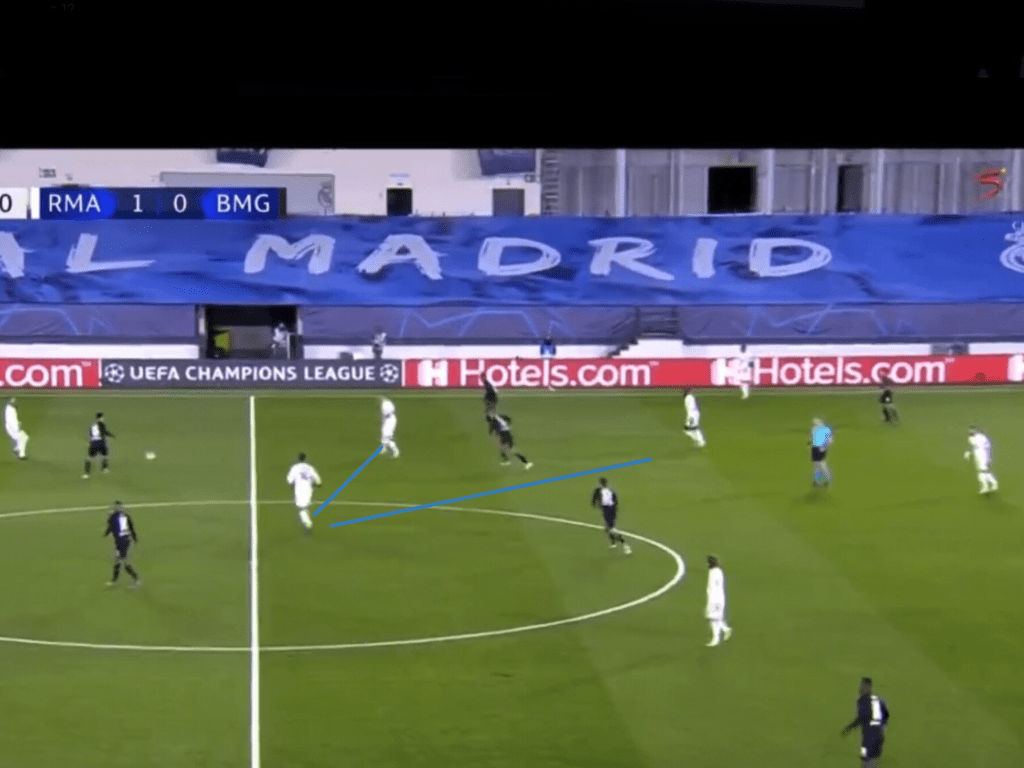
Nevertheless, this was not Real Madrid’s only means of progressing the ball throughout the game. During the 1st half Vinicius hugged the touch line whilst Ferland Mendy positioned himself between Gladbach’s midfield and defensive in the half space, with the two swapping positions occasionally depending on the situation. Benzema would also at times take up this position in the half space when he swapped with Vinicius
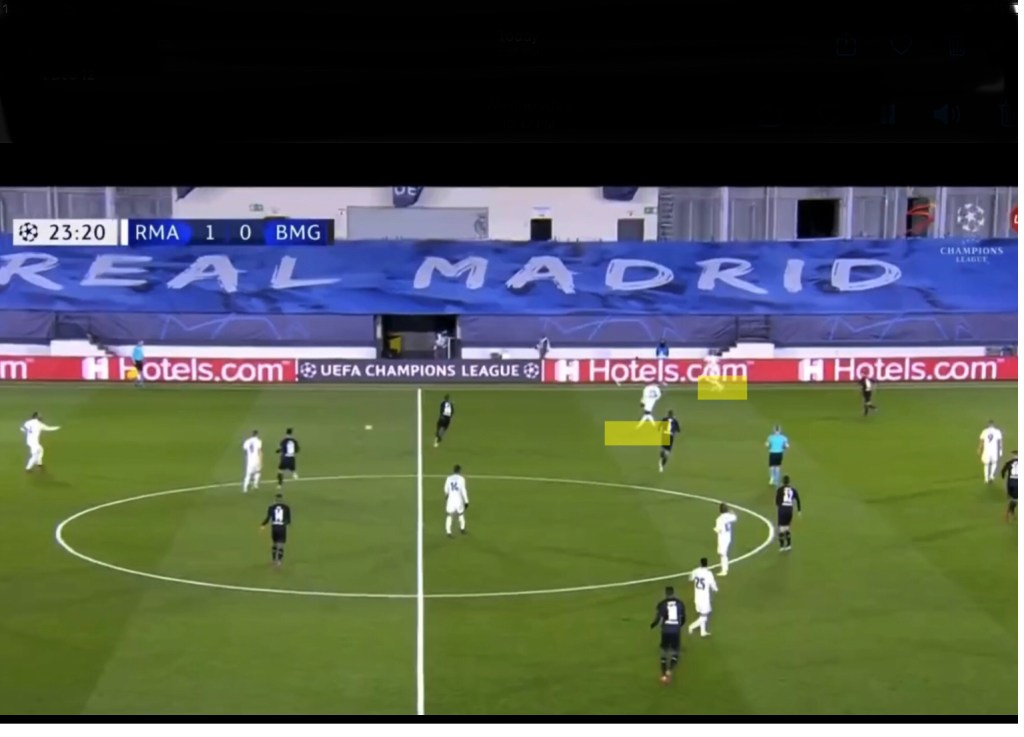
Mendys movement inwards, behind the midfield line meant that Real Madrid could achieve numerical superiority at times in the middle of the park, allowing casemiro to combined before playing the ball through Gladbach’s midfield, to the player in the half space.
Gladbach’s build up and Madrid’s press
Gladbach struggled throughout the game to play through Real Madrid’s press, as they attempted to play out of the back by either Kramer or Neuhaus dropping between the defense to form a back 3 with Lars Stindl dropping deep to form a midfield 2.
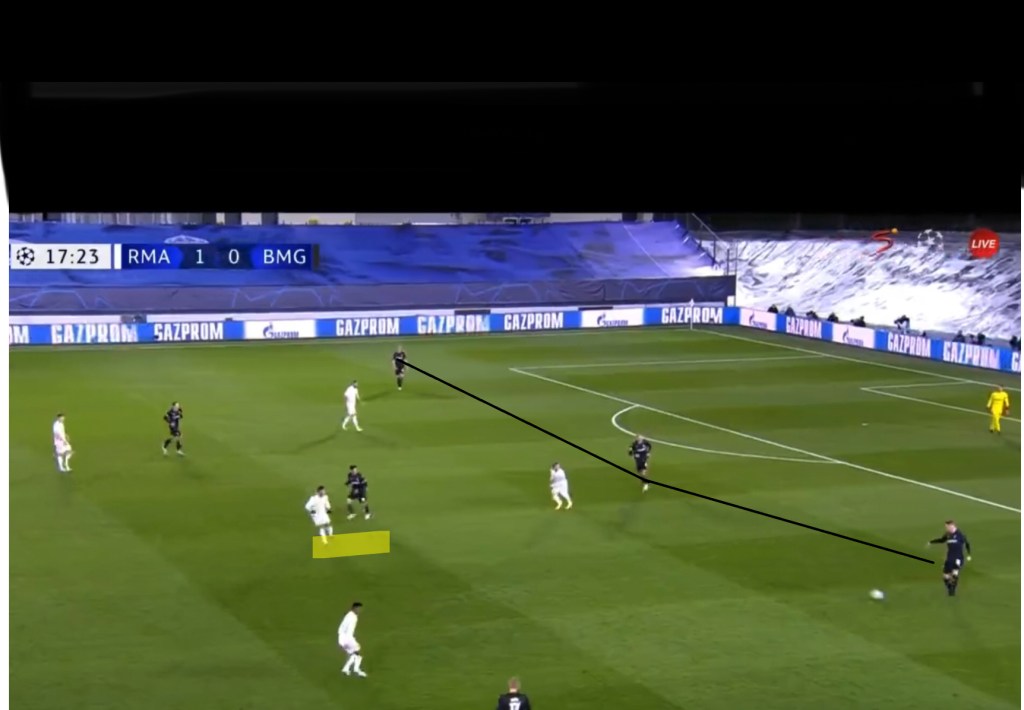
In order to combat this, Real Madrid would press aggressively and high up the pitch with their front 3 pressing Gladbach’s back 3 and Casemiro staying relatively close behind Stindl and Kroos Behind either Kramer or Neuhaus, with Rodrygo pressing Wendt on the right hand side and Mendy staying close to Lainer on the left.
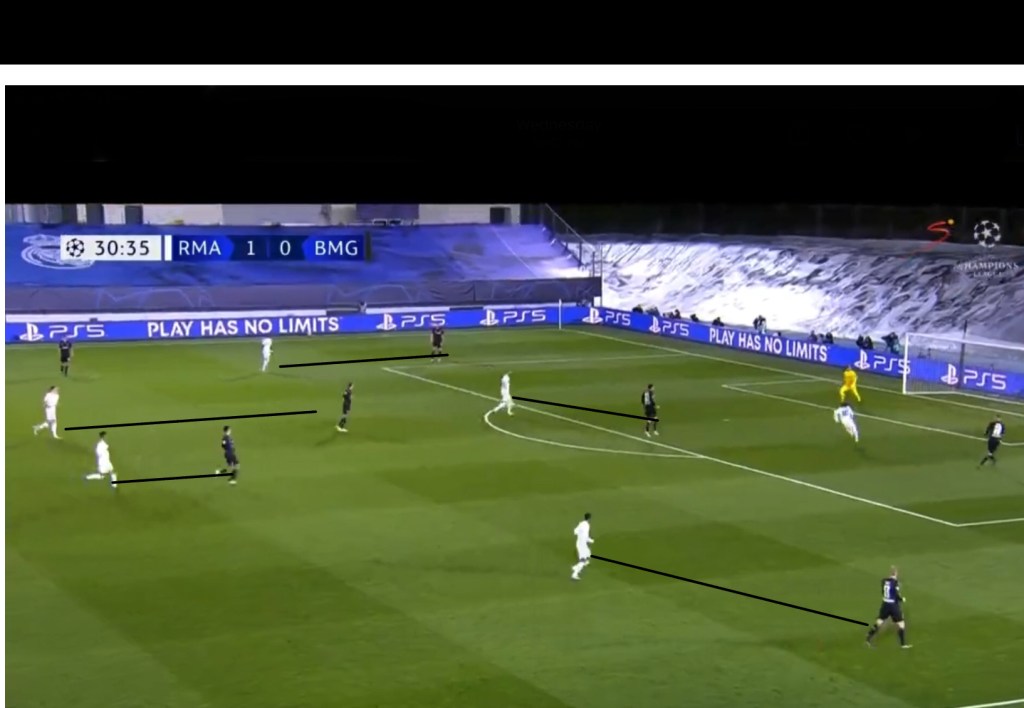
This prevented Gladbach from playing out of the back comfortably and forced them to play the ball out wide and then attempt chipped balls into the midfield, which Real Madrid were on hand to intercept. This strategy is what lead to Real Madrid’s second goal as they forced the turn over before crossing the ball into the box.
Changes made at the break
In the 2nd half Gladbach made 2 changes as Wendt and Embolo came off for Zakaria and Lazaro and this effected their build up greatly. Zakaria dropped into the midfield during the build up and Gladbach reverted away from forming a 3 at the back with one of their midfielders and formed a 3 in midfield which at times turned into a diamond at times with Stindl dropping deeper.
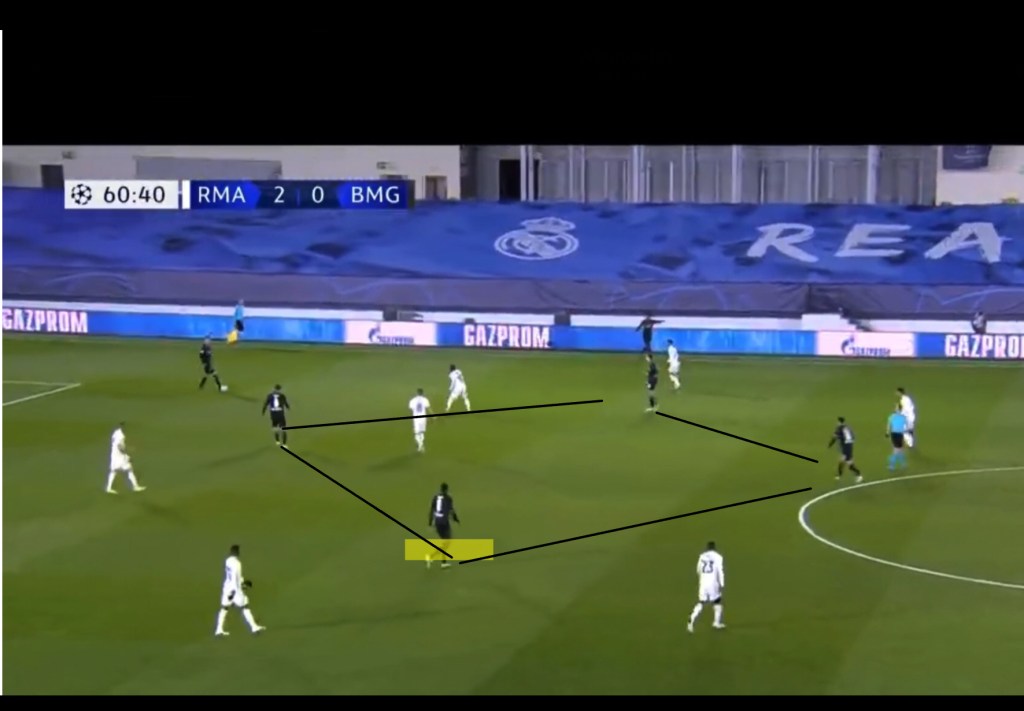
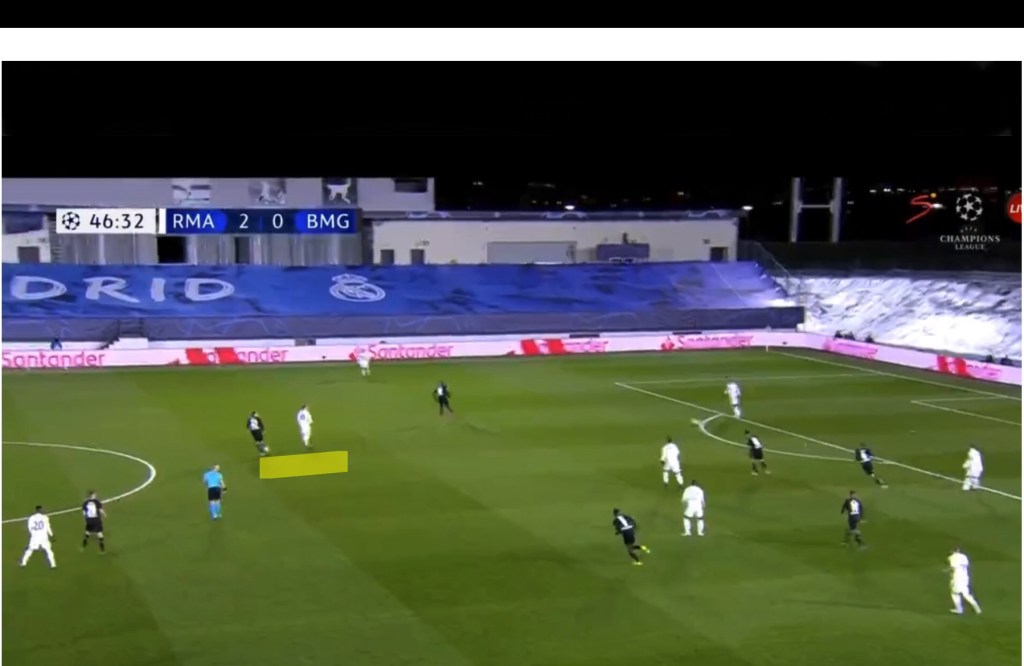
The extra man in midfield and the movement away from creating a back 3 in defense meant that Casemiro and Kroos no longer had to only press a midfield 2 but a midfield 3 and as a result modric had to press Elvedi the LCB less aggressively and prevent passes to Neuhaus in the midfield with his cover shadow. This change gave the Gladbach Centre backs more time on the ball.
In Defense, Gladbach in the 2nd half began to press more aggressively whilst still in their 4-4-2 formation and Neuhaus stuck with Modric constantly and didn’t not shift across with the rest of the defense to neutralize the threat on the right hand side and prevent quick combinations leading to crosses.
Conclusion
Regardless of the changes made at the break Madrid continued to dominate the game and booked their spot in the last 16. Although losing,Gladbach managed to also qualify for the last sixteen due to a goalless game at the San Siro. Nevertheless Zidane”s brilliant tactics managed to get the better of Marco Rose’s Gladbach.


 Skmm-ftbl
Leave a reply to Mourinho Cancel reply