Recently, on a cold Saturday afternoon I watched as the team I assist in coaching struggled to play out from the back against a very high press. Mind, I only recently began trying to coach a few months ago, so this led to a number of internal dialogues and investigations on how we could train in order to be better equipped to deal with a press like this in future games. I had found myself wanting to coach the players to be able to play through a scenario such as this one with ease, but upon watching several professional games It dawned upon me that even the best of the best struggle to play through high intensity pressure at all the time. This led to the thought of “what actually enables players to be able to progress the ball through a high intensity press?”. Are the solutions only in improving the ability of your players to be able to be technically adept to deal with little time on the ball and make and execute effective decisions? Is it in your structure which can allow for the creation of superiorities in order to progress the ball? Or is it about changing your approach of playing out the back to fit the circumstance? Now in reality, all of these are directly related and tie into and affect one another. Improving players ability to play with limited space and time is imperative in whatever structure that you have and whatever “alternative method” you want to use and your structure is also important if you want to employ an alternative method such as playing out of the back initially and then lofting the ball into a certain area. However, for the sake of the structure of this article, I wanted to examine them separately and also present a few ideas on drills that can help implement a couple of the questions I’ve had.
Structural advantage
There are situations where even despite the nature or the intensity of the opposition’s press the structure that a team uses when playing out of the back gives them certain advantages whether numerically or positionally, with teams able to prepare to play out in different structures due to analysis of the opposition beforehand. An example of this can be in Napoli’s game against Liverpool earlier on in the season.
In this game Liverpool lined up in their usual 4-3-3 with Napoli in a 4-2-3-1 with Liverpool employing relatively high press. Salah and Diaz in the front three, were in positions that would allow them quick access to Napoli’s Centre backs whenever they threatened to carry the ball, with Firmino responsible for closing down the goalkeeper as well as occasionally trying to prevent passes to stanislav Lobotka the Napoli DM. James Milner and Harvey Elliot would orient their positions to Anguissa and Zielinski and Fabinho acting as the Anchor in the midfield. It must also be said, however, that although high, Liverpool’s press lacked intensity in some areas

In this game, Napoli were able to progress the ball with relative ease, due to Liverpool having their wingers in such high positions in the front 3. This meant that whenever the ball was played out wide, Napoli would have a 4v3 and at times a 5v3 against Liverpool’s midfield line, who would as a result have a lot of space to try and cover in order to try and provide meaningful pressure allowing for Napoli to progress the ball forwards. However, even in situations where players may have a structural advantage they still need to be adept at executing actions quickly otherwise the benefits of the advantage will be lost.
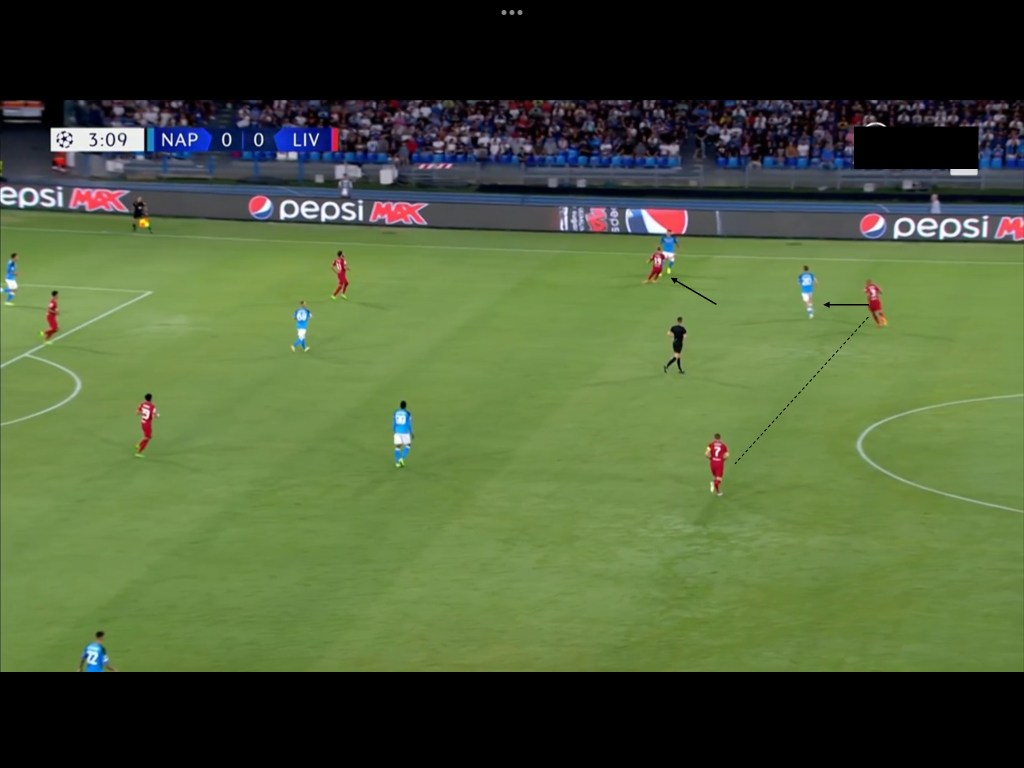
However, even in situations where players may have a structural advantage they still need to be adept at executing actions quickly otherwise the benefits of the advantage will be lost.
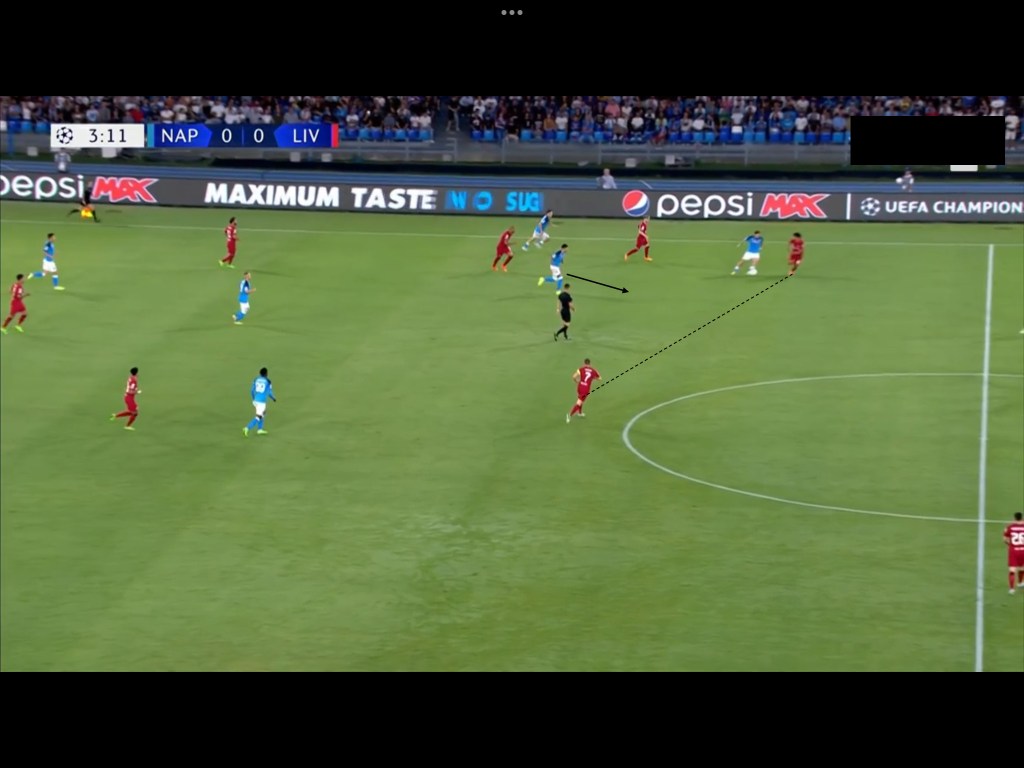
However, for obvious reasons, in the very lower tiers of domestic football you can’t analyse teams beforehand and plan to play in a particular structure that will aid progression, so you only really have a sense of how a team plays when you’re playing them. This does not mean now work cannot be done towards improving your structure if need be, but regardless of this, players will still need to be competent in dealing with situations where they have more limited time on the ball as usual.
Improving player ability
The first perception that I realised was relatively unattainable was developing the ability for players to be able master playing through an aggressive man oriented press and to always be able to do so. Whatever the level and however good players are it is virtually impossible to always be able to play out comfortably against an effective high press. Before I present some ideas through drills on how players’ abilities could be improved in order to be able to be comfortable in this scenario, I wanted to provide some examples of how even top teams have struggled to play their way out of these scenarios.
Bayern vs Barcelona
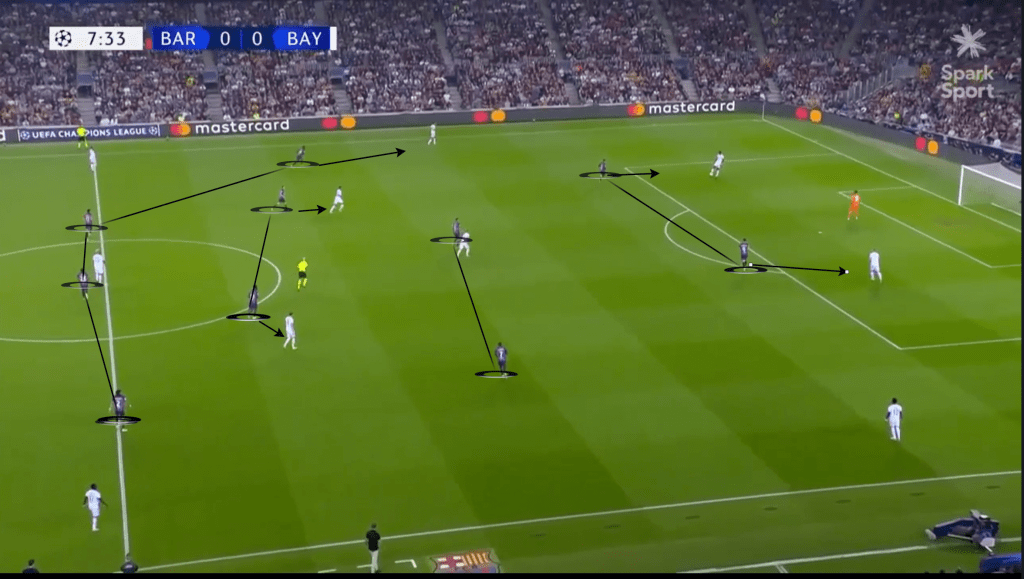
In the image below, we can see how in their game against Bayern Munchen, Barca elected to press in a sort of asymmetrical 4-2-2-2/4-1-3-2 but this would change depending on the situation due to the man oriented nature. Gavi would orient his position to the Bayern Centre backs, with Lewandoski limiting passes to both Upamecano and Neuer, whilst Pedri and Busquets would do the same to the midfield pair of Sabitzer and Kimmich, Raphina to Davies and Ousmane Dembele would invert from the opposite wing and move towards Musiala in the centre of the pitch. Barcelona looked to restrict Bayern to one side of the field, aiming to prevent short passes to the full-backs and midfielders which would allow them to switch play, with this looking to have the effect of Bayern playing long balls into an area that many Barcelona players occupied.
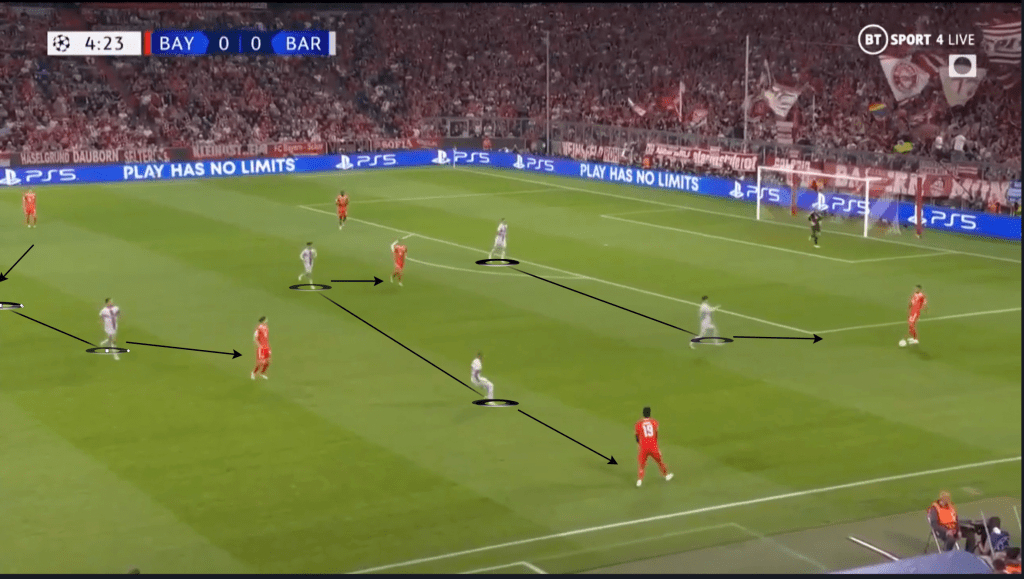
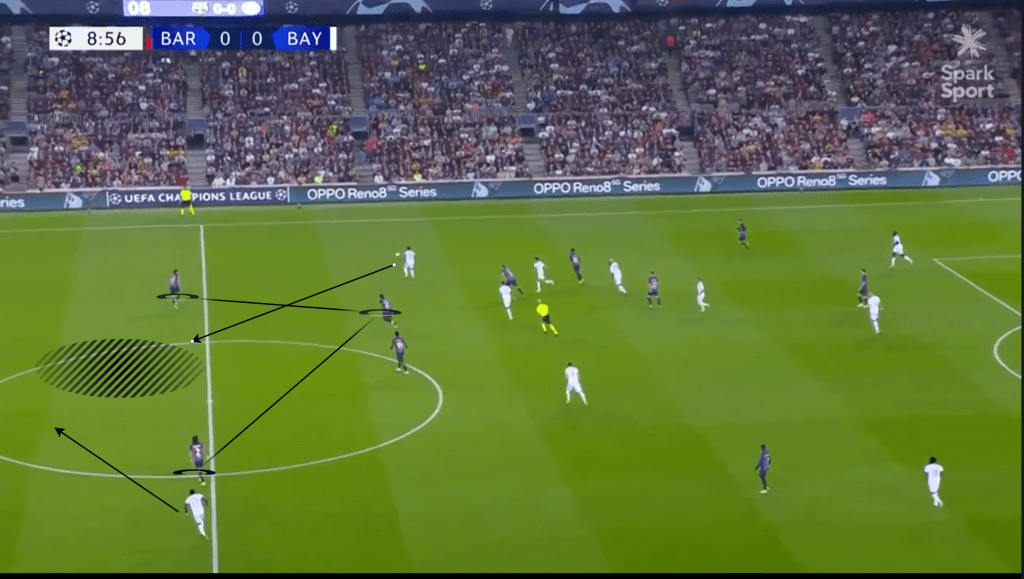
This scenario created many challenges for Bayern as their midfielders and full backs receiving the ball would trigger pressure from Barcelona players behind them, and due to the man-oriented nature of Barcelona’s press they would not be able to find a free man easily. As a result passes to these players, especially the midfielders would increase the chances of turnovers in dangerous areas. Yet despite this, Bayern, although not easily, would be able to progress the ball on a couple of occasions. The image below shows a weakness in the method of Barcelona’s approach of trying to restrict Bayern to one side of the field. Lewandoski’s position, as mentioned earlier, also meant that at times he had to choose between preventing passes to Upamecano or pressing Neuer and in this example by choosing to prevent a direct pass to Upamecano, his ability to press Neuer reduces. What can also be seen in the example below is that due to ousmane dembele having to invert his position in order to cover Musiala, Pavard as well as upamecano in certain situations would often be free. Dembele’s positioning meant that he would have to cover a relatively large distance in order to cover Pavard or Upamecano in the occurrence of a switch of play. This would mean Pavard in this example would have a slight advantage of a couple of seconds, allowing him to play a relatively uncontested header to Musiala, who was left unmarked due to Dembele’s shift in position.
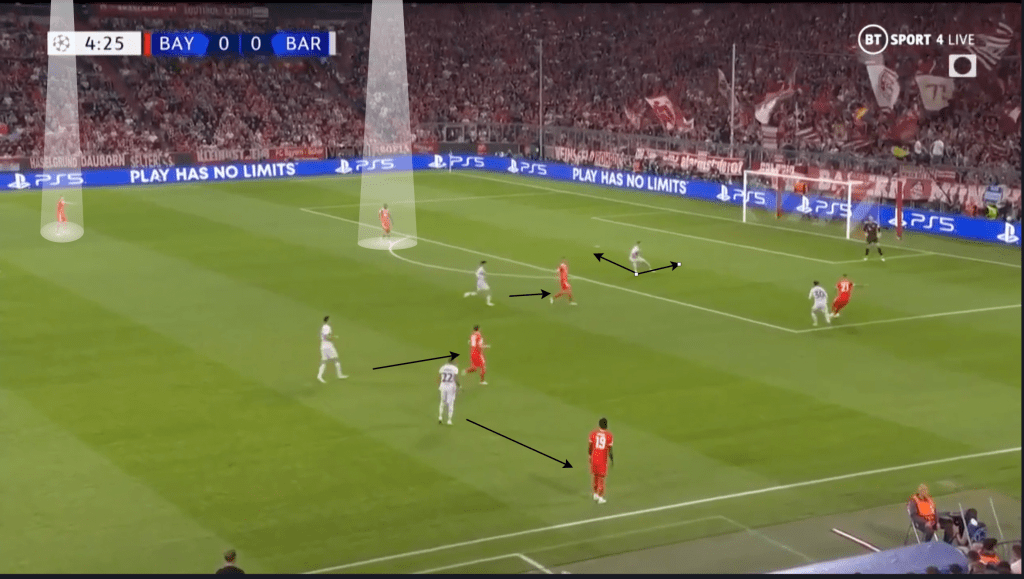
In these scenarios it is safe to say the opposition looks to limit the time players have on the ball and thus shorten the time players have to make decisions. If players are not used to being exposed to situations like this, it then means that in an in-game scenarios they will be more likely to be forced into mistakes by the opposition. As a result of this, I wanted to create drills around exposing players to situations where they would have to think and execute actions quickly due to the high intensity of the pressure.
1st drill
The first drill that can be used at the start off the session is a 3-5 minute 4v4 game, with two mini goals at either end, with the coaches passing the ball into the playing area. The drill looks to simulate the pressure players face in the wide areas of their own half, so it is important that the defending team looks to win the ball with high intensity. Players aim to progress the ball from one side to the other in order to score in the mini goals, with the main focus playing the ball quickly and movement from players after doing so. There would be no touch restriction as there may be some scenarios where players will be forced to dribble more in order to move away from their markers and create space for others.
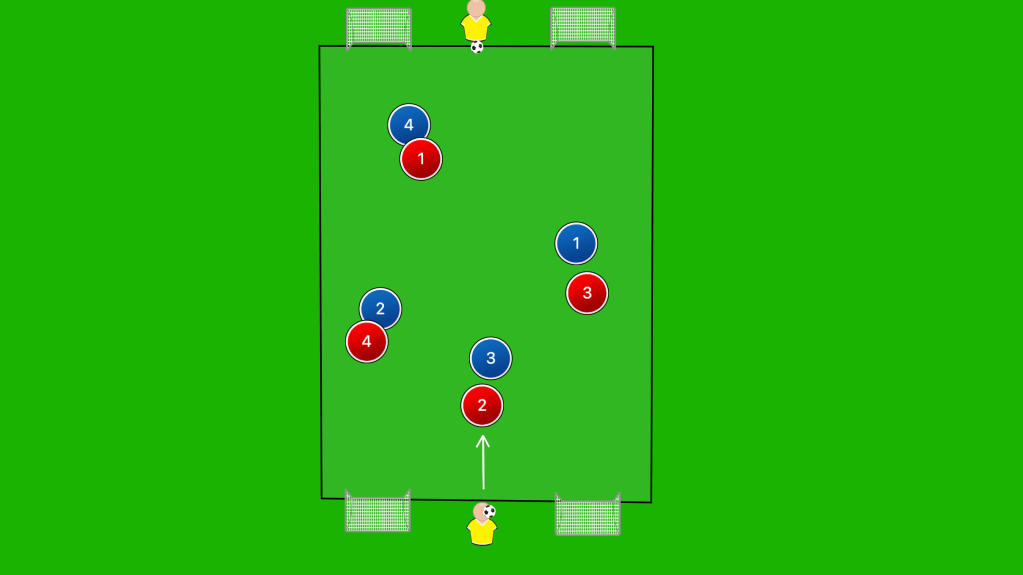
Additional focuses as well can be placed on dismarking techniques, such as double movements moving late into space etc. as well as looking to utilise the full space of the playing area. The first touch of players to set up their next action is also very important and this can be helped by opening up their body when receiving the ball as well as, when they can, avoid arriving into position after a pass is played rather than being in position to provide support to the ball carrier before the pass is played. This enables the player supporting the ball carrier to adjust themselves to a body position, which will aid their next action rather make their next action more difficult. An example of not offering support quickly enough can be seen below. Kovacic has the ball outside the 18 yard box with Cucurella facing the ball with his back to goal. Here Cucurella doesn’t fully utilise the space available to him and as a result of having his back to goal, is in a poor position to receive the ball.
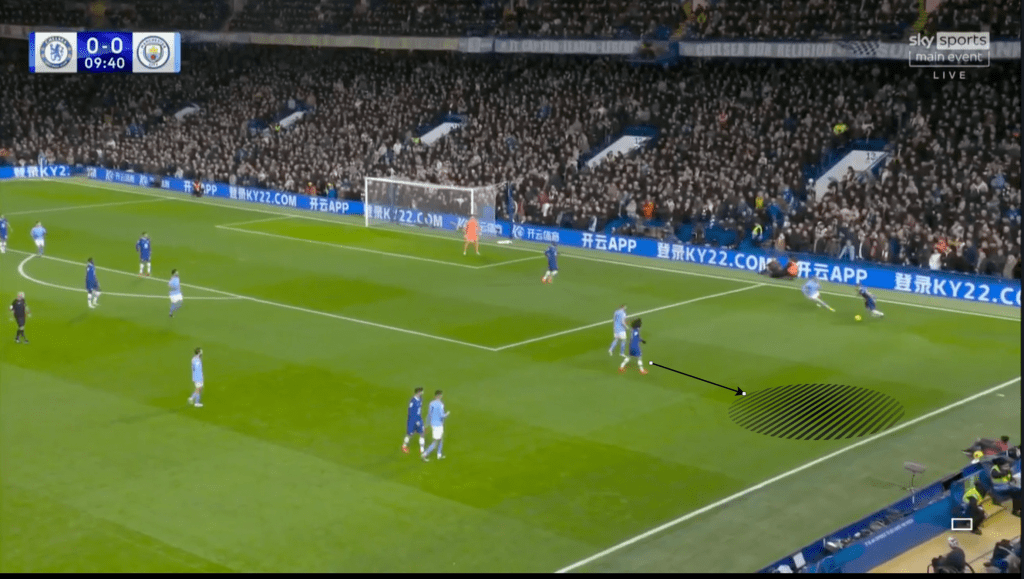
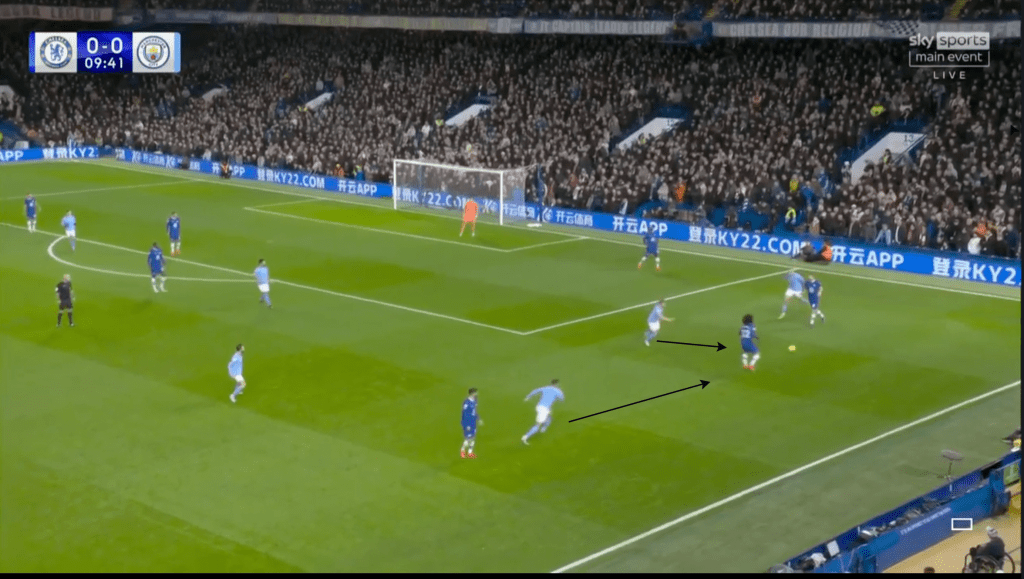
Cucurella then runs into the space to his right, but due to the fact that he arrives late to this position, he receives the ball with in a rather awkward position that limits his actions on the ball, making him easier to press and restricts the amount of the field that he would have had access to had he shifted across to provide a better angle of support earlier
2nd drill
The second drill is a possible progression of the first drill, adding two more zones this time to simulate the pressure that players may face not only in wide areas but across the whole final third. The drill is a 7v7 + 2, with both neutral players (seen in red) outside of the box and restricted to just the central areas. The coaching points and focus are the same as the previous drill with an additional focus on switching the ball and exploiting the under loaded side of the field, which in this case is the zone on the right hand side.
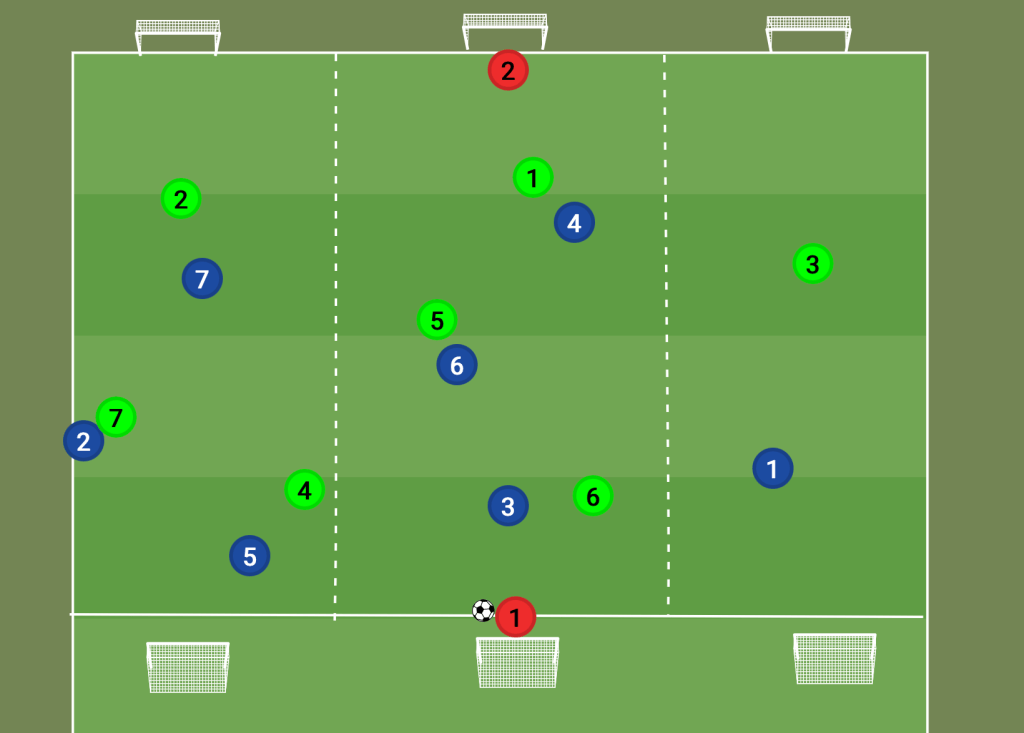
There always has to be at least one player in each of the zones from each team, with a max of 4 in each zone BUT players can only enter a zone after a pass is played into that zone. This is in order to aid players in spacing, and not make the pitch smaller for themselves by overcrowding certain areas. Players look to progress the ball and score in the mini goals with two goals awarded when the ball is switched from the near side to the underloaded side.
It would also be important to also include drills that reinforce principles that a team may have on how they want to build up such as looking for the furthest vertical pass or diagonal pass forward, as well as looking for third man combinations within this.
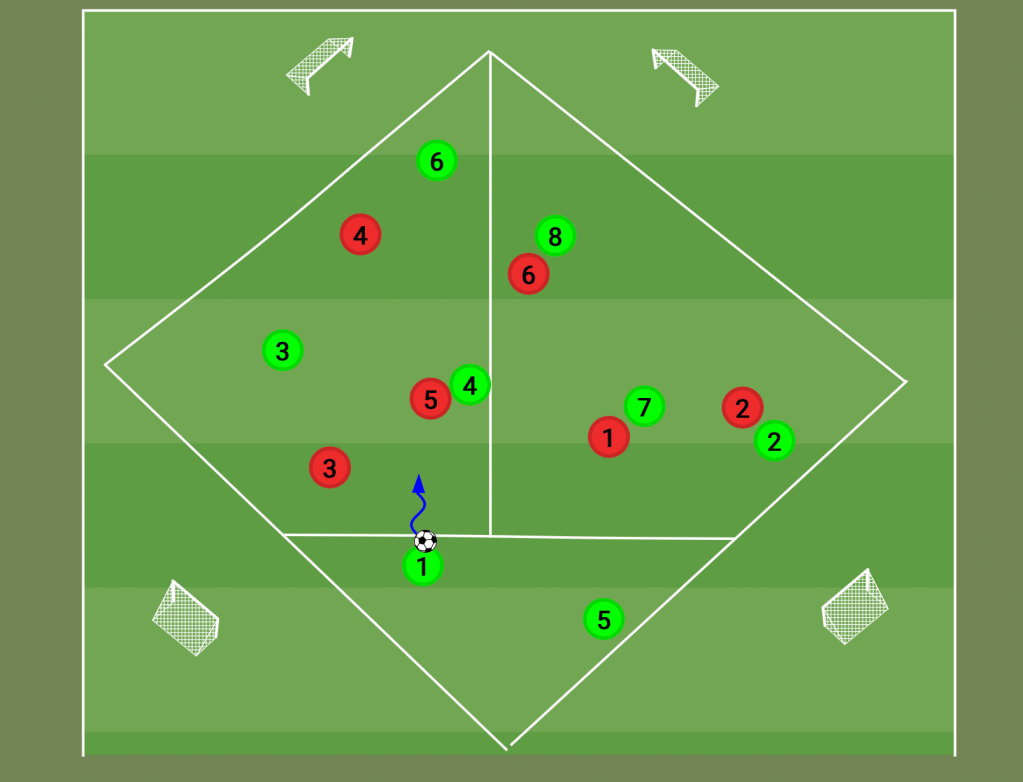
For example, this 8v6 drill is again focusing on the aspects of building up from close to our own box with the diamond shape looking to promote the use of diagonal passes by the players. Here again, we have a scenario where the players are in 1v1s in each half of the diamond. Two players occupy the zone at the bottom of the diamond and look to play passes or dribble into the space ahead of them. Once the ball enters one half of the diamond players can only score by switching the ball to the other side of the diamond and scoring in the mini goal there. The players in red look to win the ball back and counter, looking to score in the mini goals in the bottom left and bottom right of the diamond.
Alternative methods.
As I’ve already stated there is no team in the world that is able to always seamlessly play their way out of the back all the time when the opposition is pressing high. Thus another thing that I found is important to remember is the fact that possession is a tool and not the goal and that long passes in certain situations can be very useful. Playing your way out from the back with one and two touches to play short intricate passes that cut a part the opposition is no doubt aesthetically pleasing. However, the purpose of possession in the first place is to move the opposition reduce their cover and exploit the spaces that are created as a result of this but in order to press a team aggressively and high up the pitch, the opposing team may have to commit more players forward and cover may be reduced as a result of this in other areas of the pitch. Therefore, you can look to exploit this relatively directly.
This is something Bayern looked to do in their second game against Barcelona in the champions league. Barcelona looked to once again press Bayern aggressively and try to win the ball back high up the pitch. Pedri and Lewandowski would orient their position to the Bayern CBs and each of Barcelona’s midfield three to each of Bayern’s three midfielders, with Balde the Barcelona left back adjusting his position to cover Mazroui at right back and Ousmane Dembele on the left hand side in a position that would allow him to have access to Alphonso Davies.
As a result of this approach, Barcelona would be able to defend a switch of play better than they were able to do in the first game, but I can only speculate whether or not this was their main intention. Nevertheless, this approach by Barcelona in this game meant that due to Balde covering Mazroui, their back four would become a back three. Rather than look to play out through their full-backs and midfield, Bayern would look to play the ball to the centre backs, particularly Upamecano, who would play a lofted ball to Choupo moting who would look to knock it down to Gnabry. Bayern with this approach were looking to take advantage of the space between Baecelona’s last line and midfield line. With Choupo further reducing the cover of the Barcelona defensive line, as often, as he dropped deeper to win the header he was followed by a Barcelona centre back. This is what led to Bayern Munich’s first goal as well as their second. It’s also important to note that structurally, Bayern players are positioned in a way that allows them to immediately challenge for the 2nd ball if possession is not initially retained.
Conclusion
This last game mentioned presents an example of why it is important to train different variations of playing out from the back, as this whole exercise, showed me that it is important to be adaptable and not only look to play out in one particular way, but to create scenarios which require different solutions. Whether that be a drill focusing on playing out and then aiming to switch to the underloaded side, or exploiting the high line of the opposition, players should be challenged with multiple scenarios which create different solutions to solving problems.
Feature photo by Alexander Hassenstein/Getty Images



 Skmm-ftbl
Leave a comment