
Around this time last year I sat down and wrote my first piece of Graham Pottergnada as I frantically tried to explain that even though Brighton sat near the drop, tactically in possession they were one of the best sides in the league. You can imagine my happiness, as the seagulls have been given their flowers this season, even though ironically, statistically their attack hasn’t been as potent as it was last season. I have enjoyed reading the various articles dissecting Potter’s side in possession but I began to feel that there was still a lack of coverage on the defensive side of Brightons game. It is rather funny(and annoying) that throughout the period of me writing this article Brighton have conceded 9 goals in the last 4 games but nevertheless, their methods and principles when defending still does deserve some credit, with the seagulls having the joint 6th best defensive record in the league. As a result i decided to take a look at the various ways the seagulls have looked to defend this season.
Before I begin a question that I have asked myself throughout my 18 months of analysing games is: “what makes a team good”. I know. I’m asking the really big questions here that no one’s ever thought of. All jokes aside, I have pondered what the difference is between an average coach and a great coach and recently the question has become somewhat less vague as I’ve wondered what makes a defence “good” and what goes into coaching one. As I have written more and more I have developed the sense that what forms the foundations of any team is the principles that are trained, whether in possession or out of possession. Whether or not these foundations are strong depends on the attention to detail and preparing a side to deal with the many everchanging complex aspects of the game. Some key broad principles that I have written about in the past are pressure covering and compactness, with all three of these influencing one another. Pressure is fairly straightforward, referring to how team presses a ball and what triggers they use to do so with covering aiding pressure to ensure that players support one another when pressing.This directly affects Compactness (and increases access to the ball) as with all players engaging as a unit the pitch is made smaller for the opposition in certain areas, hopefully leading to certain desired and predictable actions from the opposition. “But why hasn’t this guy started talking about Brighton yet, I’m two paragraphs in and he’s just waffling?”. Alright, alright, fair enough. It is time to get off of my soap box and get to what you came here for.
The Seagulls in advanced areas
So, how do brighton specifically employ the principles mentioned in the previous paragraph. Well, the first aspect of Brighton’s defence that I shall address, is how they look to engage with the opposition when pressing higher up the pitch in the opposition’s third. Brighton have the fourth lowest PPDA of any team this season at around about 10.3, meaning that Brighton make a defensive action every 10.3 opposition passes. As we can see by this, Brighton are a particularly aggressive pressing team, however, they don’t necessarily win the ball back in very high areas. Before we understand why this is the case, it is important to understand how and when Brighton press teams. A common pressing trigger for Brighton this season has been passes backwards, particularly passes back to the goalkeeper, as well as horizontal passes across the back line. As the team steps up to press, Brighton’s midfielders orient themselves to the opposition midfielders, which allows Maupay and Trossard to press more aggressively as the lane between the two strikers is covered by either one of the midfielders. This is a common trend from Brighton both in high areas and in a mid to low block as players defend in 3s in order to cover passing lanes, which allows the other two players to press more actively. As we can see below, the covering of the passing lanes to the midfield allows Trossard to bend his run to restrict the keeper from playing passes to the left hand side of the pitch, with all of these aspects working together to force the keeper to play a long ball forward due to the pressure, covering and ball near compactness. From this scenario, we can see how the long plays into Brighton’s strengths as their towering centre backs are well adept at dealing with aerial balls. Webster is winning 72% of his 4 areial duels per game this season, with Shane Duffy winning 76.4% of his 6 aerial duels per game. Dunk is less actively involved in competing for aerial balls from the press with his role recovering any balls that trickle past the back line.
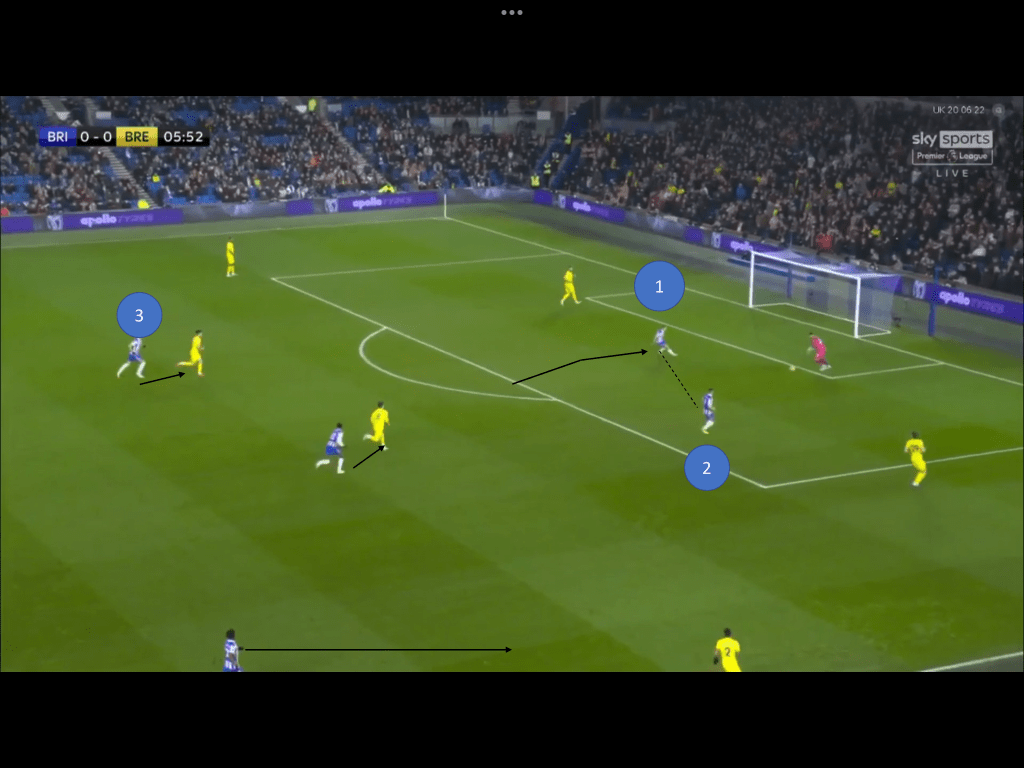
This is where we also see another nuance in Brighton’s structure when pressing further up the pitch, as in the first picture it can be seen that the first two sets of 2 of the 4-2-2-2 advance as the ball is played backwards as well as the full-back of which ever side the ball is directed twoards(in this case lamptey) but the third set of 2 as well as the majority of the back line doesn’t advance as aggressively as the first two lines.From what I have been able to deduce Brighton always look to have at least one player slightly deeper, covering the space in font of the last defensive line. We can see the reasons behind this in this game with the third set of 2 in midfield lagging somewhat behind the first two sets allowing the two centre backs to stay deeper which as a result allows them to be deep enough to defend long balls and depth runs but at the same time keep the distance between the last midfield line relatively short. This is where Brighton’s backline can put their aerial prowess on full display as depending on the situation either CB can step into the space in front of them and challenge for the ball. Whilst one centre back steps into the space in front of them, the other CB holds their position whilst either one or two full backs tuck in to cover the space left by the CB challenging for the ball. This is to ensure that if Brighton don’t win the first or second ball, the opposition can’t play a pass directly through the centre of the pitch. However, Brighton rarely ever face a situation like this due to the fact that the third midfield line doesn’t advance as high as the first two lines. Due to their closer proximity to the back line relative to the first two lines, they are often closer to the second ball than the opposition after the aerial duel and the fact that they also enjoying a numerical advantage increases the chances of winning the second ball.
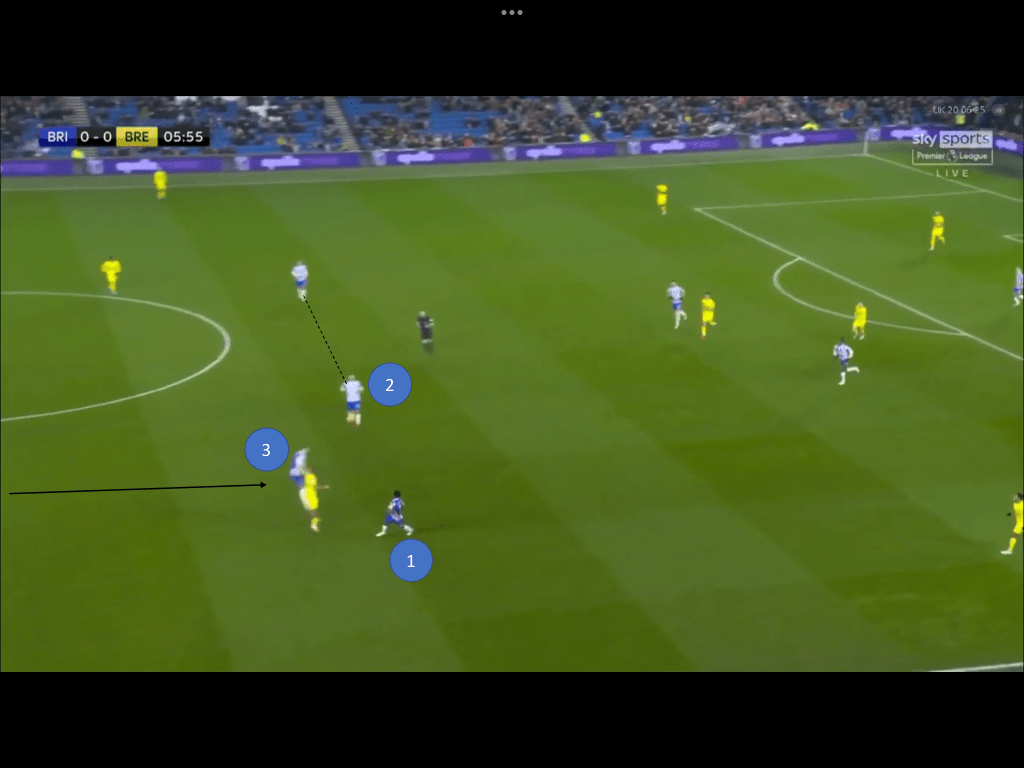
Obviously due to the fact that the third set of two don’t advance as aggressively as the first and second line, in certain scenarios there is still a considerable distance between the third and second line. However, this area is rarely accessed due to the manner in which the first two lines press the opposition as explained above. In other cases the opposing team may play the ball out wide to a full back if they are not forced to play it long immediately but this too is due the execution of Brightons press. As seen once again in the Brentford game, Maupay’s press is triggered by a pass back to the goalkeeper with the Frenchman blocking the left hand side of the pitch. We can see familiar execution of principles as Moder orinets his position to the Brentford 6, whilst Mwepu presses the square ball from the keeper to the CB acting as the second striker in this situation.
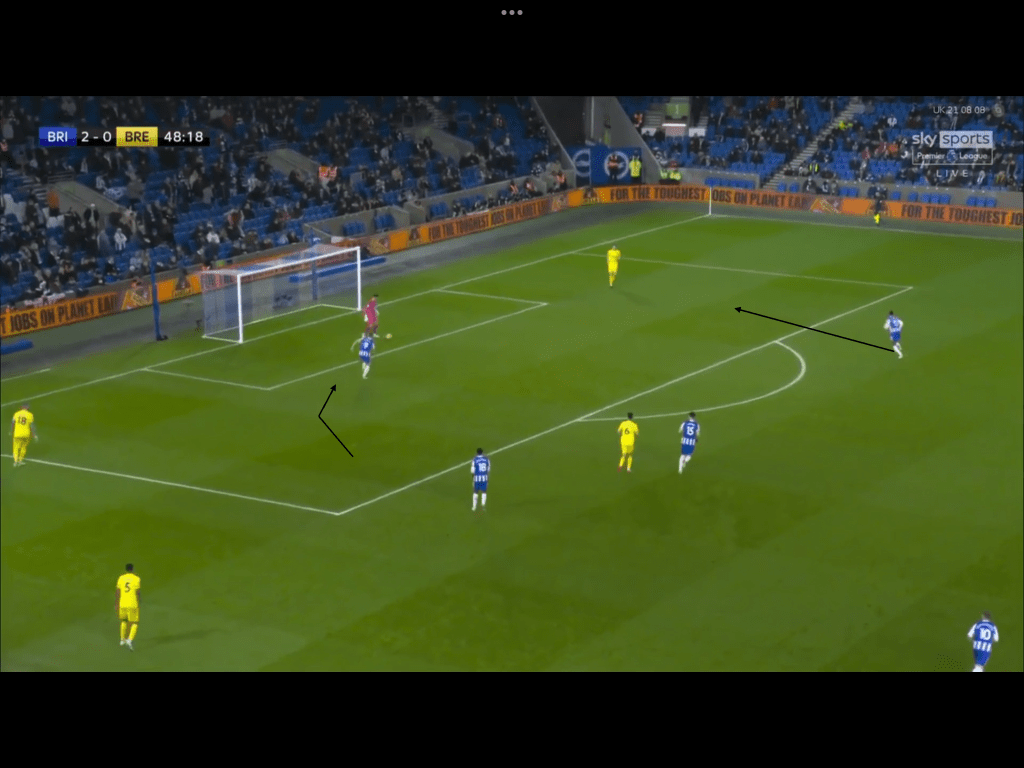
The pass from the CB to the full back acts as a pressing trigger for either one of Brighton’s Fullbacks to begin their press as the ball travels to the recipient. Whilst this is occurring we can notice how Moder has shifted across and adjusted his positioning to the position of Brentford’s second pivot, preventing an easy pass to the centre. This is another variant of the principle of defending in 3s, particularly the third player prioritisng covering the oppositon player positioned in the passing lane between two players. It should also be highlighted how Maupay also adjusts his position to the left centre back to prevent a backwards pass, with all of these actions combining in the Brentford full back playing a rushed long ball.
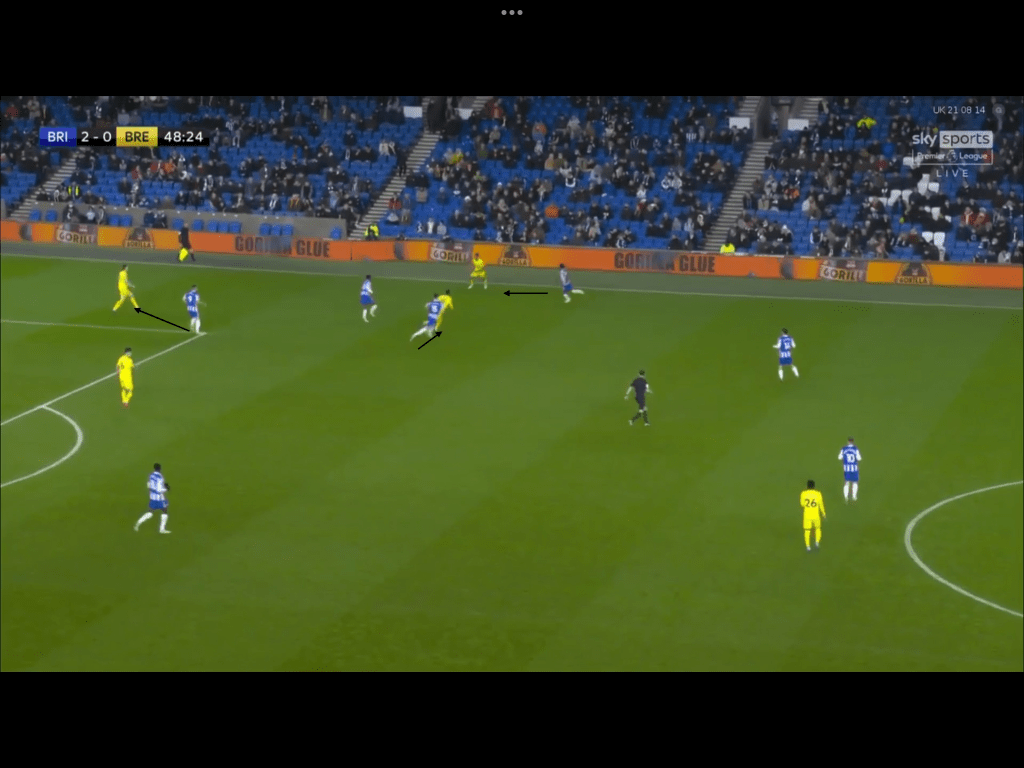
This leads to the same advantages as the previous example with Brighton having a numerical advantage in the midfield after the contested second ball. It is also important to notice Cucerella’s indented positioning covering space in the back line, protecting the space to the left of the CB as well as also creating a 3v2 against the Brentford forwards.
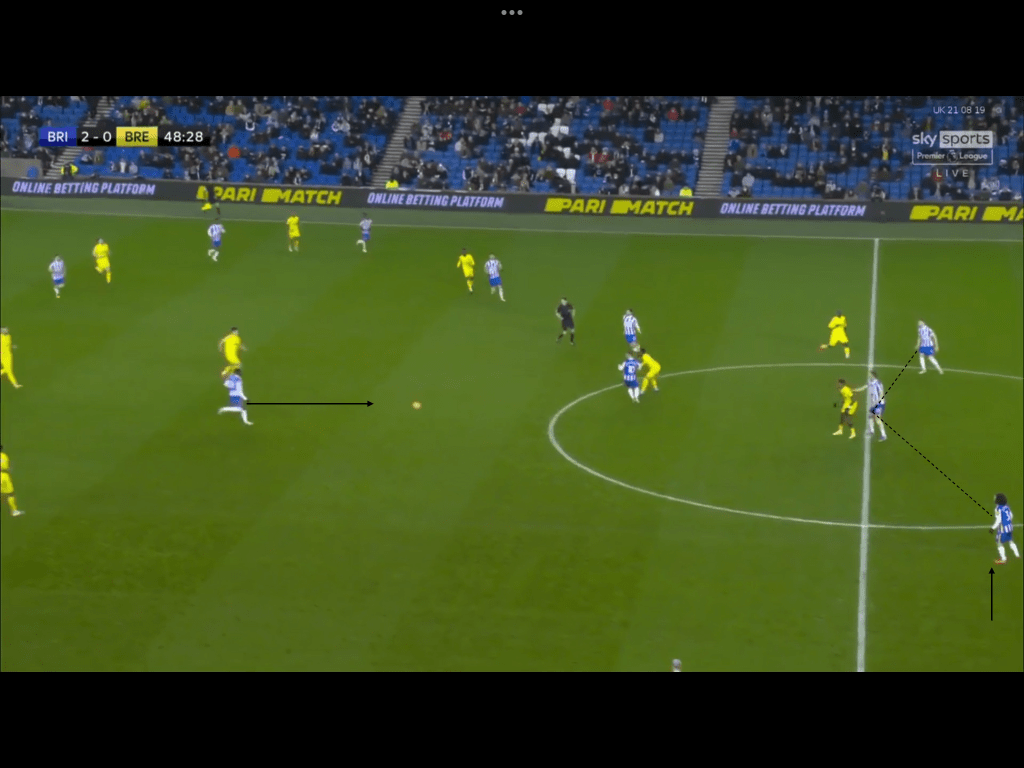
Seconds later we see the same scenario once again occurring on Brentford’s left. Welbeck presses Pontus Jannson as the ball moves backwards whilst Maupay prevents a pass backwards. Once again we see Birghton defending in 3s as MacAllister orients to Norgaard and Cucerella presses Canos the right back. This results in Canos playing a first time ball to Toney but due to the pressure from cucarella this pass is rushed an inaccurate.
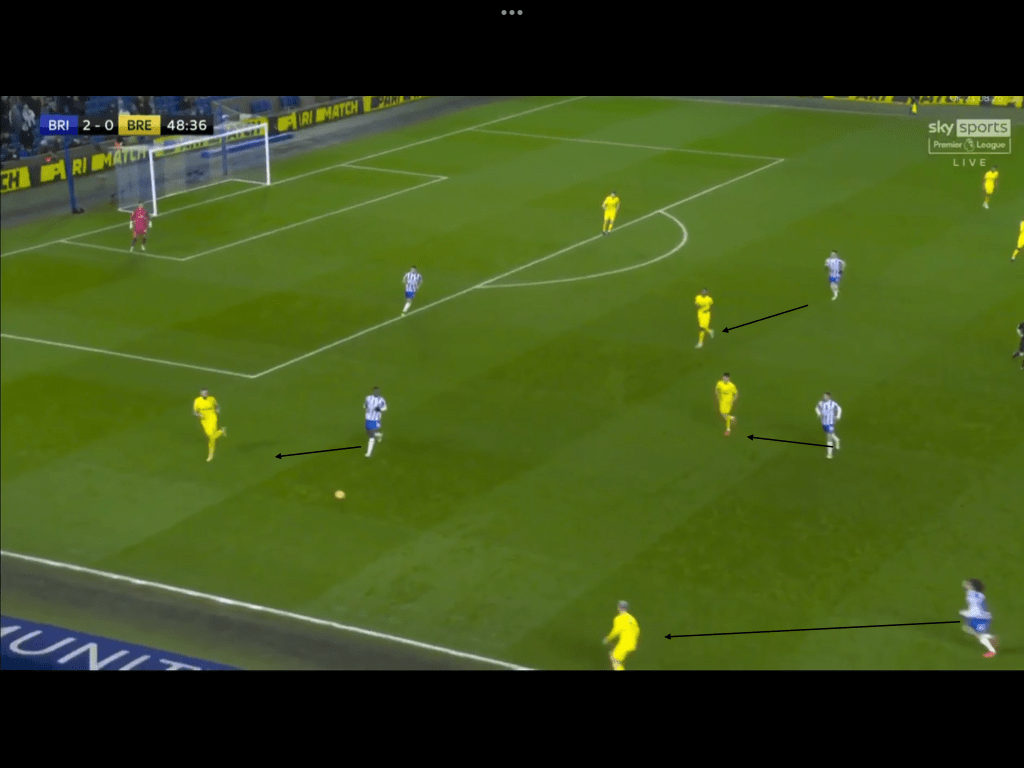
Dan Burn then acts as the 3rd man in the press as he adjusts his position to Ivan Toney as the Centre Forward dropped deeper. We can then see how Adam lallana dropped deeper to cover the space left by the advancing full back, whilst Lamptey tucked in to form the back 3.
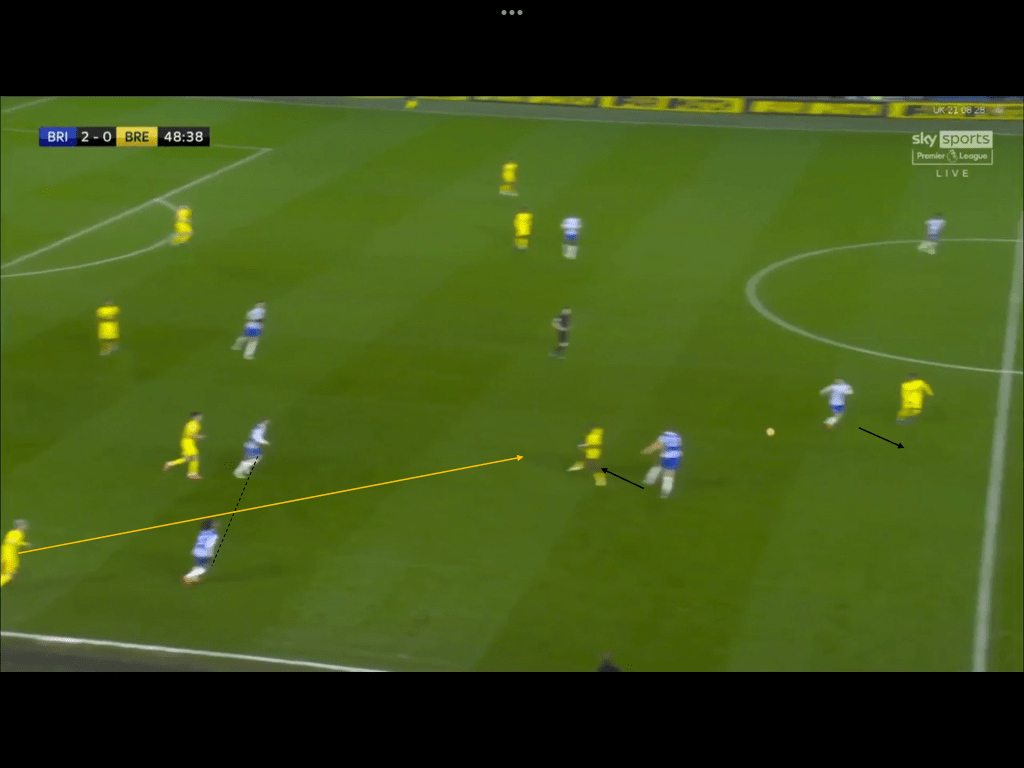
The same scenario could also be seen in the games against watford and chelsea although with the use of different formations.
Against Watford on paper, Brighton lined up in a 4-4-1-1 but we could still see the same principles being applied, although in a different formation
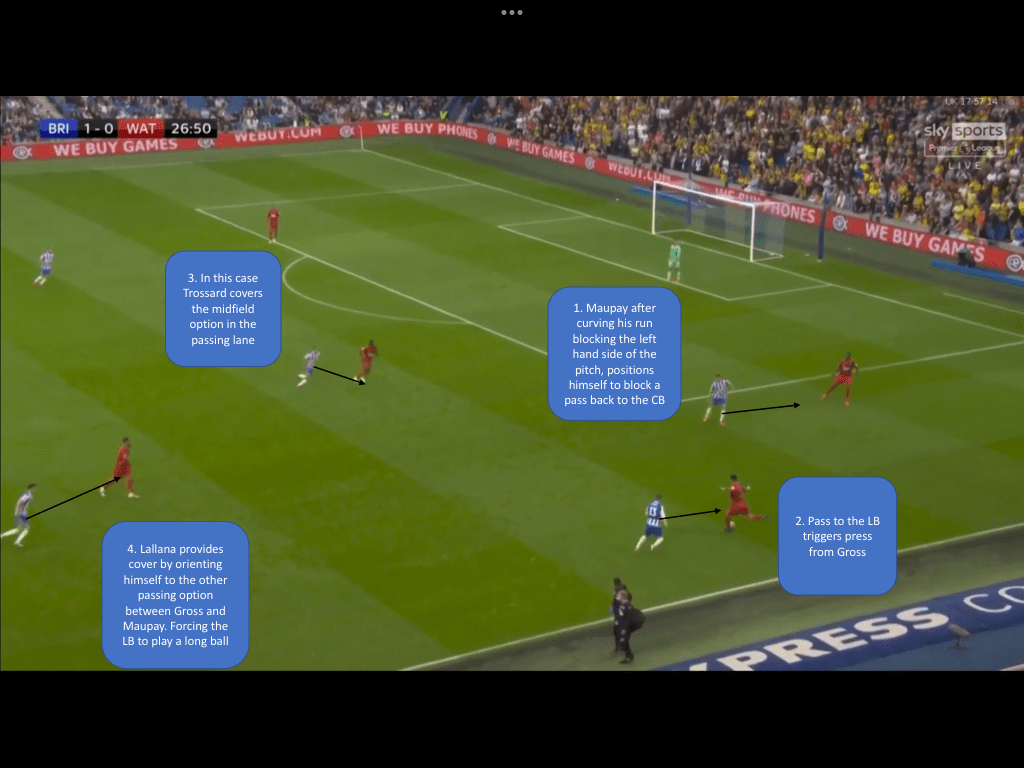
After Duffy wins the header from the long ball, we can see how once Brighton outnumber the watford players by 5 to 3 but in this case they could only retain possession monetarily.
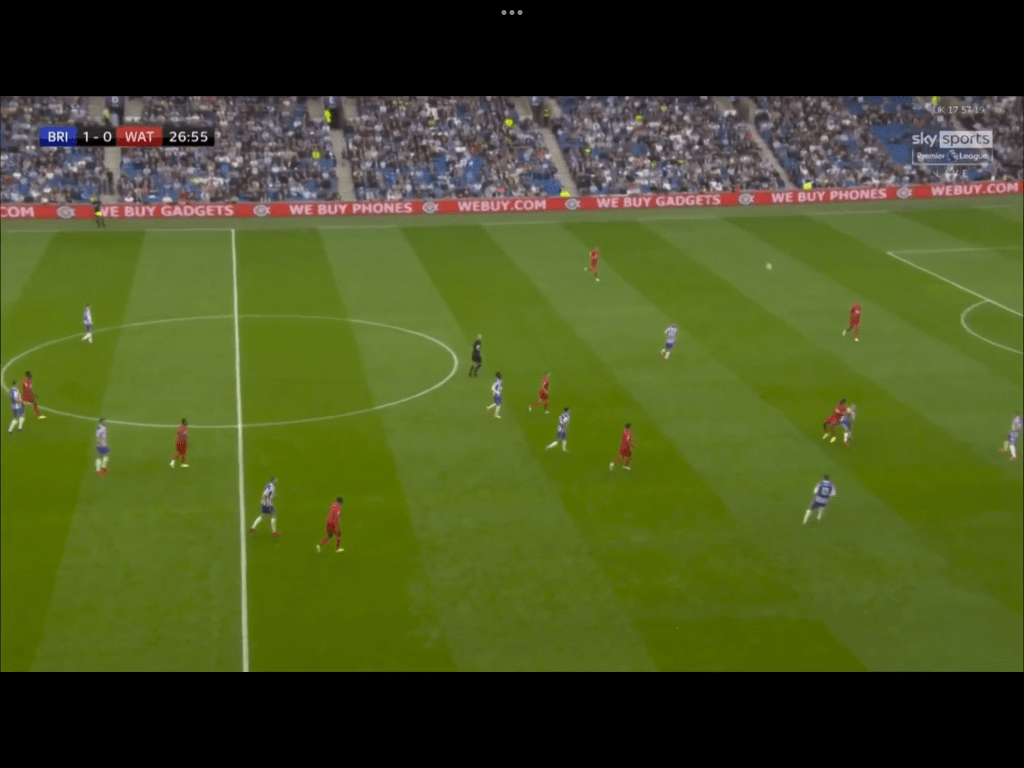
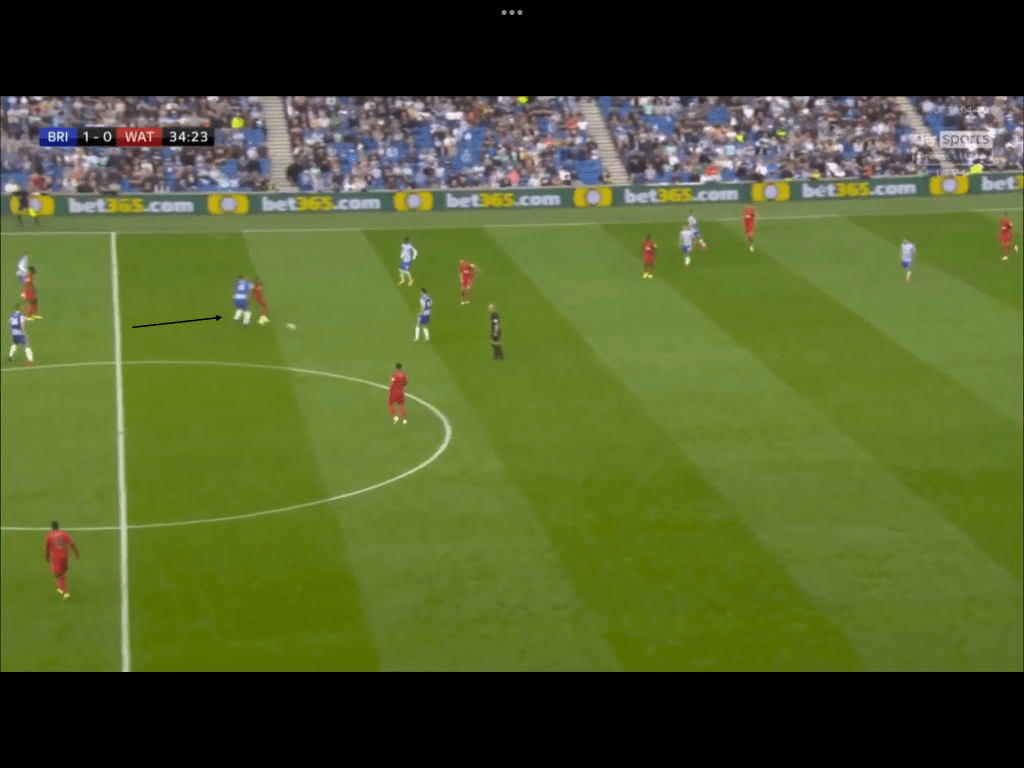
On the left hand side we can see the same patterns repeating, with Maupay once again restricting the pass to the CB and Trossard preventing the pass to the midfield option while the opposition RB is pressed by Solly March, forcing him to play a long pass between Lallana and Bissouma.

But Dunk in this instance is the third player covering the two in midfield. As a result, due to the the pressure from Dunk, the speed of the pass and the two midfielders and Dunk having a 3v2 advantage Brighton could win back the ball after a loose touch.
Defending in a mid to low block.
When in a mid to low block, Brightons press is triggered by passes out wide as well as passes into their shape. In addition to this players also once again orient themselves to the opposition players, which facilitates in applying the principle of one player covering the passing lane between two of his teammates. In the example below, we can see how Gross adjusts his position to Jorginho in between the front 2, whilst MacAllister covers the lane to Kante between Welbeck and Gross.
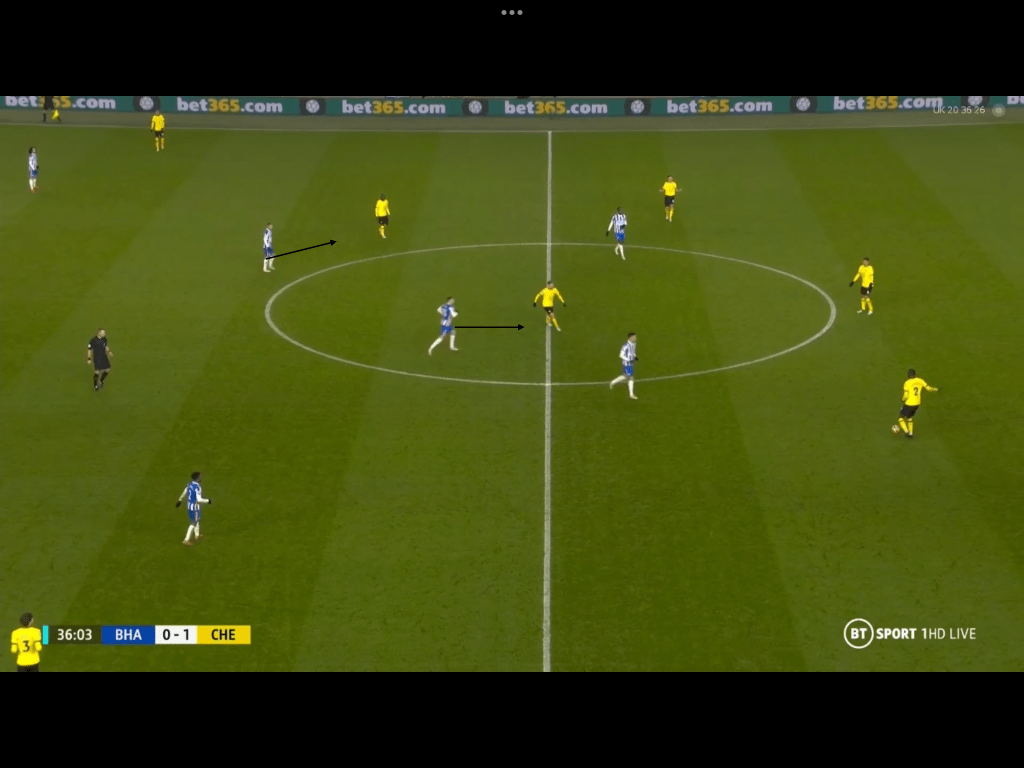
Seconds later as Azpilicueta pushes wider and advances the horizontal compactness of Brighton’s shape is affected as Welbeck tracked the run. This created a larger passing lane for Ziyech to receive the ball, but as we can see once again Cucarella tracks the Moroccan, In between his teammates.
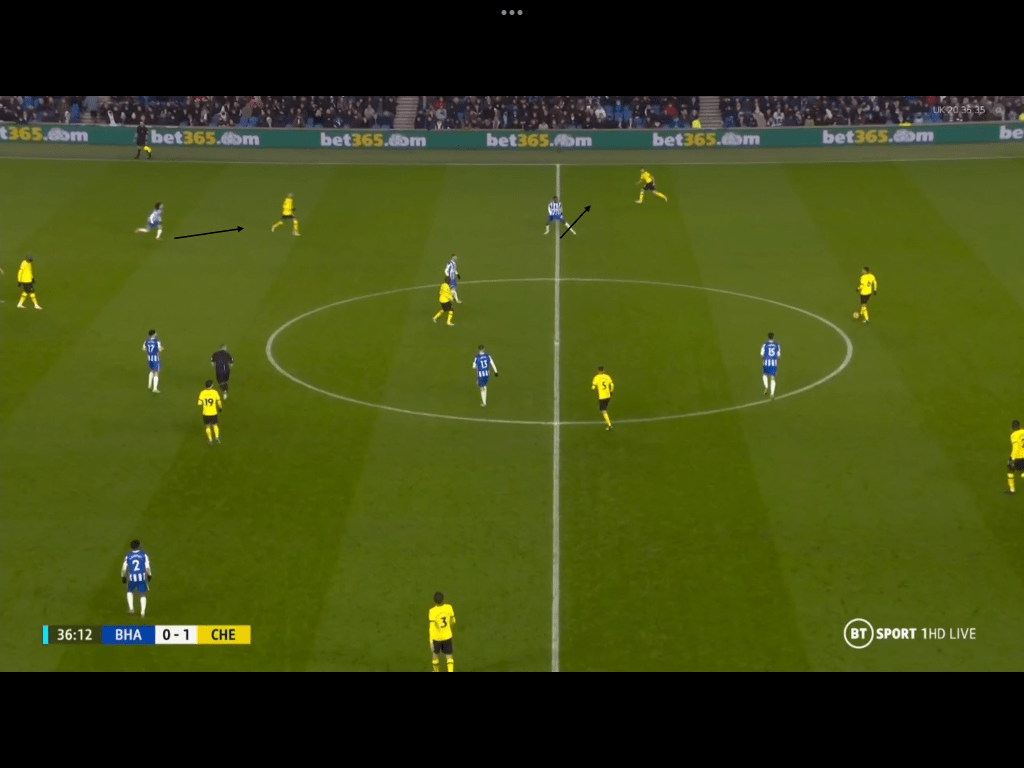
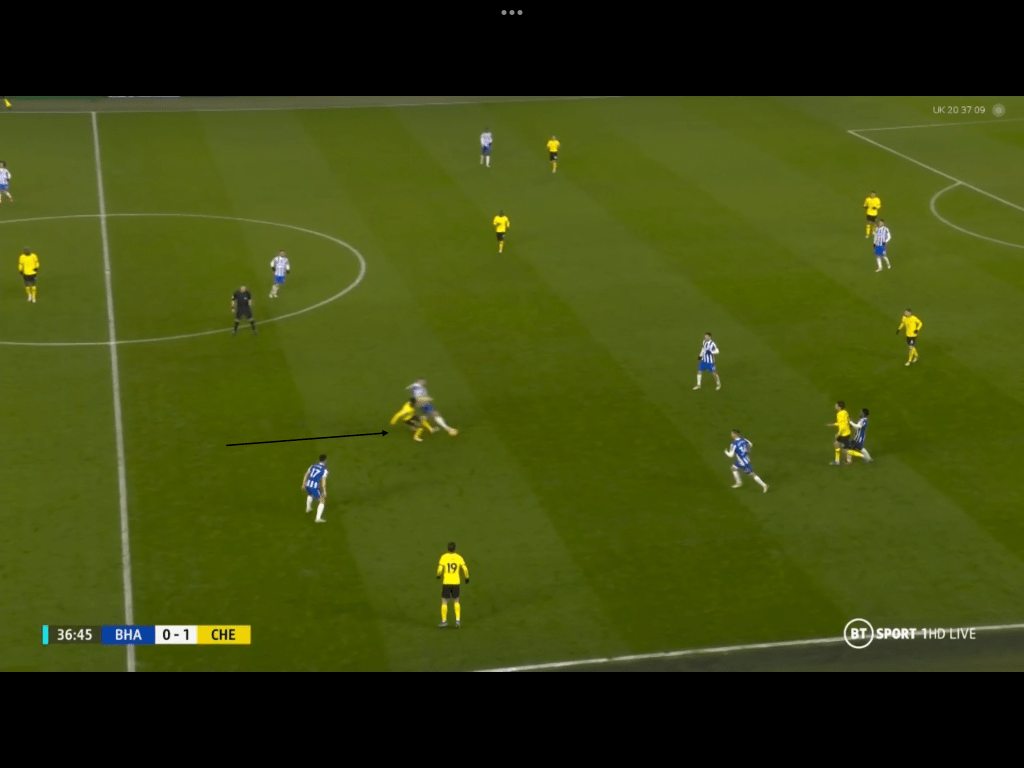
Below we see another example, this time with Alzate covering the space between his two teammates. Ultimately the goal of this approach is to create good moments for Brighton players to win back the ball through tackles from Behind. Opposition players often move from higher areas into the space between two Brighton players to receive the ball, which reduces their options when receiving the ball as their backs are away from the goal. This means that most of the time the only viable option is to play the ball back in the direction in which the pass came but if the passer of the ball is some distance away the attackers only option is to take a touch, which is a prime time for the Brighton defender to pinch the ball from the opposing player. Brighton’s Back line are also involved in adjusting their position to players in the passing lane between their teammates forcing errors through applying pressure from behind the opponent as seen in the example below, with Webster dropping with Hudson-Odoi.
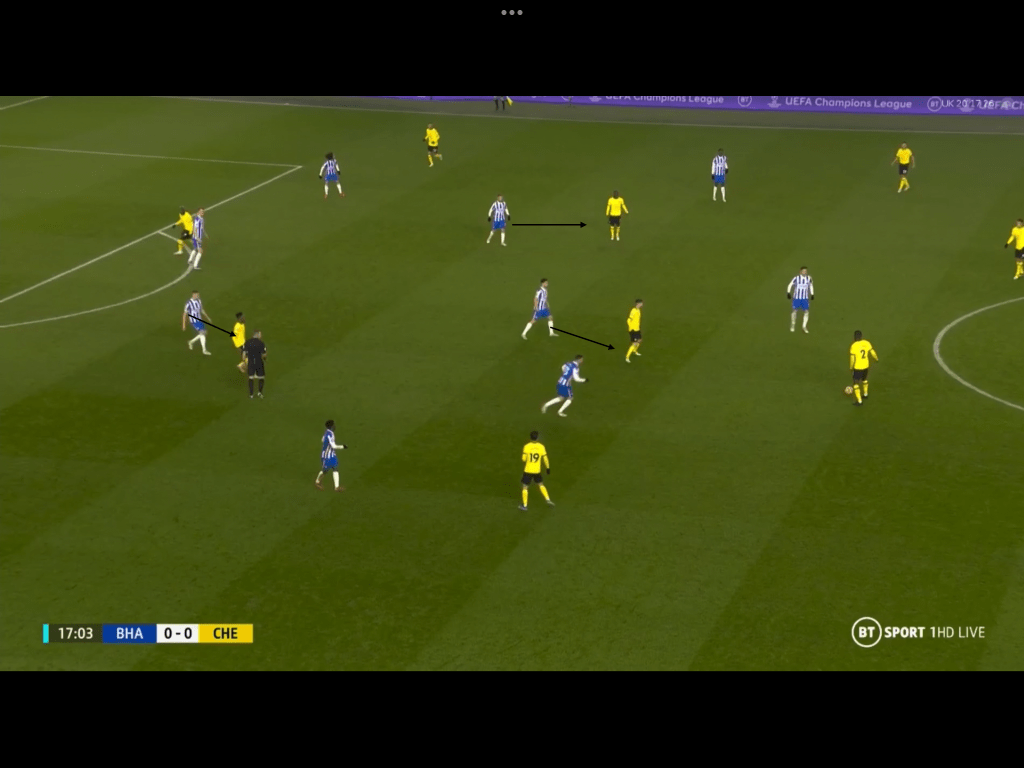
Due to the fact that Brighton players adjust their positioning to opposition players in passing lanes, teams have tried to rotate players in order to disrupt Birghton’s defensive shape. However, countless times this season we have seen Brighotn players communicate as well as react well and then adjust accordingly. In the example below, we can see how Webster has orients his position to the dropping Toney, as lamptey shifts to his left in order to cover the threat from the Brentford WB

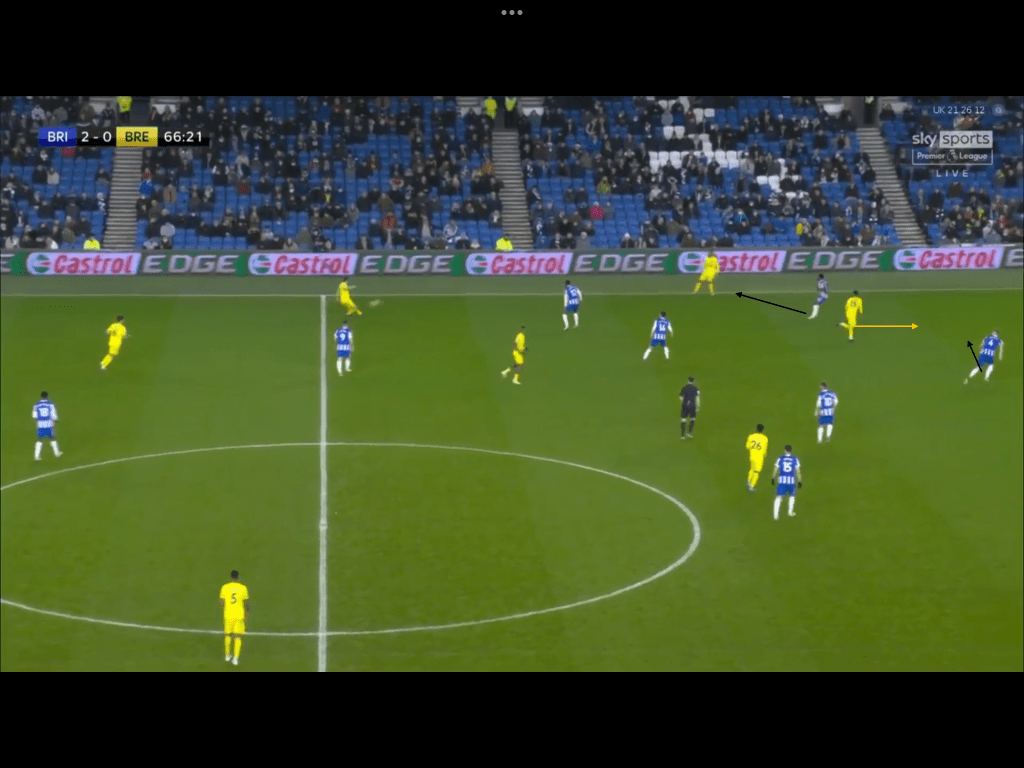
Seconds later we can see How the WB indents his position as Toney continues to drop deep, with Lallana then adjusting his position to the forward.
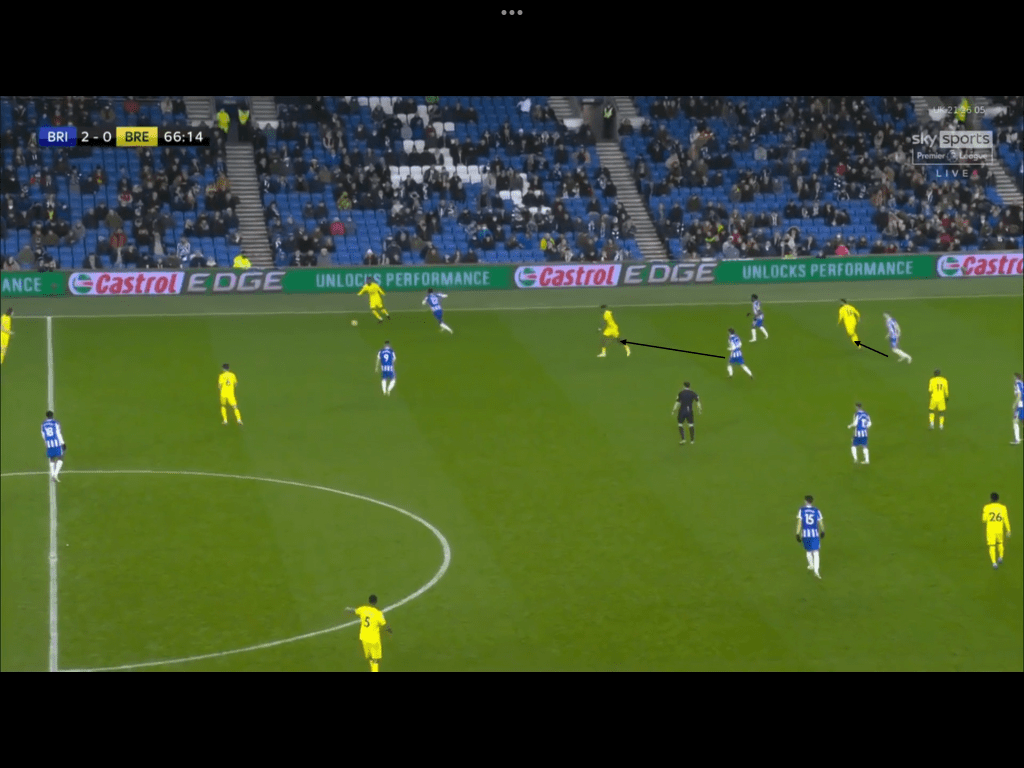
We then see How as the WB takes up his starting position and Toney continues to drop deep, the Brentford CM looks to exploit the gap between Webster and Lamptey, But Webster is on hand to cover the space.
As mentioned before, when in a mid block Brighton’s press is triggered by passes out wide as well as vertical passes into their defensive shape, all whilst preventing passes to the pivots. All in all this is an attempt to force the opposition backwards so that the team can advance further up the pitch. Obviously the extent to which the team advances depends on the score but ultimately the goal is to get the opposition as far from the goal as possible, where Brighton use the various methods i have discussed beforehand to win the ball. The Example below shows all of the usual patterns and principles we’ve grown accustomed to seeing, with MacAllister pressing Kante in the passing lane between Gross and Welbz. After Azpilcueta receives the pass back from the Frenchmen he is then harrowed into playing the ball backwards.
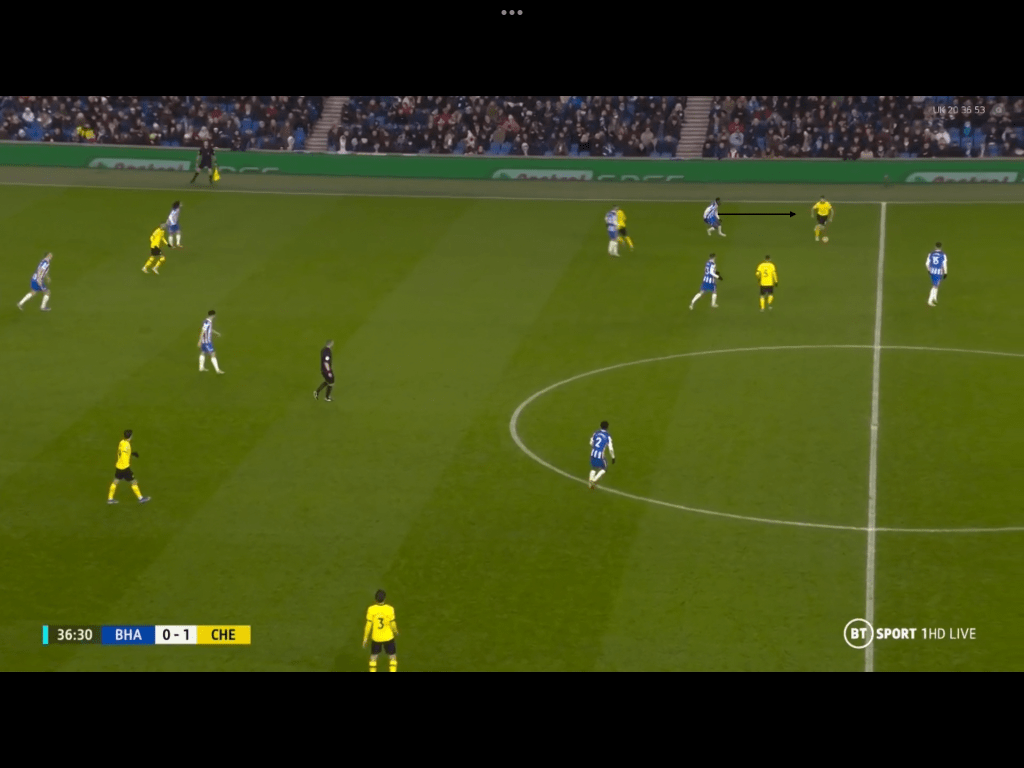
Potters men then use this as a prime time to advance further up the pitch.
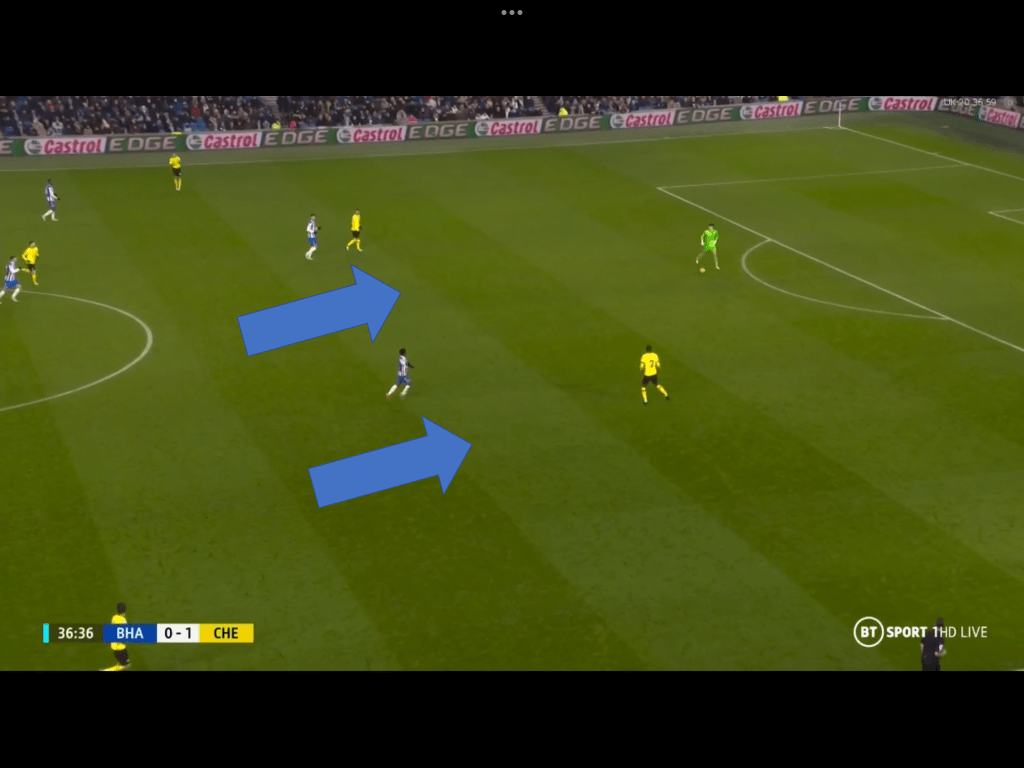
From the pass out wide to Alonso triggered Vletman to press the Spaniard with Gross oriented to Jorginho in the midfield. Ideally Veltman should have started pressing earlier to prevent the wing back from being able to receive the ball with an open first touch forwards.
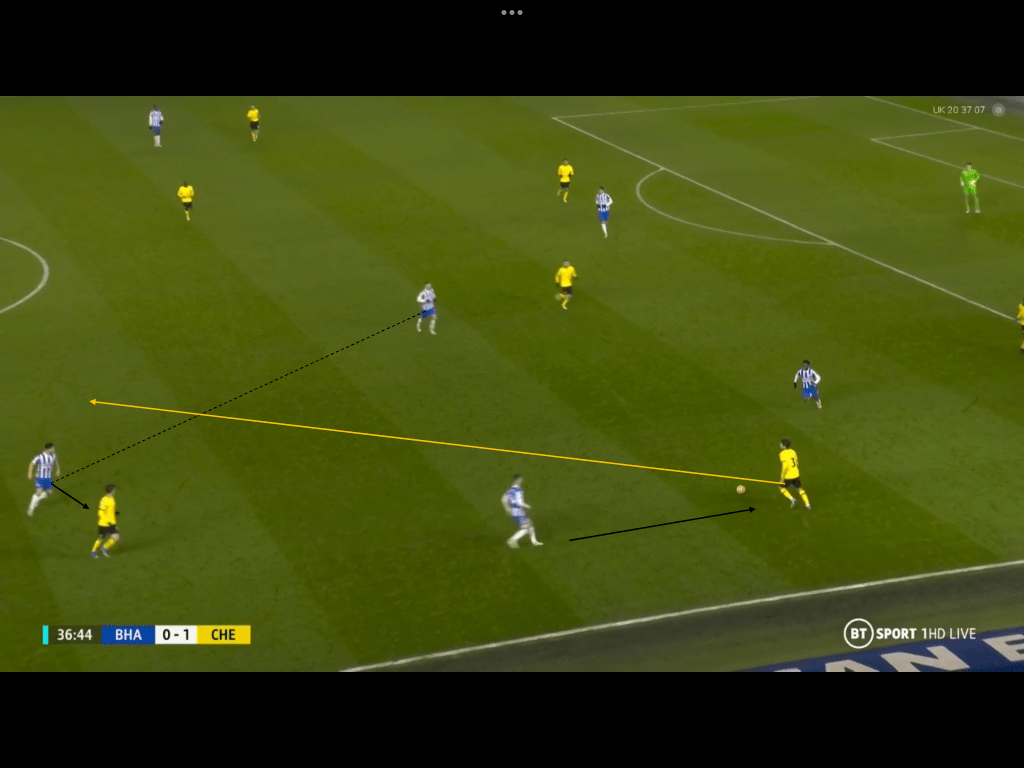
Alonso plays a pass to Hudosn-Odoi in between the the acres of space separating Gross and Veltman, but as we have seen time and time and time again a player covering the passing lane is on hand to apply immediate pressure to the recipient of the pass and in this instance wins back the ball.
Conclusion.
It is a bit annoying that over the course of me writing this article in praise of their defence, Brighton’s defensive record has slipped from being quietly remarkable to a tiny bit average. It must be said though that according to Xg there is an element of unluckiness in brightons defensive woes particularly in the game against Burnley. Adam Webster has also been missed in the back line(*whispers* as well as BIG DAN BURN) and as much as it pains me to say this, Lewis Dunk has been rather poor recently(hopefully a just a little injury hangover). Nevertheless, it is not as if Brighton’s defensive record prior to this 3 week slip has been a flash in the pan. Historically under Graham Potter, Brighton have had a good defense, with the principles mentioned in this article strongly contributing to this even in prior seasons, but in order for their season not to tail off, individual errors will need to reduce and the standard in attacking performances will need to improve exponentially.
feature photo credit: Sussex express


 Skmm-ftbl
Leave a comment