
Possession with purpose has become a common phrase that has been banded about online, emphasising that possession is not the aim of a team but rather a tool that a team should use in order to create opportunities. This statement is true but like any other tool possession has different components to it; possession is talked about as if it is the whole tool when in my opinion it is the result of different components and principles coming together. Think of it in the way a shovel would have a handle, the long wooden or plastic rod and then the end of the shovel that actually does the shoveling. Each part of the entire tool makes the job of digging easier or more efficient. Imagine having to dig with only the part at the end or without the handle etc. As Luke Griffiths put it perfectly on twitter “Possession shouldn’t be your aim it should be a byproduct of your other principles working successfully”.
The other components could be seen to be structure in possession superiorities looking to be achieved etc but off the ball movement within a structure has become one aspect of the tool that has specifically interested me. Ten Hag has stated that “in order to destroy the opponent you need off the ball runs, that’s the key to success”. The goal of player movement is to stress the opponent; it’s like how Stephen Curry for the Golden State Warriors is constantly on the move. Defenders have to constantly worry and adjust to his position and by doing so, if they have a lapse in concentration Curry is either free or one of his team mates is. In a footballing sense it can be seen as looking to cause disruption for the vertical and horizontal line of the defense, through stretching the various lines of defense, or forcing them to rotate.
Curry is an extreme example as excessive movement without purpose becomes less effective but the concept still stays the same. An “effective” structure in possession can reduce opposition coverage in certain areas and runs from players can exploit this lack of coverage. Ten Hag’s Ajax this season have consistently shown how space can be created and exploited in their structure in possession over recent campaigns and the same can be said for the current season as well.
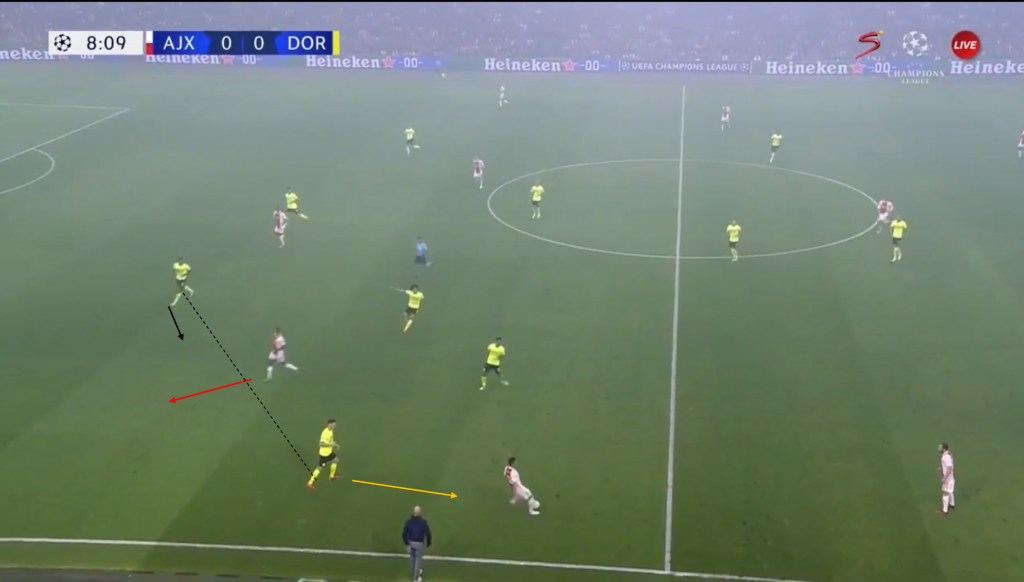
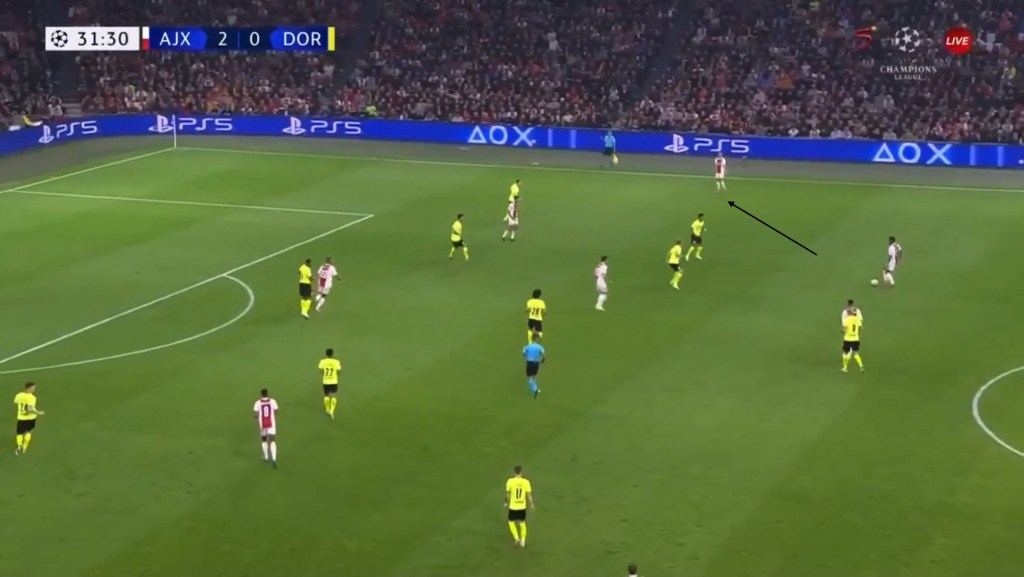
Throughout the course of the season, one of the things Ajax have looked to do is occupy the half space and wing area , looking to stretch the two lines of the opposition’s shape. In the image below the subsequent moments before the players shift to these areas can be seen. It’s important to notice the position of Tadic who hugs the touchline, disrupting the horizontal line of the back four and incresing the gap between Akanji and Meunir. Due to Tadic’s positioning, Gravenberch begins to drift into the space between the Dortmund CB and LB, with Witsel, who was previously tracking Gravenberch, electing to protect the space in the centre of the park. Haller and Berghuis also begin to drift towards the ball, with Antony holding his position.
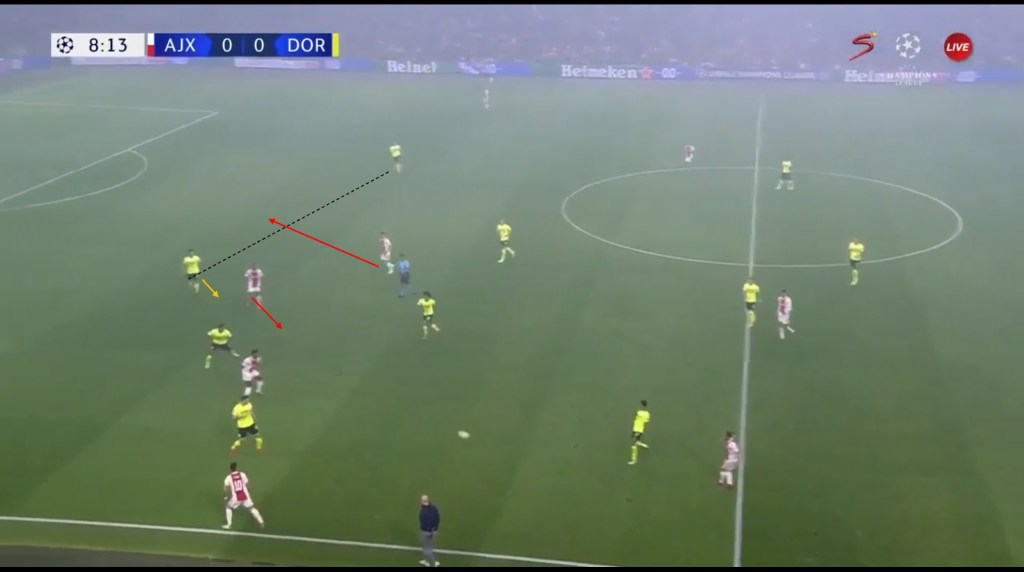
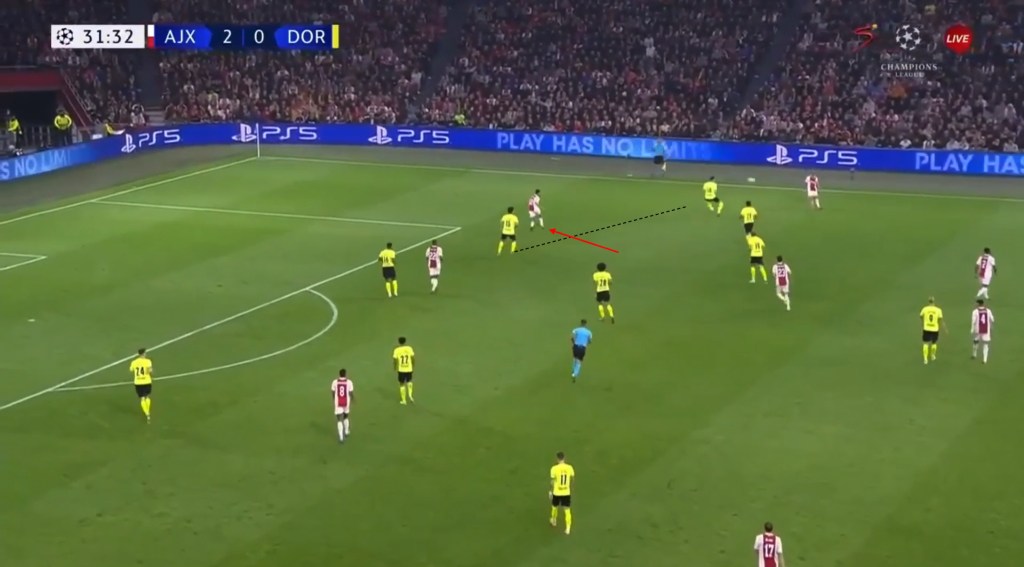
A few moments later we see the effect of the structure on the ball and the movement within the structure.The midfield line is affected horizontally as Bellingham steps up to press Blind with Akanji orienting his position towards Gravenberch in the free space and Hummels tracking Haller. The movements of these two players and the position of Antony meant that the horizontal line between Hummels and Schulz would become stretched, giving Berghuis space to run into. The ball is played vertically from Blind to Gravenberch to Haller and then to Berghuis.
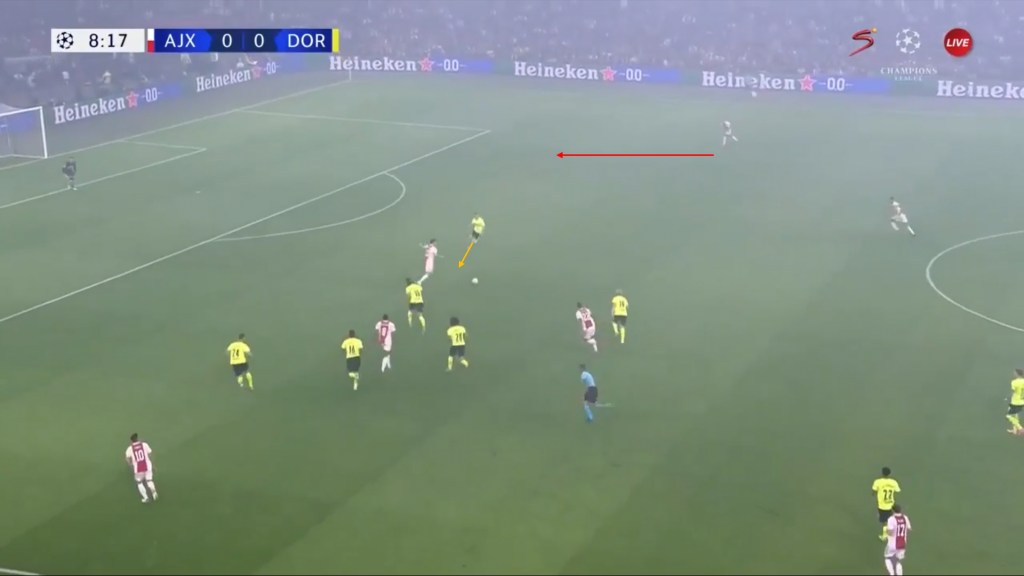
Below we see the effects of Beghuis’ movement into space, with Schulz now forced to engage Berghuis, resulting in Anthony being left alone in acres of space. This resulted in a shooting opportunity, however, Anthony could have inverted his positioning slightly creating minimum width, reducing his distance to goal and the time for the Dortmund defenders to recover.
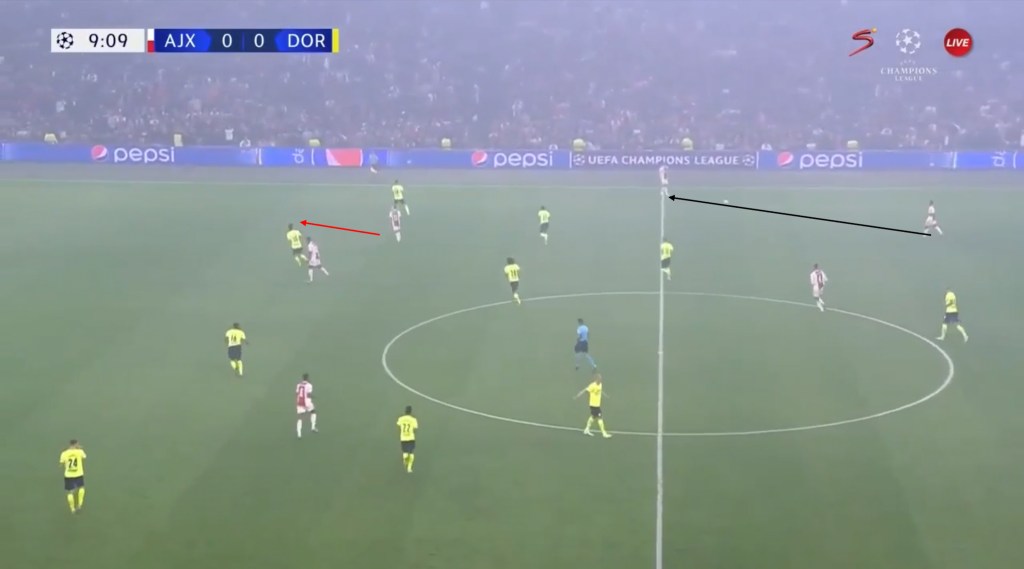
A common theme that could be seen throughout points this season is Ajax’s persistent attacking of the space between the Full backs and CB’s. This occurred numerous times in the Dortmund game including the in the scenario which resulted in the free-kick that led to the first goal. Antony’s positioning in the half space led to Malen dropping deeper and indenting slightly to prevent a direct pass to the Brazilian, leaving Masraoui time on the ball out wide. As Mazraoui received the ball, Antony would then dart into Schulz’s blind side attacking the space between the left back and Hummels, dragging the latter out of position. The run from Antony leads to two benefits, mainly reducing the cover in the box by dragging out the CB and stretching the horizontal compactness of the last line as well as creating a 1v1 between a CB and a winger.
In the latter stages of the first half the same scenario could be seen occurring but this time with Mazroui acting as a makeshift inside forward, pinning the CB and LB as well as influencing the positioning of Malen. Due to this Antony was now the player with time and space on the wing, and as Schulz jumped to engage the winger, Mazraoui moved into the space between the CB and LB
Mazraoui would then make a similar run to that of Antony’s earlier on.
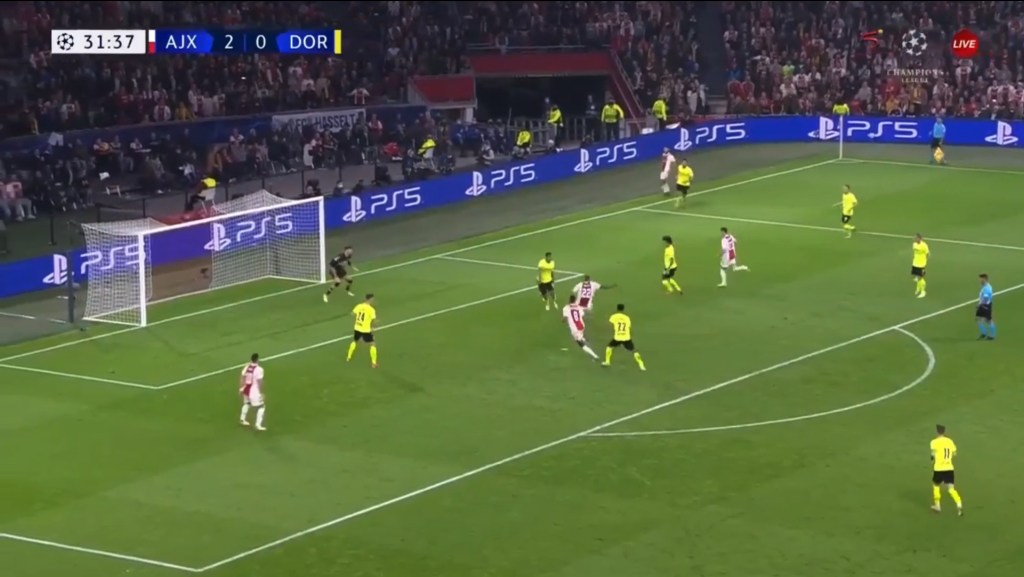
Reduced cover in the box leading to a shooting oppurtunit as seen below, as Hummels moves to engage the right back
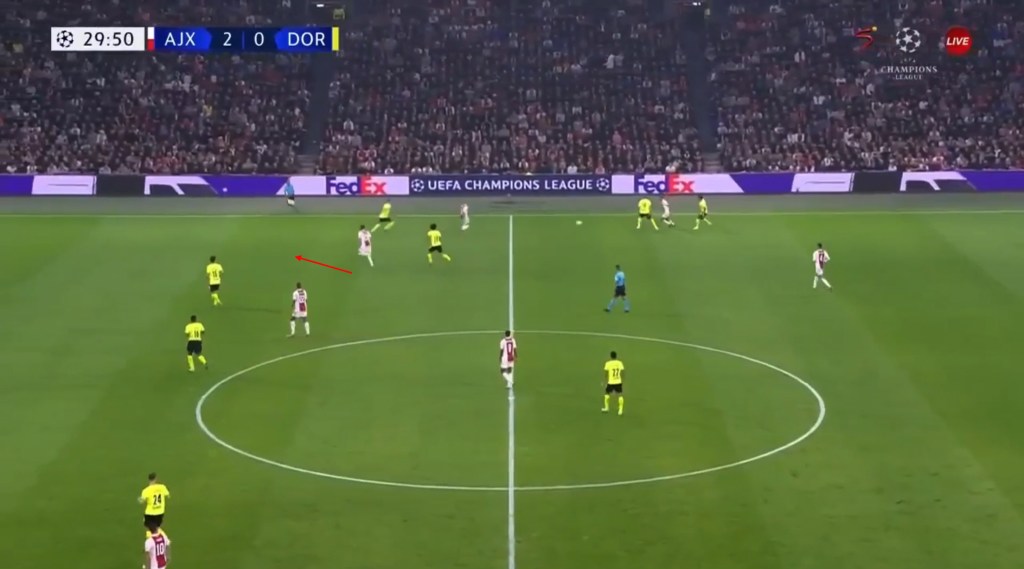
Ajax have also used counter movements to full effect to once again attack this space with the example below showing Antony dropping deep to receive the ball, with Schulz stepping up orienting his position to the winger and Berghuis attacking the stretched line in the defence. After an Antony dummy, Berghuis would receive the ball, however, this time the centre back was not dragged out of position but Witsel the central midfielder was, creating space centrally
In the game against PSV the same pattern could once again be seen, with Antony’s positioning influencing the opposition LB and LW, allowing Mazroui to occup the touch line.
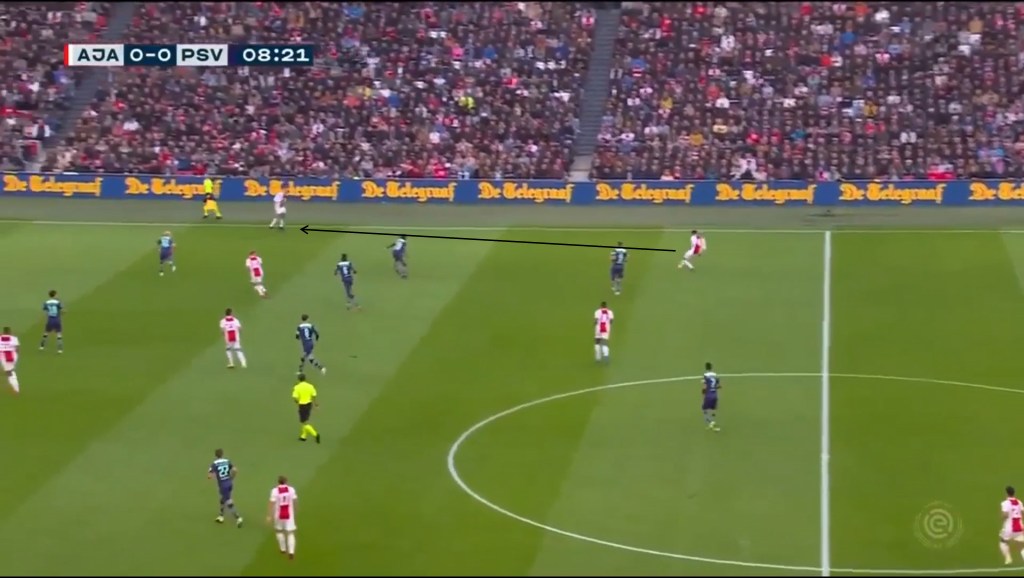
As soon as Max, the LB jumps out to press the Moroccan, Antony moves into the space between the LB and CB, forcing the CB to orient his position to the Brazilian. As this occurs the distance between the two centre backs increases substantially.
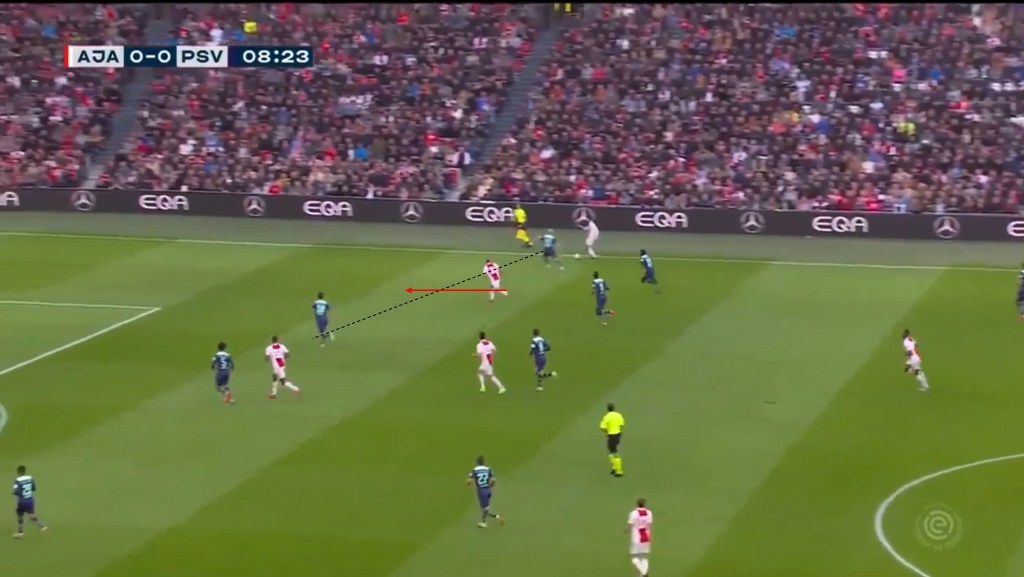
Through these movements Ajax are able to disrupt the oppositions last defensive line, by increasing the the distance between the CBs reducing the oppositions coverage in the penalty area.
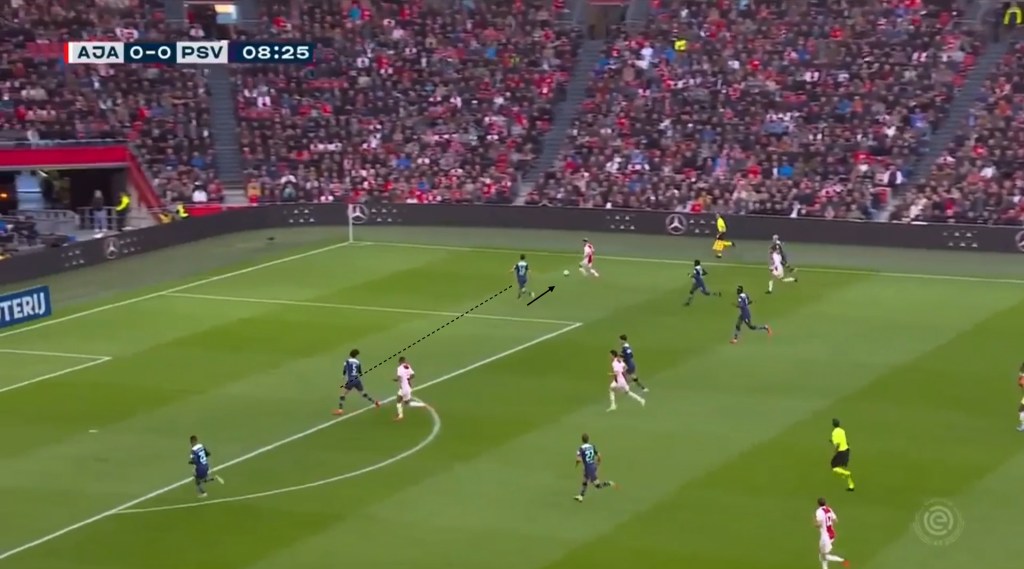
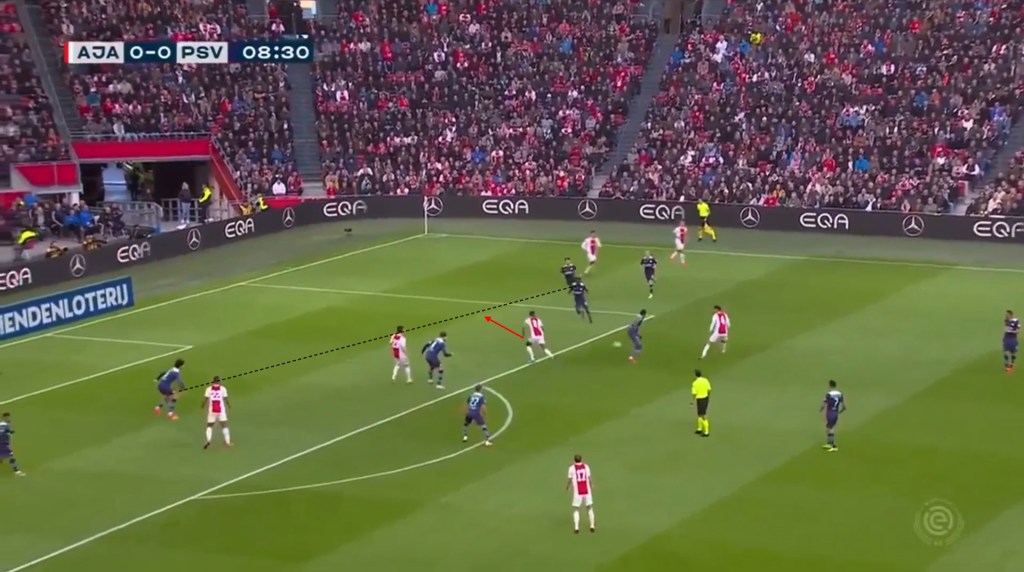
Antony would then play the ball back to the edge of the box, where Gravenberch would then make a vertical run, exploiting the increased distance between the two CBs
Sarri’s Napoli
One team I also enjoy watching in regards to this topic is Maurizio Sarri’s Napoli, which constantly reduced compactness and forced rotations in the defensive lines of the opposition.
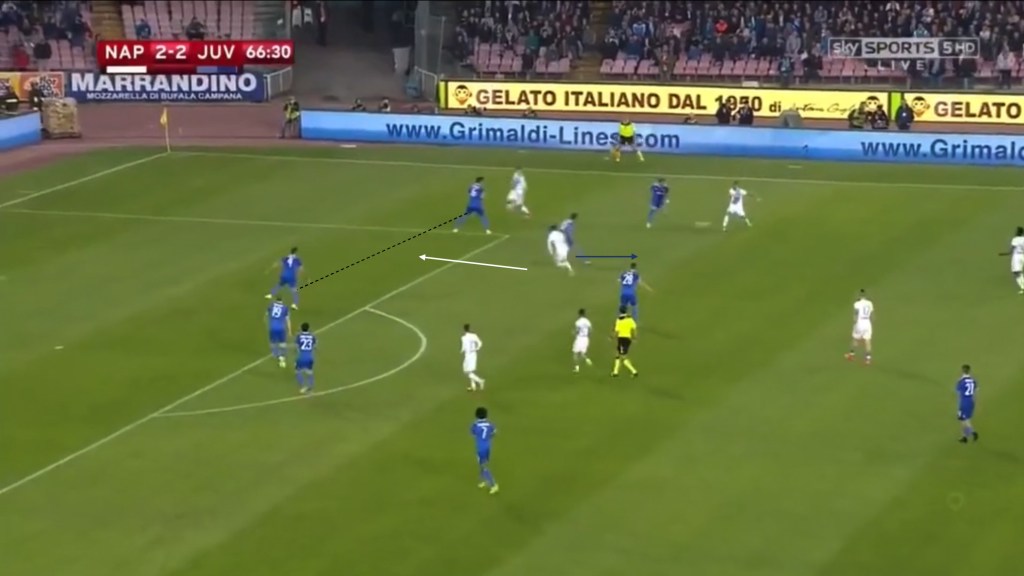
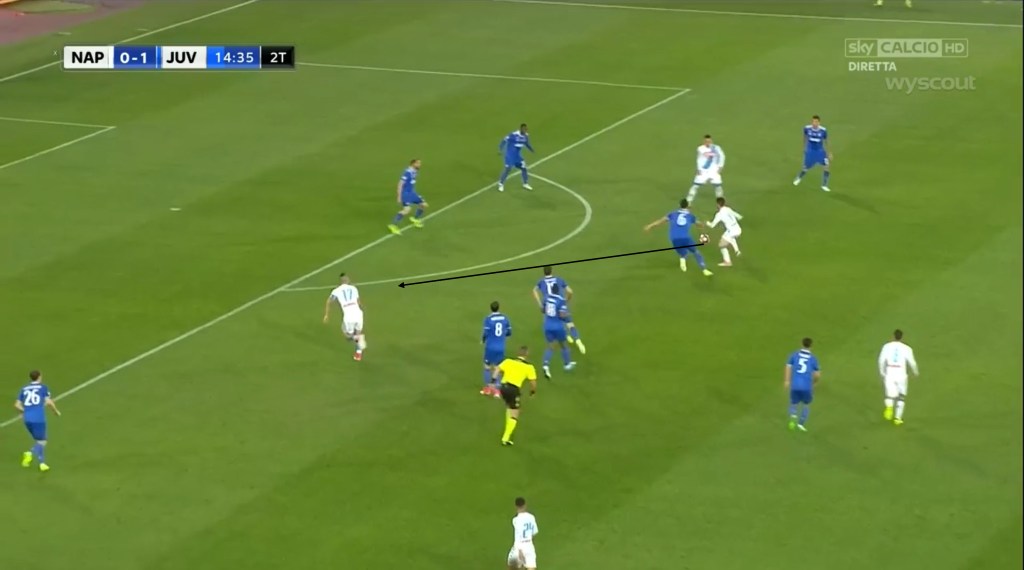
In the example below, we can see that Juventus elected to use the left midfielder in their 4-4-2 shape to create a situational 5-3-2in order to still engage the man out wide without reducing coverage in the box. Despite this, space between Alex Sandro and Sturaro is still stretched. Zielinski begins to make an underlapping run into this space, forcing Khedira to track his run and thus creating space for the Napoli full back to drive into.
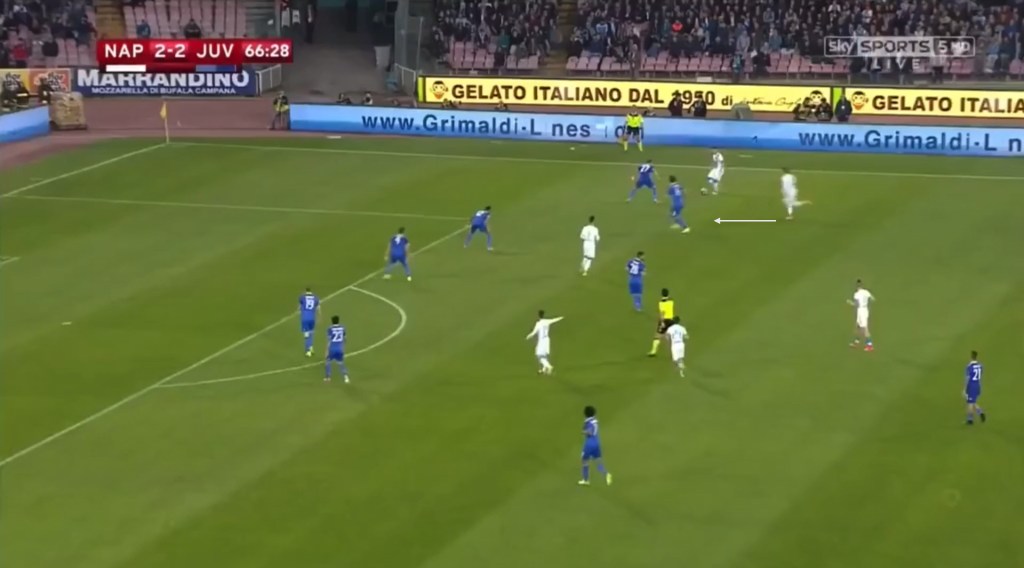
Once he does so, Alex Sandro then pushes forward to cover the free space, with Callejon darting into the space that Sandro had occupied receiving the ball and ultimately cutting the ball back to Insigne in the box.
In a different game, with the same teams involved we can see the effects of horizontal runs, this time within a more concrete representation of Napoli’s principles. Jose Callejon would move in from the RW and act as a second striker, creating depth by pinning the back line, while Mertens would drop into the ten space. As a result, Khedira would orient his position towards the Belgian, reducing the horizontal compactness in the midfield line. Hamisk takes advantage of this by moving horizontally into the space between Lemina and Khedira, with horizontal runs effective in creating space behind a line of defense.
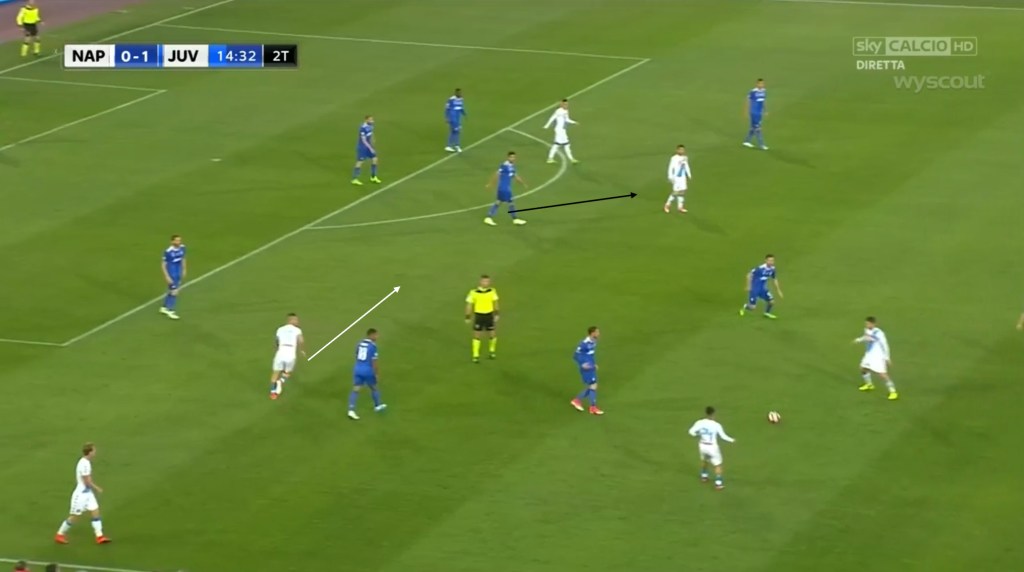
Ultimately moving into this space resulted in Bonucci stepping out of the defensive line as well as Hamsik finding the third man in Mertens.
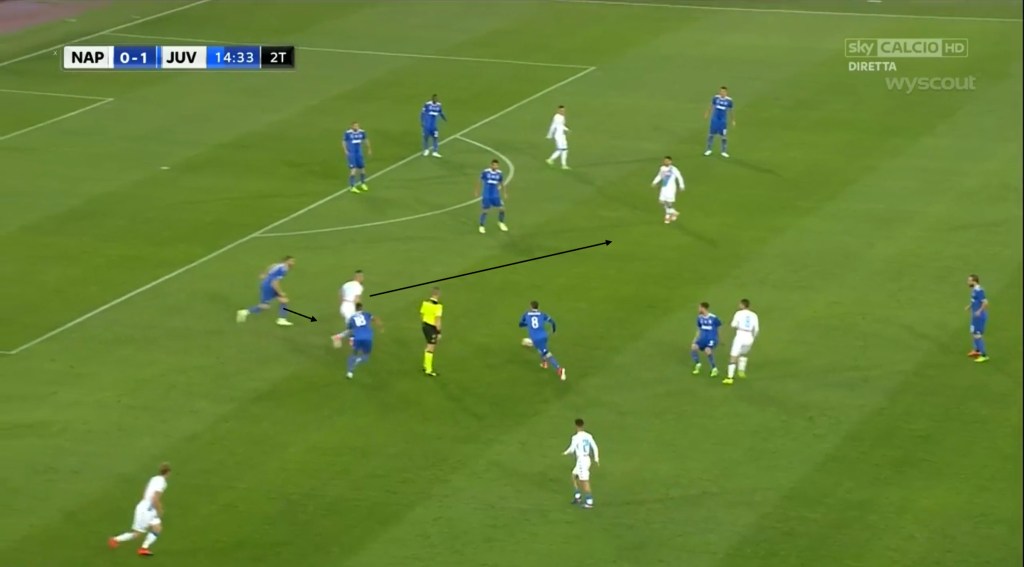
From this point, Hamsik could then penetrate the space in the back line before finishing spectacualry with an effort into the top right.
Conclusion.
Player movement in possession is for me the difference between sides that end up keeping possession for possession’s sake and sides that are maximizing all of their principles of play to create shooting opputunites. Not only are sides with dynamic movement more entertaining to watch but they also offer themselves more solutions when going forward, if the runs help destablise the opposition defensive line by reducing the compactness or forcing rotations.

 Skmm-ftbl
Leave a comment