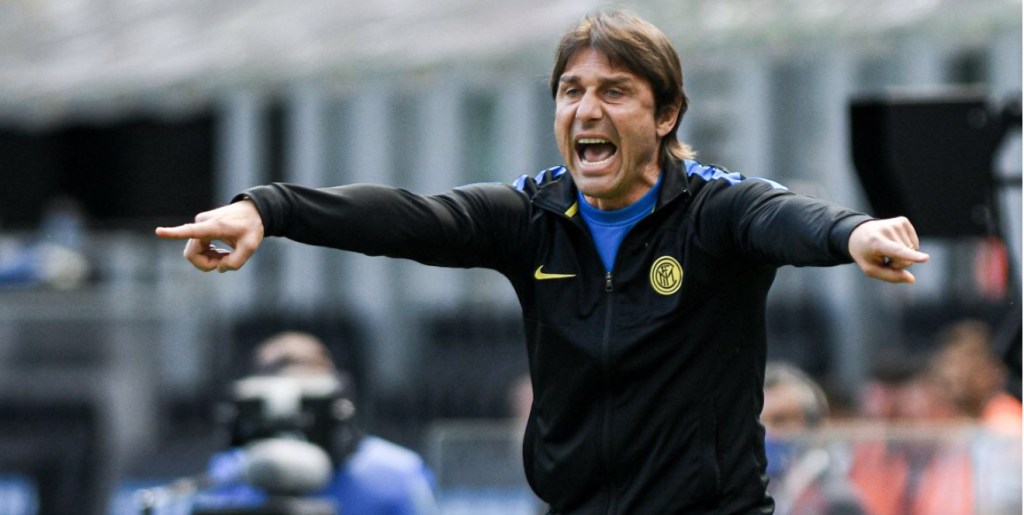
The last 10 years in Italian football saw the two big clubs in Milan fade away into relative obscurity. Juventus firmly cemented their place year on year as the best team in the division, fending off challenges from the likes of Roma and Maurizzio Sarri’s very impressive Napoli, while AC Milan and Inter Milan struggled with issues on and off the field. But in 2019, Antonio Conte, the man who kickstarted Juve’s Serie A dominance, was announced as Inter’s head coach, signaling the chances of a possible renaissance for the Neazzurri. Although Conte’s first season at Inter ended in disappointment with a UEL final loss and second placed finish, this season has seen his side clinch their first title in 11 years. In this article I will cover important tactical aspects that led this Inter Milan side to securing their first Scudetto in over a decade.
Build up: positional structure, rotations and patterns of play
Inter’s build up play has been fantastic to watch throughout the course of the season. Their positional structure in possession, positional rotations and switches of play have all helped create and exploit spaces in several games this recent campaign. Conte’s men on paper this season have lined up in a 5-3-2 which in possession and various passages of play has changed to a 4-2-4, 3-4-1-2 as well as a 3-5-2.However, in all these variations the positional structure of the side in possession has relatively stayed the same.
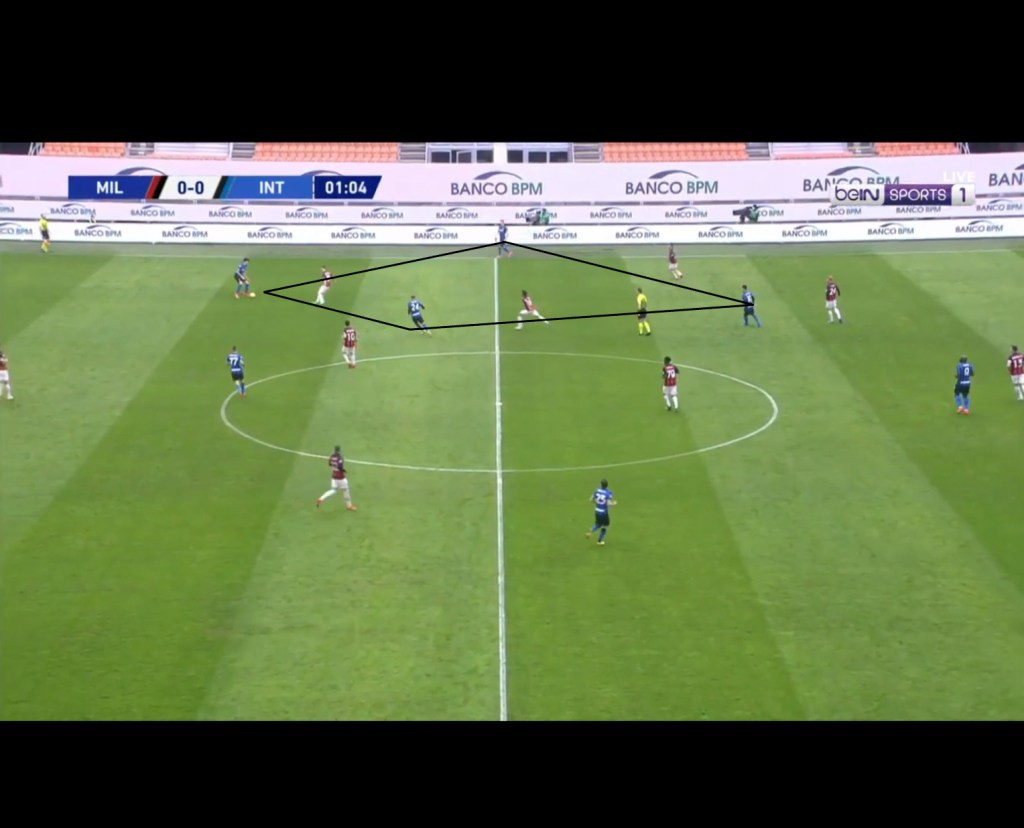
Inter this season have looked to create overloads on the right and left hand side of the pitch, Creating flexible passing triangles/diamonds whilst also attempting to stretch the oppositions press reducing vertical and horizontal compactness with either the RCB or LCB keeping the width with their corresponding wing back. On the right hand side this diamond structure consists of Skriniar, Hakimi, Brozovic and Barella at the tip but in the opponents half/final third Hakimi Brozovic Barella and Lukaku make up the structure. On the left hand side the diamond structure consists of Bastoni Eriksen Perisic and Lautaro Martinez . An example of this positional structure can be seen down below, in the early stages of the Milan Derby. Achraf Hakimi keeps the width by positioning himself on the touch line while the double pivot in the midfield shift to the right, with Brozovic providing support and Barella higher up in the half space, creating the tip of the diamond. Within Inter’s structure it is also important to highlight the options who aren’t in the diamond structure that act as “links” from one side of the pitch to the other allowing a smoother switch of play. In the example below, this player can be said to be DeVrij, however, on some occasions it can be both Eriksen and DeVrij or just Eriksen.
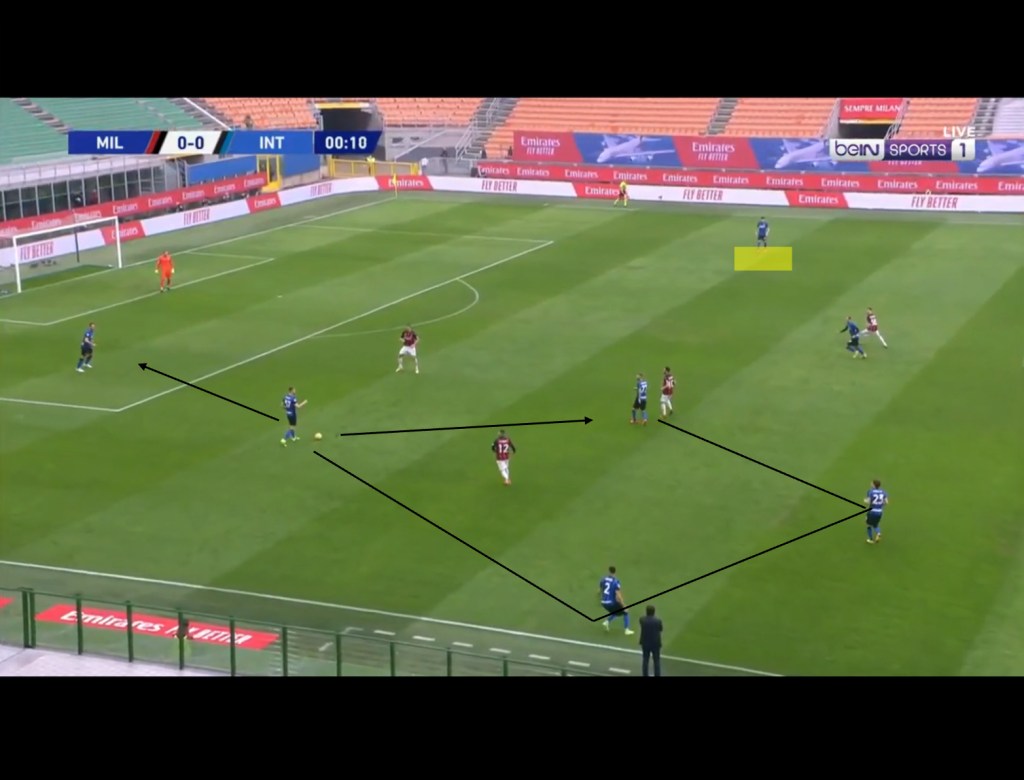
Above we can also see Bastoni’s the LCB’s position as he stays fairly wide, with the defender the most likely option from a switch from right to left. This has a number of benefits, with the most prevalent one being the fact that because of his distance from his CB partners he will often be left free, as if the pressing team were to attempt to cover him they would stretch their lines and reduce their defensive compactness allowing their shape to be penetrated easily or making one of their own players redundant in the press.
This did happen during Inter’s game against Juventus earlier on this season as we can see below. Juve pressed in a 4-4-2, originally opting to orient Morata to Brozovic, the right central midfielder and Ronaldo to DeVrij. However later on in the 1st half, Pirlo decided to change this with Morata orienting his position towards DeVrij and Ronaldo to Bastoni in order to prevent the left CB from receiving the ball from a switch in play. However, this made it easier for Inter to play through Juve’s first line of pressure and made it easier to create overloads on the right hand side using their diamond structure.
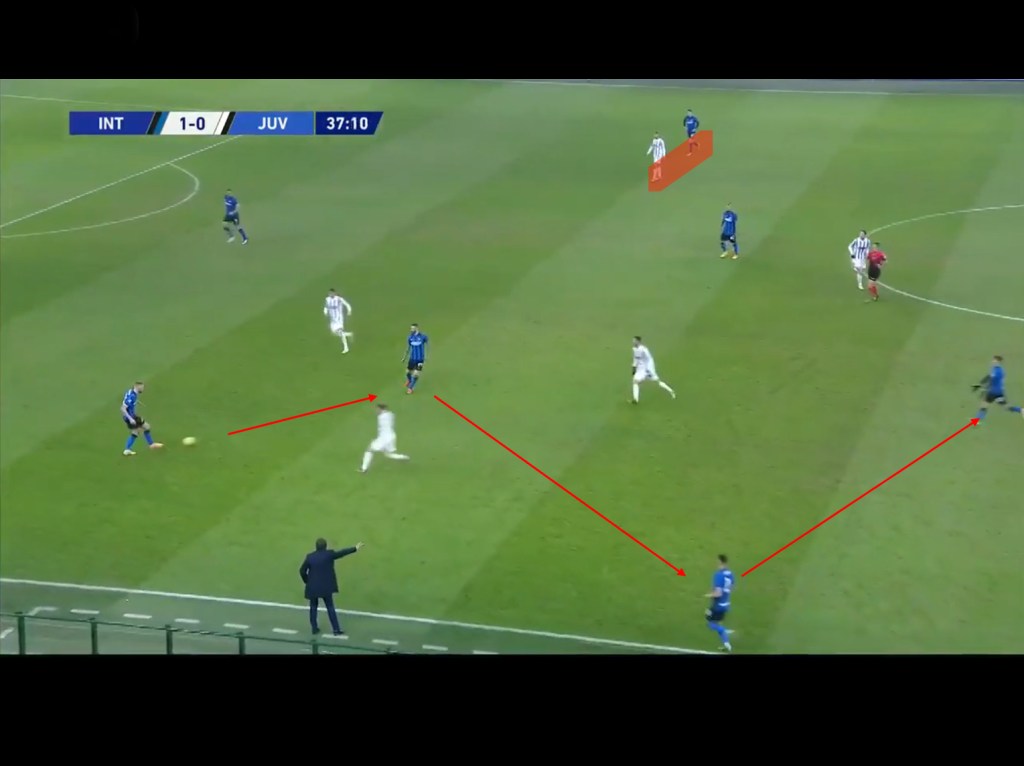
As seen above Ronaldo orients himself to Bastoni, which weakened Juventus’ press exponentially. Ronaldo’s positioning meant it became even easier for Inter to create overloads on the right hand side and find the third man, using the aforementioned diamond structure which gave an Inter players at least one passing option forward.
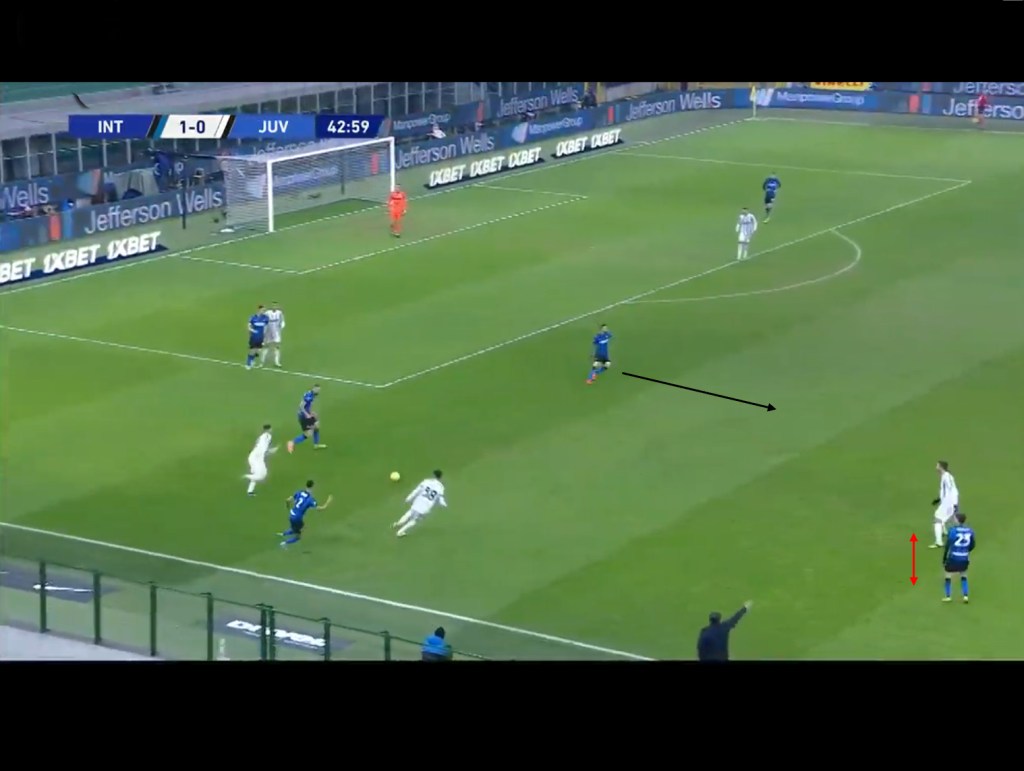
In the next picture below, we can again see how Ronaldo’s orientation meant that it became easier for Inter to create overloads on the right hand side which would ultimately create space in the midfield as Bentancur had the dilemma of choosing who to cover. In the example below he selects to orient his positioning to Barella, which creates space for Brozovic.
On the left hand side Inter attempt to create a similar shape created to aid ball progression. This time however Bastoni is the ball carrier while Perisic provides width, Eriksen shifts to the left hand side to provide support, whilst Lautaro creates the tip of the diamond.
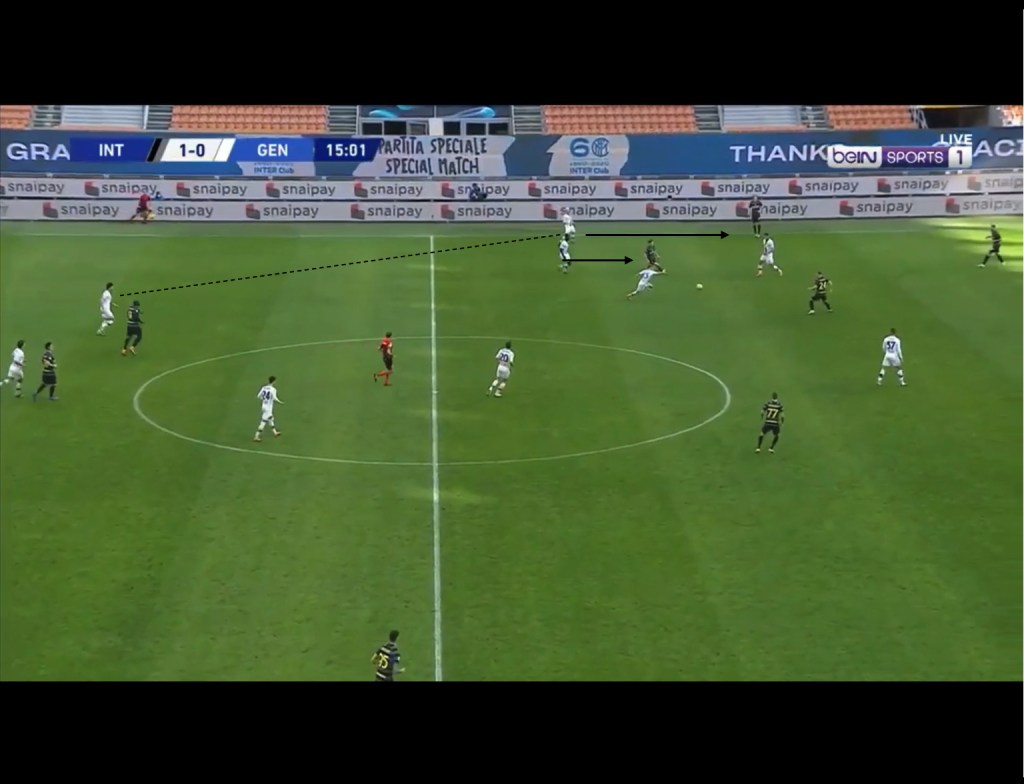
Another variation of the left hand sided diamond could be seen in Inter’s game against Genoa but this time with Devrij Perisic Eriksen and Bastoni making up the shape. Here we can also see how Skriniar stays wider, with Brozovic providing the “link” option for a switch of play. Like the Juventus game Scamacca the left striker has oriented his positioning to Skriniar but due to Genoa pressing in a 5-3-2 Inter could not create numerical superiority as easily as they could against Juventus. Nevertheless Genoa’s pressing lines were still stretched as two of their 3 central midfielders advanced forwards to press Eriksen and Bastoni leaving Brozovic in acres of space in the midfield. Had Eriksen opted to pass the ball to Perisic instead of the attempted pass to Lautaro Martinez (off screen) which was intercepted, Brozovic could have been able to receive the ball in acres of space.
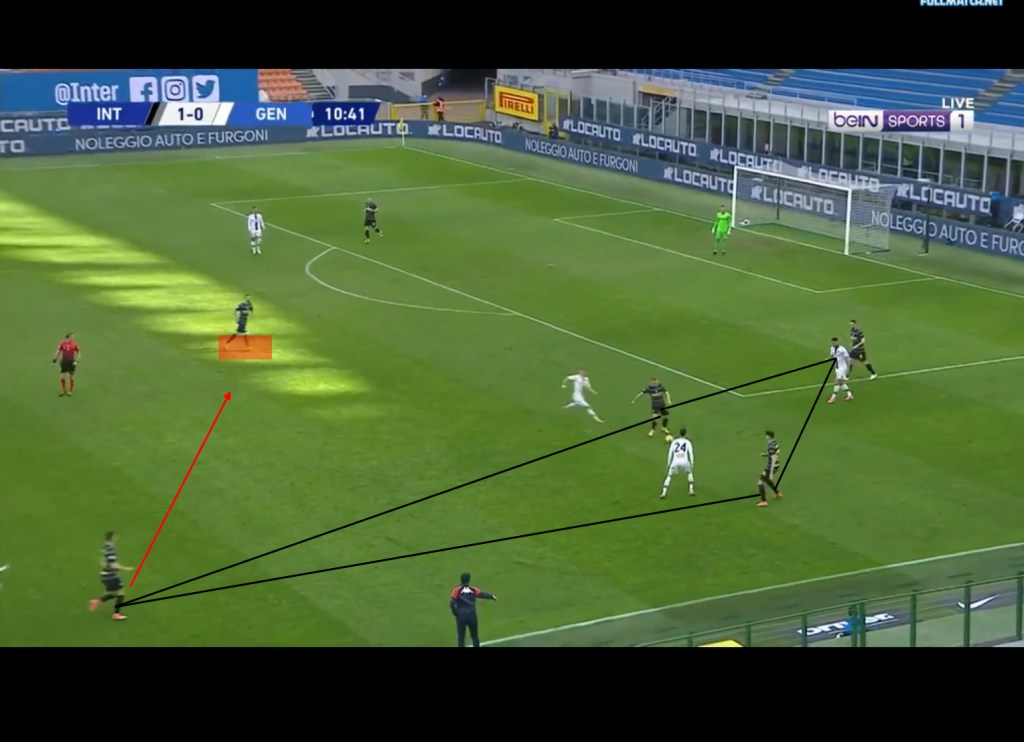
By leaving one of the centre backs in a wider position, Conte’s men will always have an option to switch the ball directly to the CB or through one of the links. On the other hand if the opposition chooses to cover the wider defender their pressing lines may be stretched, creating space or Inter will find it easier to create overloads on the flanks, depending on the formation the opposition are using to defend. However, this isn’t the only way Inter’s spacing in possession creates issues for the opposition.
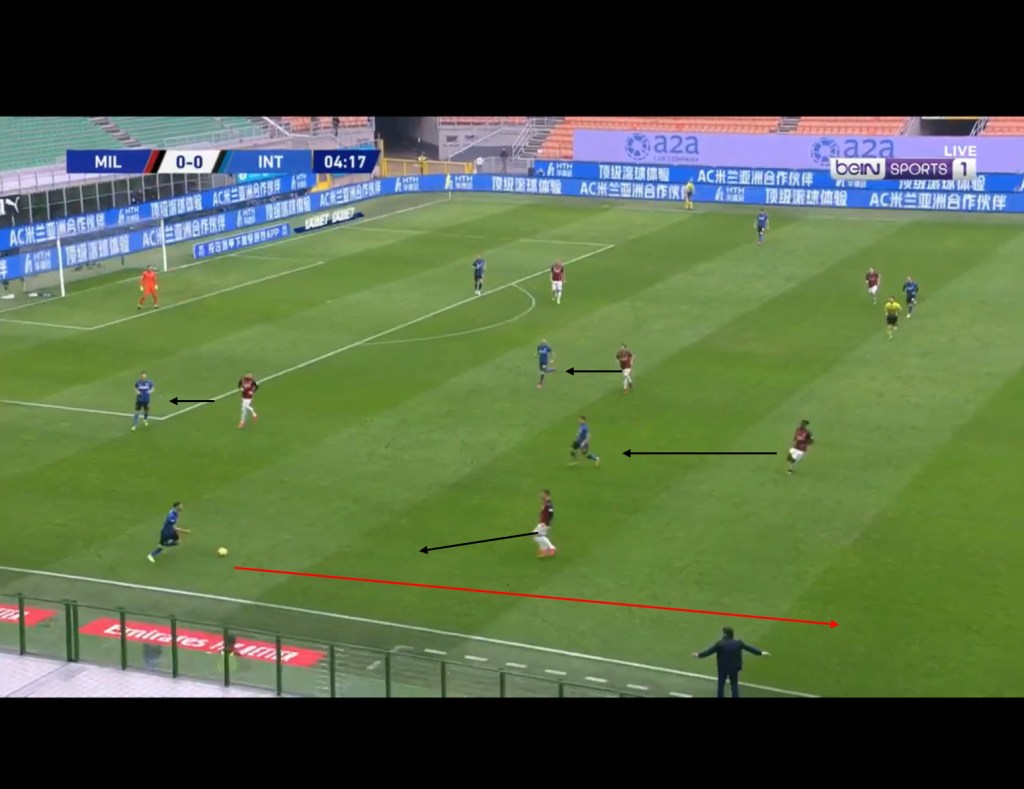
As mentioned before, Inter try to create overloads on both flanks, however, progression of the ball this season has not always directly occurred through numerical superiority all this recent season. In some cases Inter do create overloads and still “bait” a man oriented press from the opposition through their structure. However, often opposition teams will know of Inter’s intentions and as a result orient their players in the press to prevent these overloads. This can be seen in the picture below, with Inter in their diamond structure in possession with each AC Milan player orienting their position to one of the Inter players. As a result the threat of numerical superiority is neutralised with a 4v4 created in the area. However, because of Inter’s formation and structure in possession, in order to prevent an overload on the right or left hand side, the oppositions full back will need to advance forwards in order to cover Inter’s wing backs. For example in the scenario below, Theo Hernandez Milan’s left back orients his position towards Hakimi and advances forward deep into Inter’s half. As a result of doing so, Theo left space in behind him and Hakimi played a pass down the line to Lukaku into the space, ultimately leading to the first goal of the game.
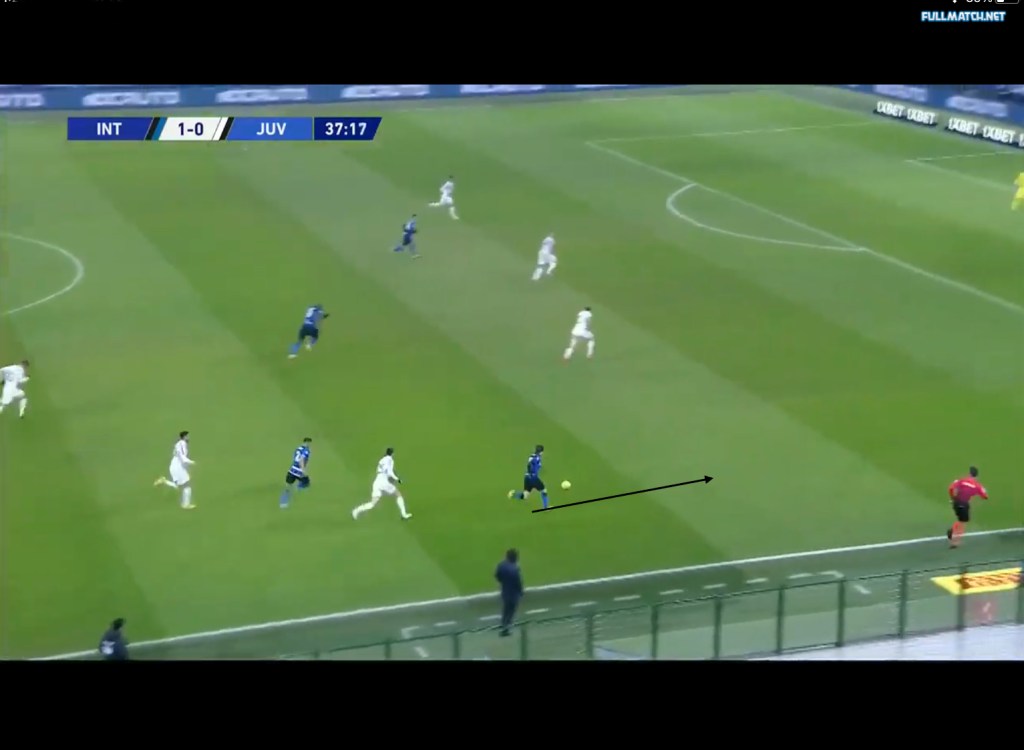
The next example comes from the Juventus game where Inter were able to create overloads on the flank and due to Juve’s press, we still see a similar issue occurring to that in the Milan game. As the ball is played to Hakimi, Frabotta moves forward from the left back position to press the Moroccan, who plays a first time pass to Barella
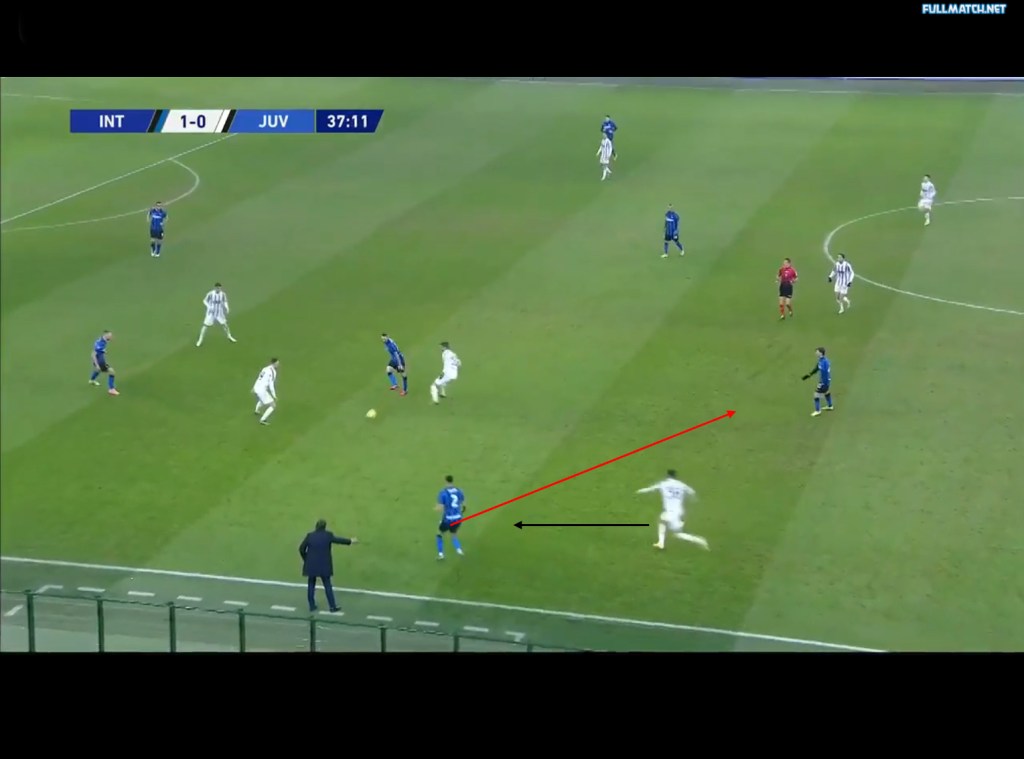
A few seconds later we can see Barella moving into the space vacated by Frabotta, who would play in a cross resulting in shot from Lukaku.
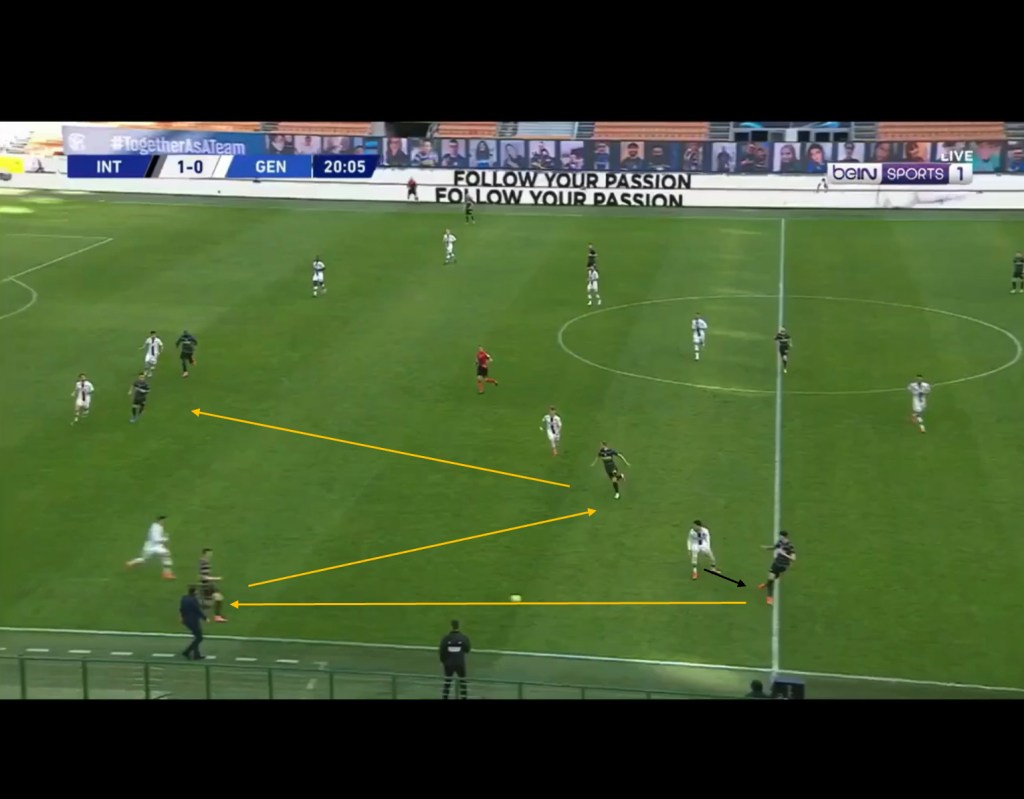
Again the same creation of space could be seen in Inter’s game against Genoa, with Genoa opting to press in a 5-3-2 with their RCB Zapata pushing up to cover Barella. Here again we can see Inter’s structure, with a 4v4 in this area and once again the opposition full back pushing up to prevent the overload. Just like the previous examples, we can once again see space created behind Czyborra, the left wing back with the the large distance between him and the CB,Radovanović. However, in this instance Inter did not exploit the space.
Positional Rotation and Patterns of play.
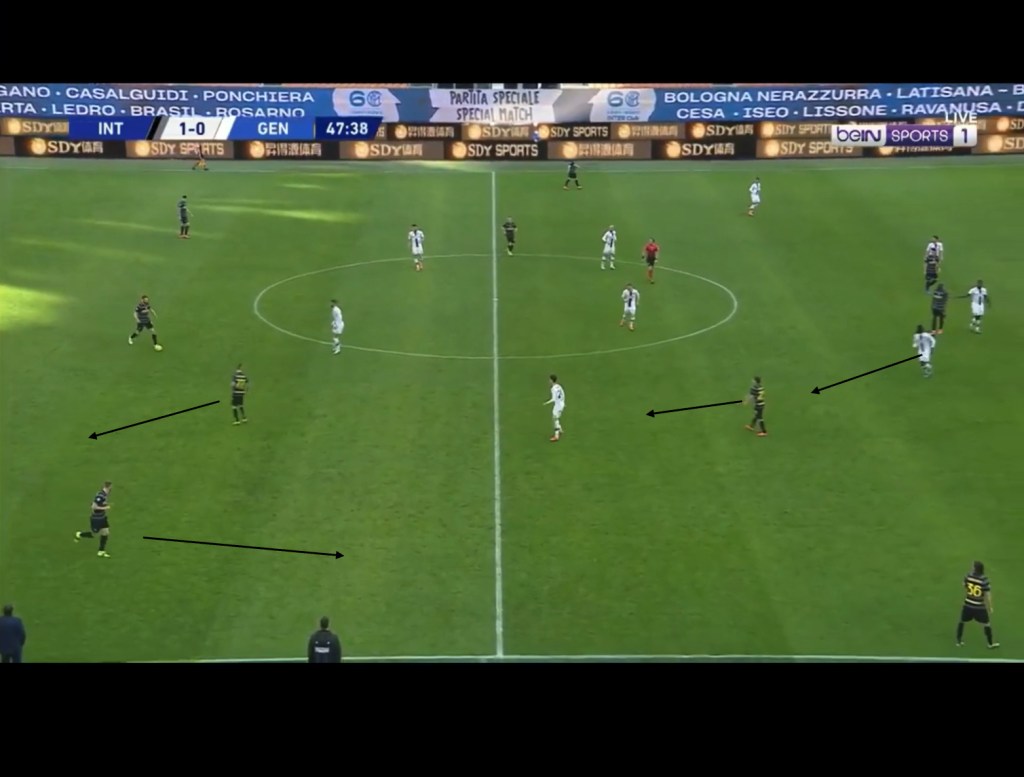
Through his team’s positional structure in possession Conte laid the foundations for his side to achieve positional superiority by looking to play the 3rd man (as can be seen in some of the examples above) who would be facing goal wards via different means such as up back through combinations. Through their structure in possession Conte’s side were also able to make flexible rotations, often without sacrificing key areas of the pitch. These rotations of position combined with set patterns of play have proved to be extremely effective and as a result Inter have slickly played the ball out of the back on a number of occasions in the 20/21 season. This can be credited to the passing circuits that have been meticulously conducted by Conte in training, resulting in certain patterns repeating themselves throughout several games.To start I will focus on the right hand side, where as seen below in the 2nd half of Inter’s game against Genoa, Brozovic begins to drop into the defensive line which triggers Skriniar’s movement further up the pitch. As a result Barella begins to drop slightly deeper taking up Brozovic’s usual position and we can see Onguenè beginning to orient his positioning towards him moving out of the back 5 like Zapata did in the first half.
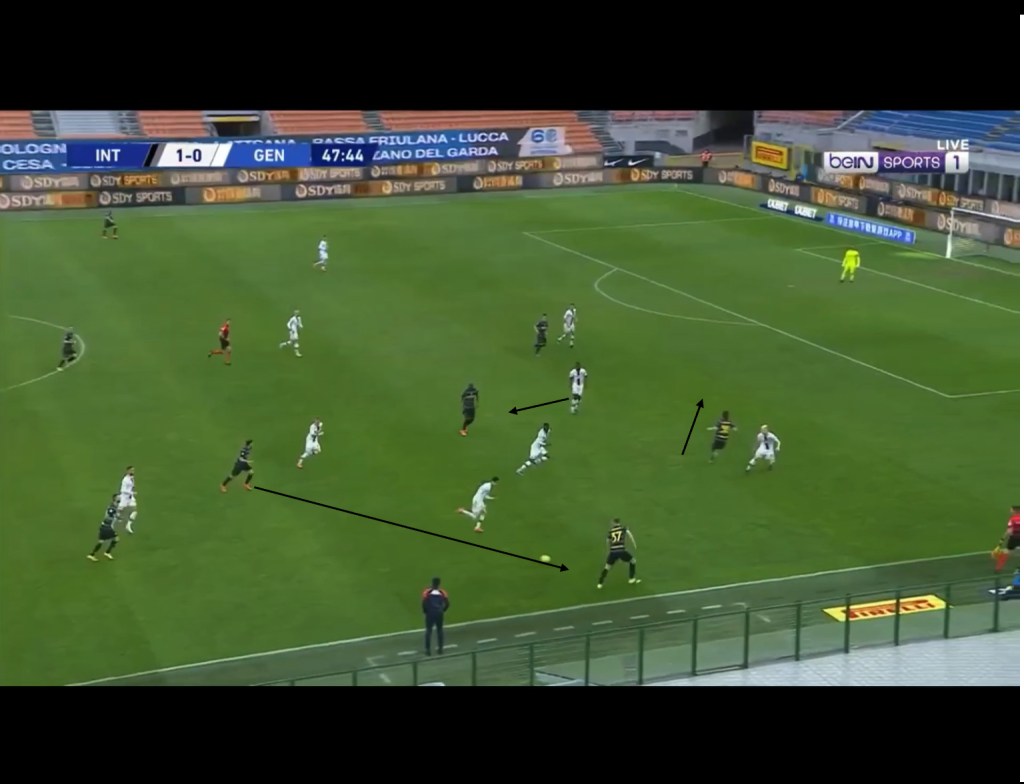
As the ball moves out wide we see how Lukaku has also dropped slightly deeper taking up Barella’s usual position,which drags Zapata slightly out of position. Darmian then makes a diagonal run into the space created by Lukaku’s movement,however, Skriniar did not see the run in time and failed to play the pass. Nevertheless we can see the benefits of positional rotation, as through rotating, Conte’s men managed to drag players out of position leading to the creation of space. In the image below we can also see the formation of the “new” diamond structure formed higher up the pitch that I mentioned earlier with Barella Lukaku Skriniar and Darmian now making up the structure.
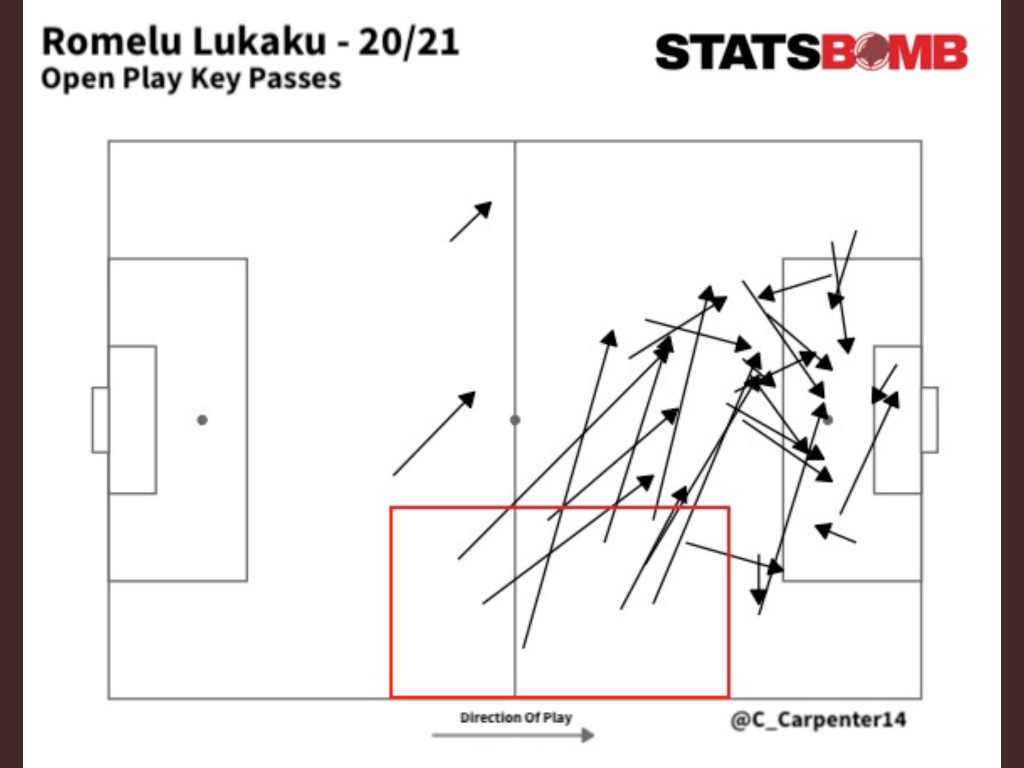
Throughout several games this season at various stages of the game, Lukaku can be seen dropping deeper on the left hand side, with an opposition centre back closely following him, creating space in the back line. In this position Lukaku uses his phenomenal strength to hold up the ball as the strong runners in close proximity to him(Barella,Hakimi,Darmian) run into the space created. Below, an image can be seen displaying Lukaku’s open play key passes this season.Although the highlighted area on the right hand side shows where he is making his passes from, it gives a very good indication of where Lukaku often receives the ball.
This could be seen in the game against Milan as seen in the next example, as after carrying the ball into the midfield, Skriniar plays the ball to Lukaku who has dropped deeper into the midfield with Romagnoli close behind him. As a result a gap opens up in Milan’s last line and Barella begins to make a diagonal run similar to that of Matteo Darmian’s run against Genoa in the last example. Lukaku lays the pass off to Hakimi who then plays a pass to Barella. Through this passage of play we could once again see positional rotation, with Skriniar moving into the midfield with Brozovic dropping into the back 3 as a result, and Lukaku dropping into the midfield while Barella ran into the “striker space”. This image also provides an example of Inter’s combinations looking to fin the third man.
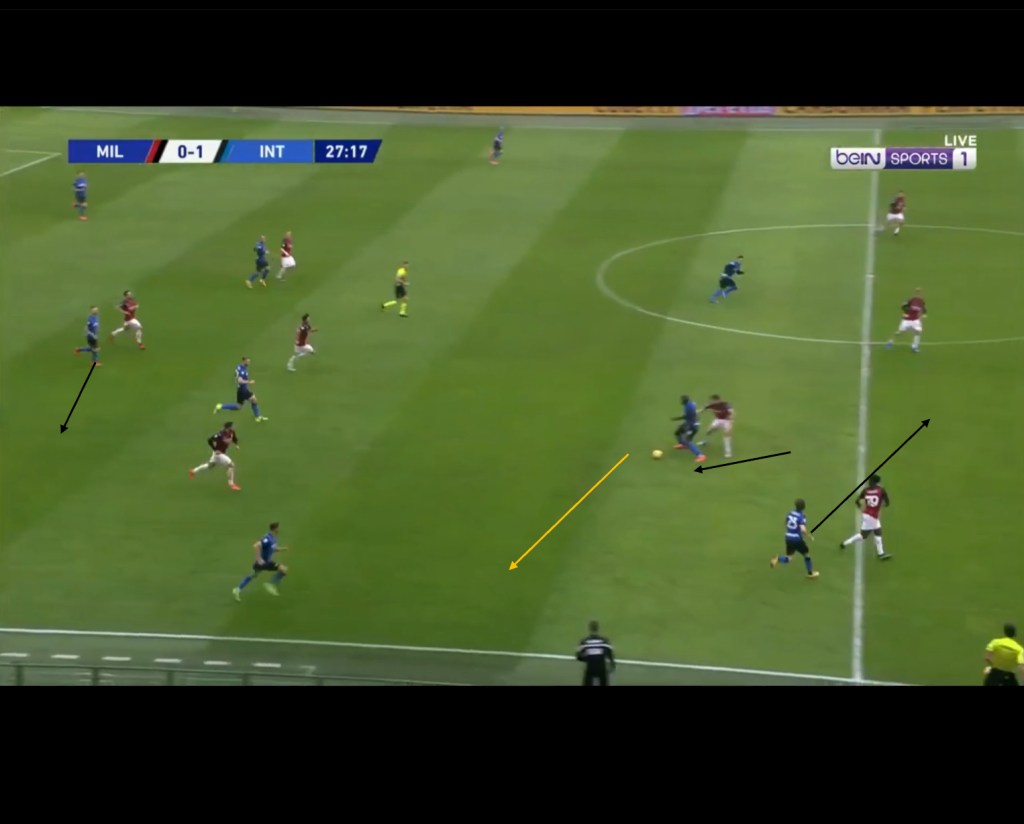
In other instances Hakimi is the one who makes the run into the vacated space and this could be seen again, in the game against Milan in the build up to Inter’s second goal. As mentioned earlier, Milan looked to prevent Inter from gaining a numerical advantage in wider areas, so as Barella dropped deep to receive the ball, Kessie began to orient his position to the Italian. From this position Barella played a lobbed ball to Lukaku who moved towards the touch line on the right hand side.
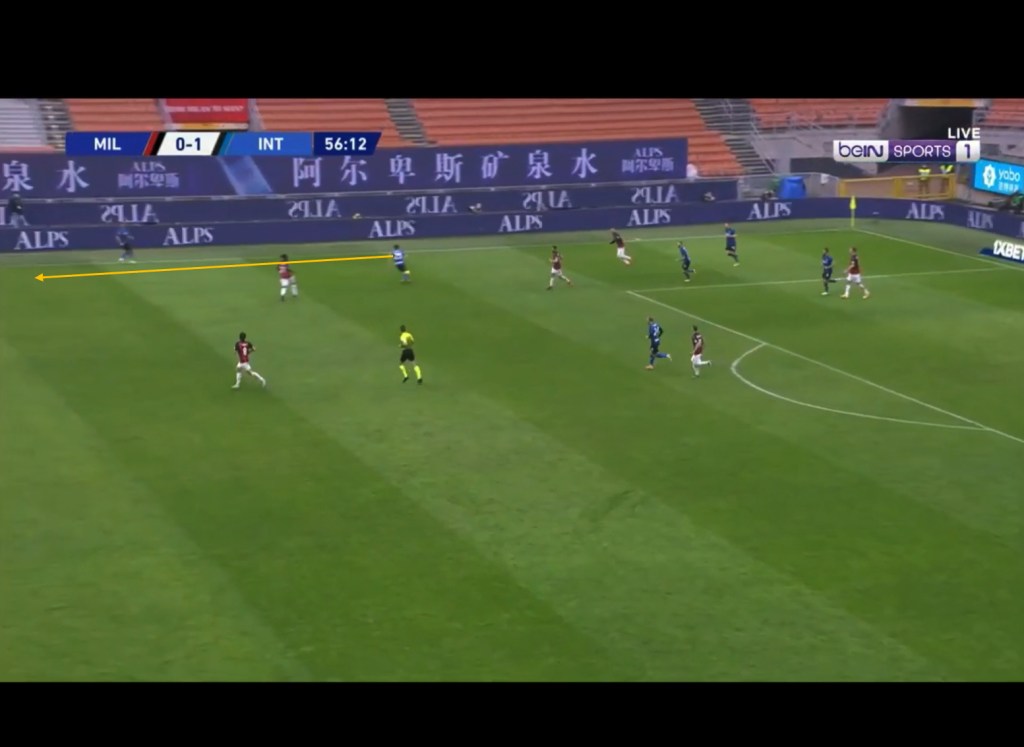
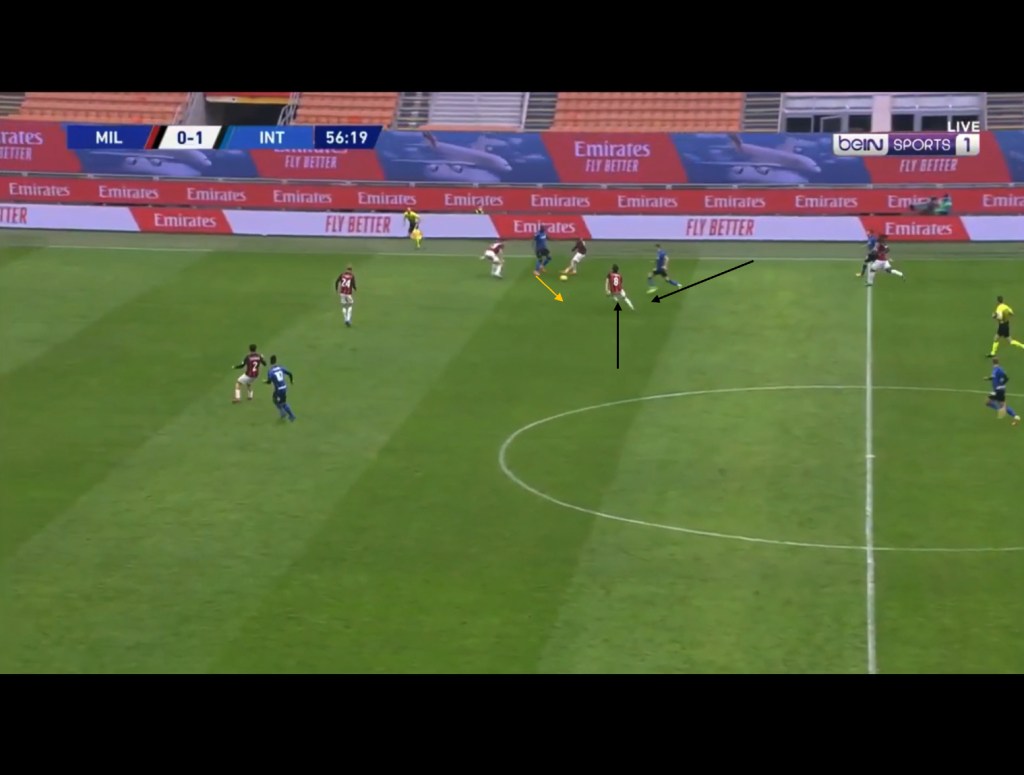
From this position Hakimi then made a run inwards into the space that was created through Kessie’s movement up the pitch when moving towards Barella. As result of this, Tonali had to shift across which created even more space in the middle. Due to this, Christian Eriksen would then receive the ball after Hakimi skipped past Tonali’s challenge ultimately resulting in the second goal of the game.
Underneath, in Inter’s game against Hellas Verona we can see another example of Hakimi running into the gap in the defensive line. Once again we can see Lukaku receiving the ball on the right hand side as he drops deeper. Dawidowicz, the centre back, sticks to him tightly, creating a gap in the back line. Hakimi recognizes this and begins to divert his run into the space while Lukaku would then lay the pass off to Alexis
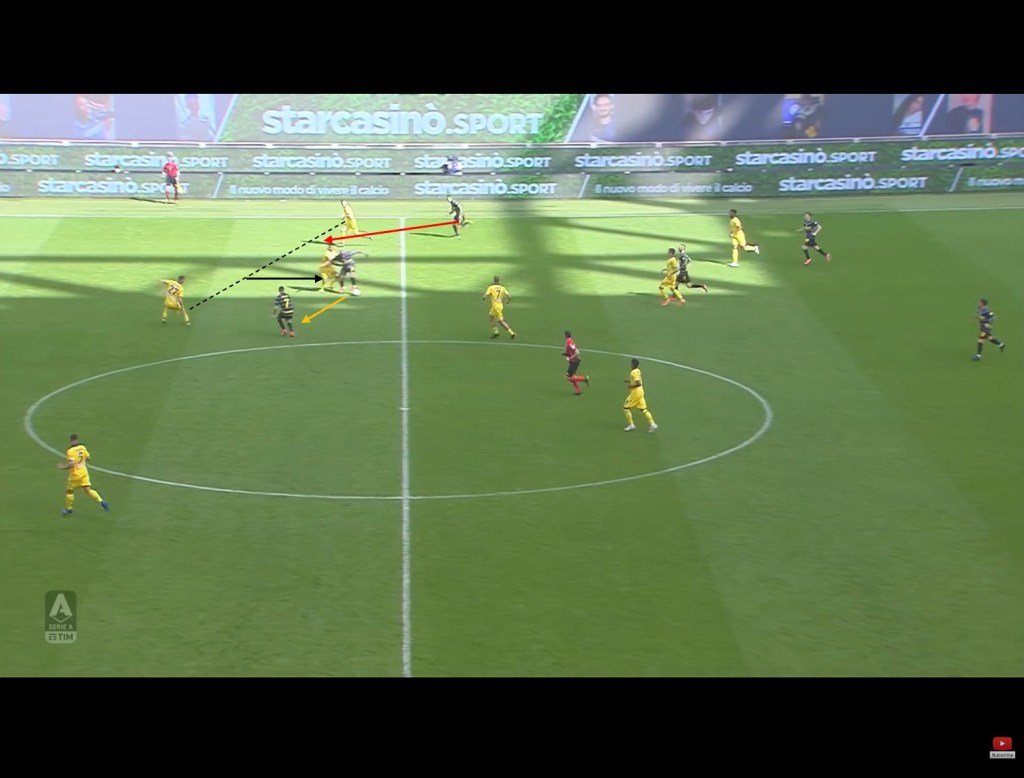
Moments later, We see Hakimi about to receive the pass from Alexis with this sequence of play resulting in the first and last goal of the game.
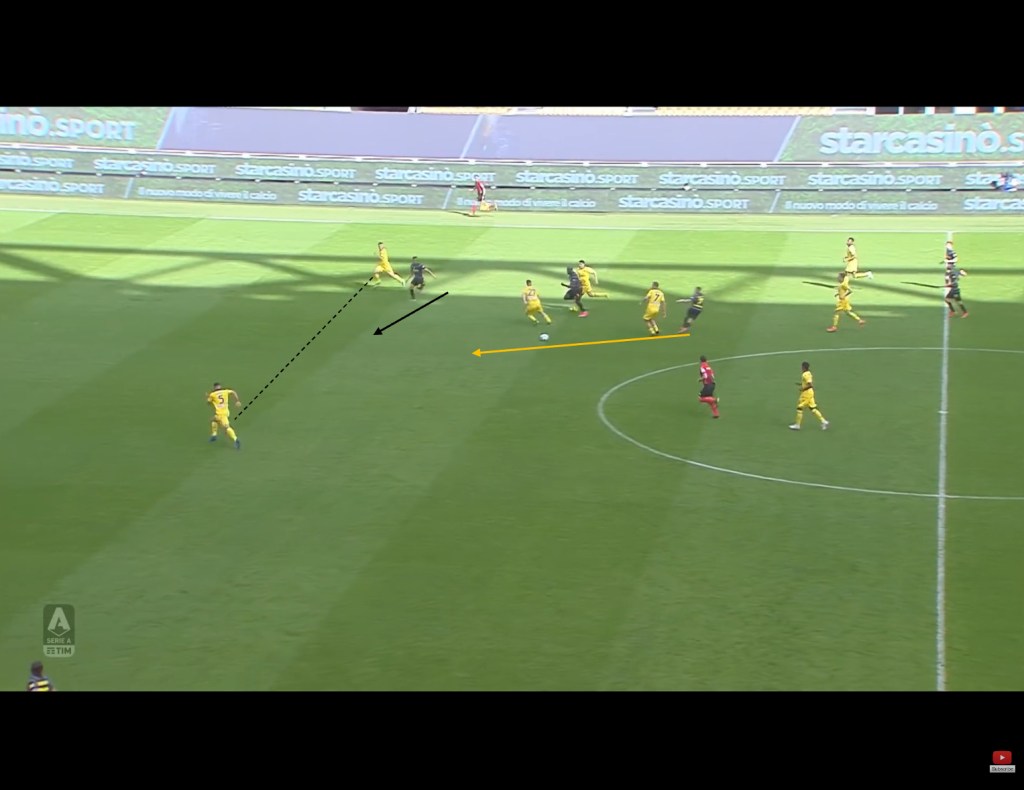
When playing against teams in a deep block, the importance of the width created by the right wing back making runs in the gaps of the defence can once again be seen. As mentioned earlier, the wide position of the right wing-back often results in the opposition left back or left wing-back orienting his position to the RWB. This results in reduced horizontal compactness between the opposition centre back and left back creating space that Inter’s right wing back looks to exploit. We can see this once again in the example below as Hakimi receives the ball on the touch line with Cagliari’s left wing back moving out wide to cover him, increasing the distance between him and his centre back.
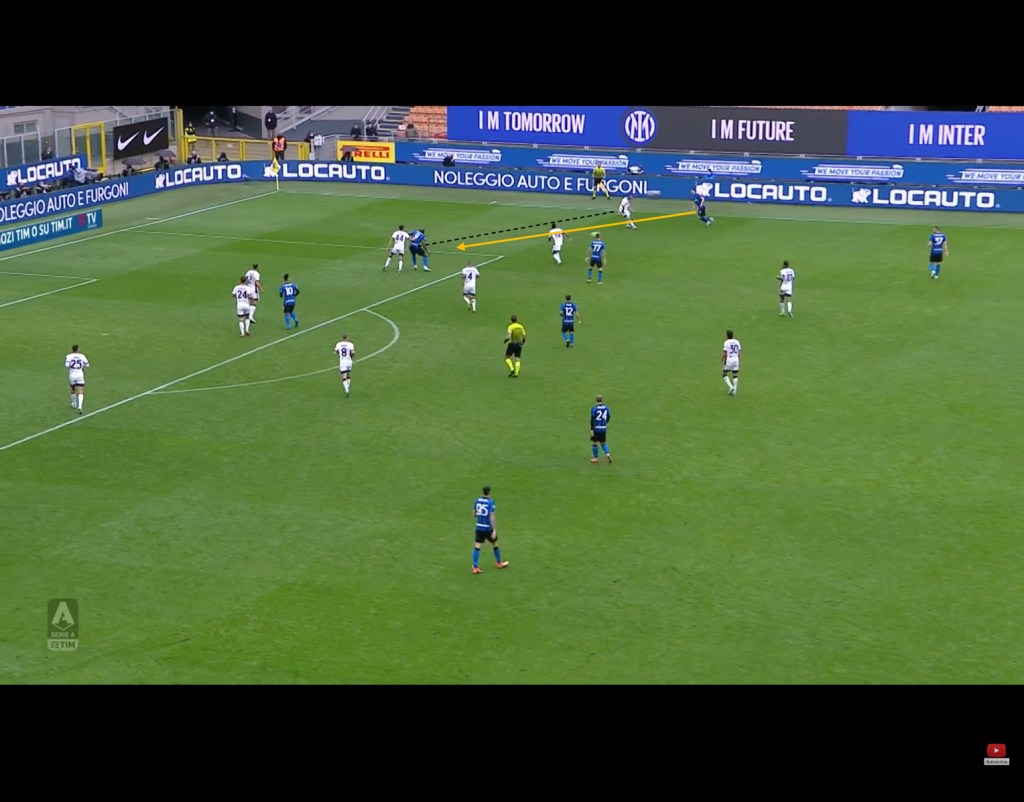
Hakimi then plays a pass to Lukaku who holds the ball up while the Moroccan darts into the space between the oppositions defensive line, taking advantage of the left wing back’s frontal body positioning making it difficult to turn and react to Hakimi’s run. Hakimi would the receive the ball before squaring it to Matteo Darmian.
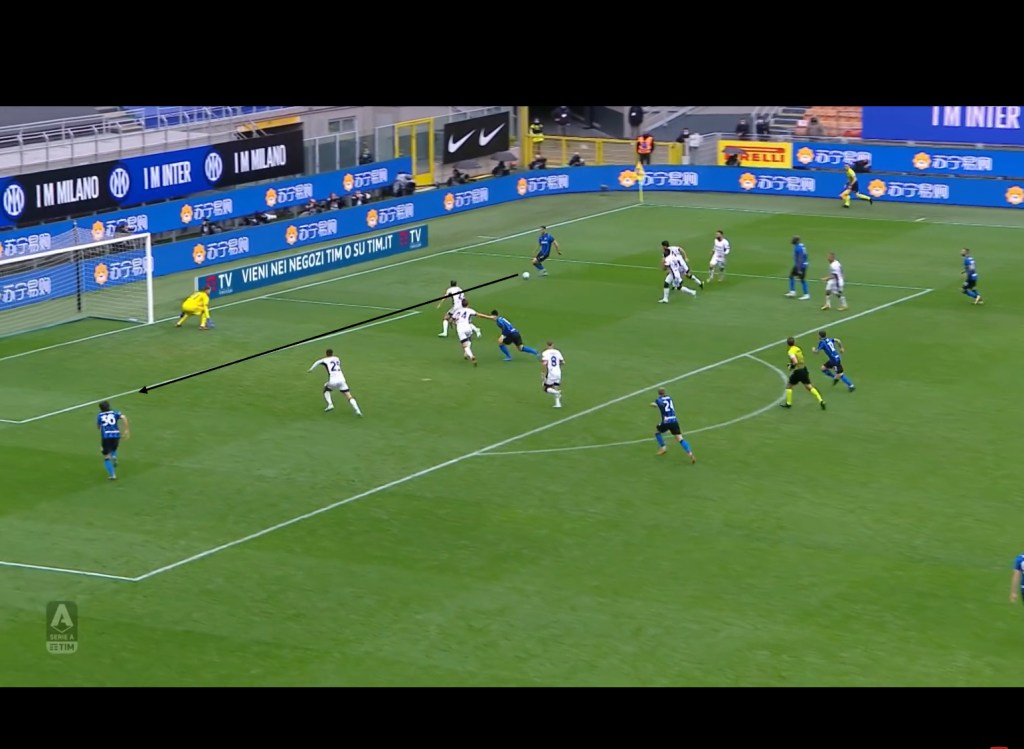
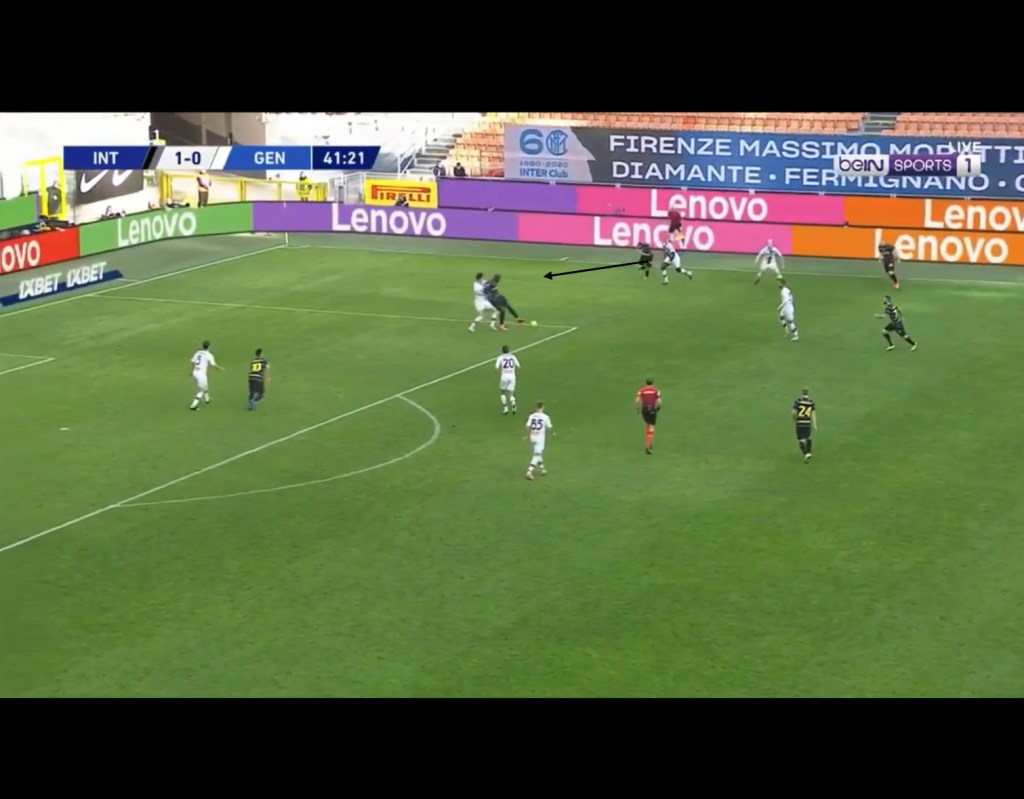
The same pattern could once again be seen against Genoa, but this time with Darmian operating as the right wing-back. Darmian receives the ball on the touch line stretching the Genoa back 3 and then plays a pass into Lukaku.
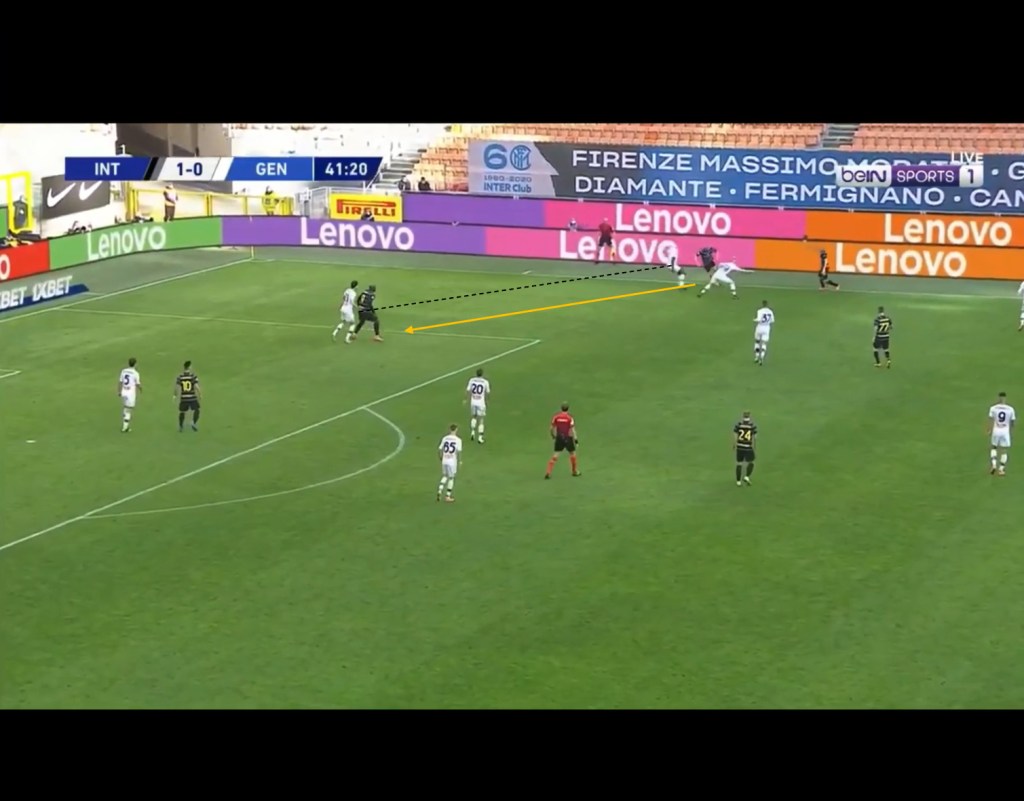
Darmian then makes a similar movement to that of Hakimi’s in the previous example but Lukaku didn’t not manage to play a pass to him.
Ball Progression on the left hand side
On the left hand side Inter’s solution for ball progression is much more reliant on positional rotation between Eriksen Bastoni and Perisic in their flexible diamond structure. This once again stretches the opposition’s defensive line, dragging different players out of position, reducing their vertical and horizontal compactness creating spaces to pass and run into. An example of this can be seen underneath, with Eriksen dropping into the back 3 which triggers Bastoni to advance further up the pitch. Notice that as Eriksen moves into the back line, one of the three Genoa midfielders in their 5-3-2 formation begins to orient his position towards the Dane.
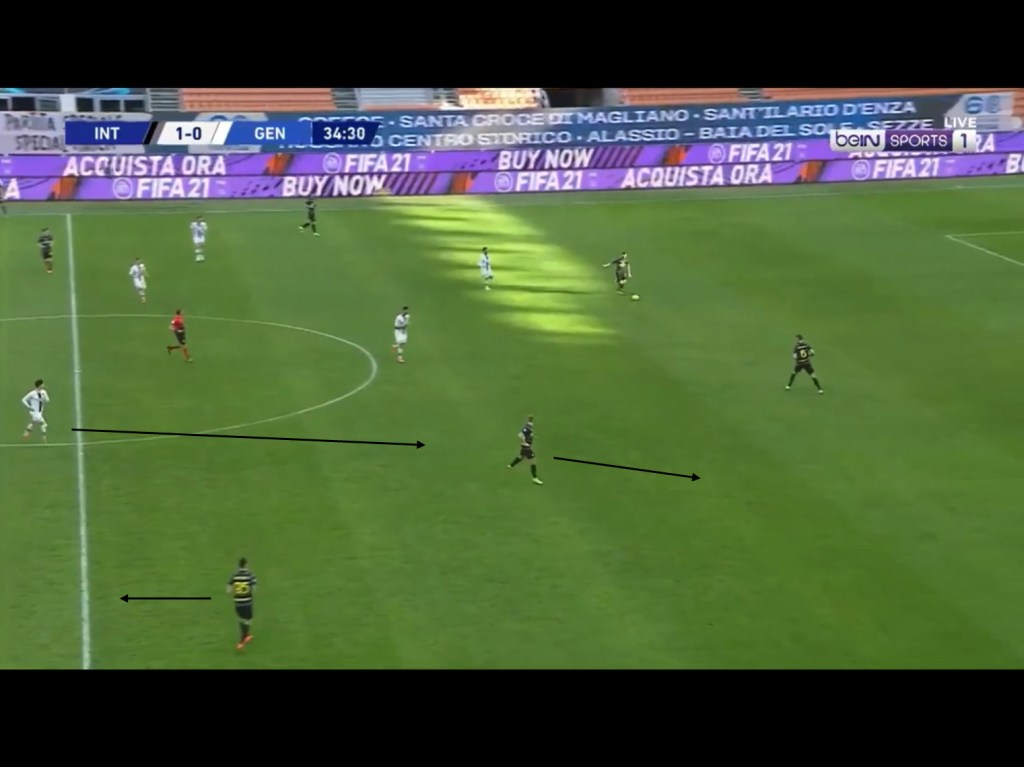
A few seconds later, we can now see that as Bastoni shifted upwards due to Eriksen moving into the defensive line Perisic moved inwards. We can also begin to see how the rotations began to stretch Genoa’s defensive lines, reducing their horizontal compactness. By orienting his position to Eriksen’s movement into the defensive line, Melegoni, the right central midfielder increases the distance between him and Rovella in the midfield line. This meant that by the time Perisic received the ball, Rovella was too far away to apply any meaningful role in trying to intercept or tackle the Croation, who would then play a 1-2 with Bastoni, exploiting the space between the right centre back and right wing-back.
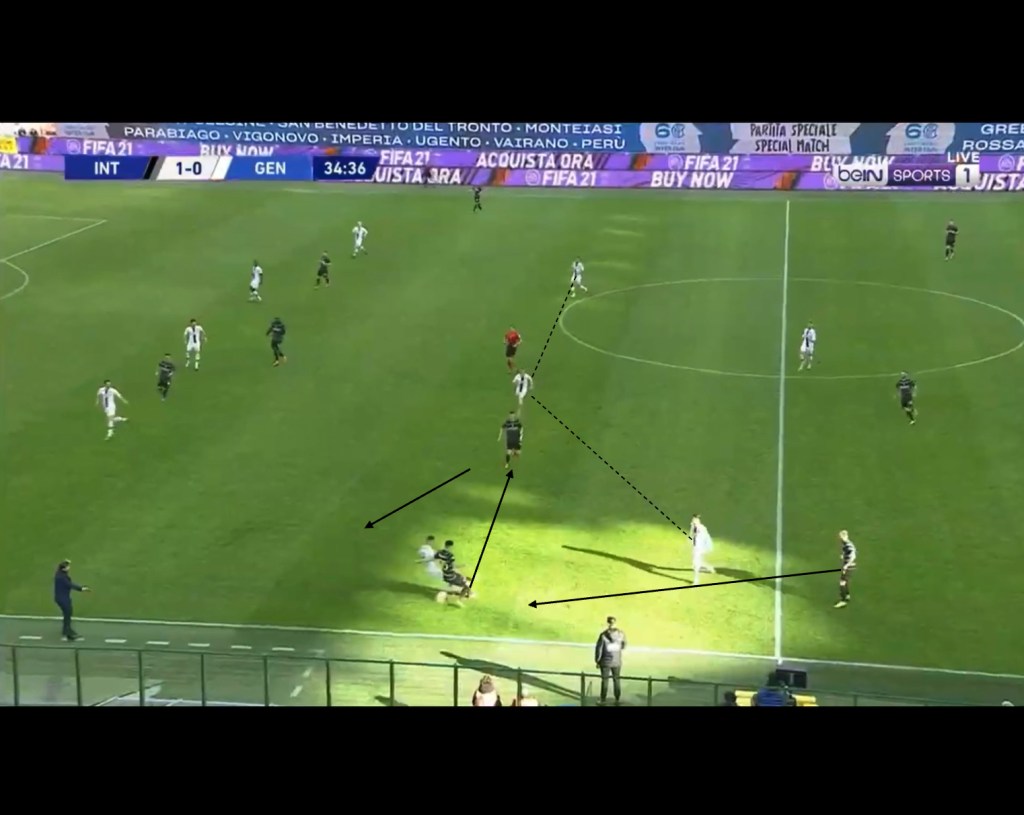
Earlier on in the 1st half the same rotation, albeit this time involving Barella and not Eriksen, could be seen taking place, causing similar issues for the Genoa midfield. Like the previous example, Bastoni pushed forwards as the left sided midfielder began to drop into the defensive line. Melegoni began to orient his position towards the number 23, once again stretching the midfield line.
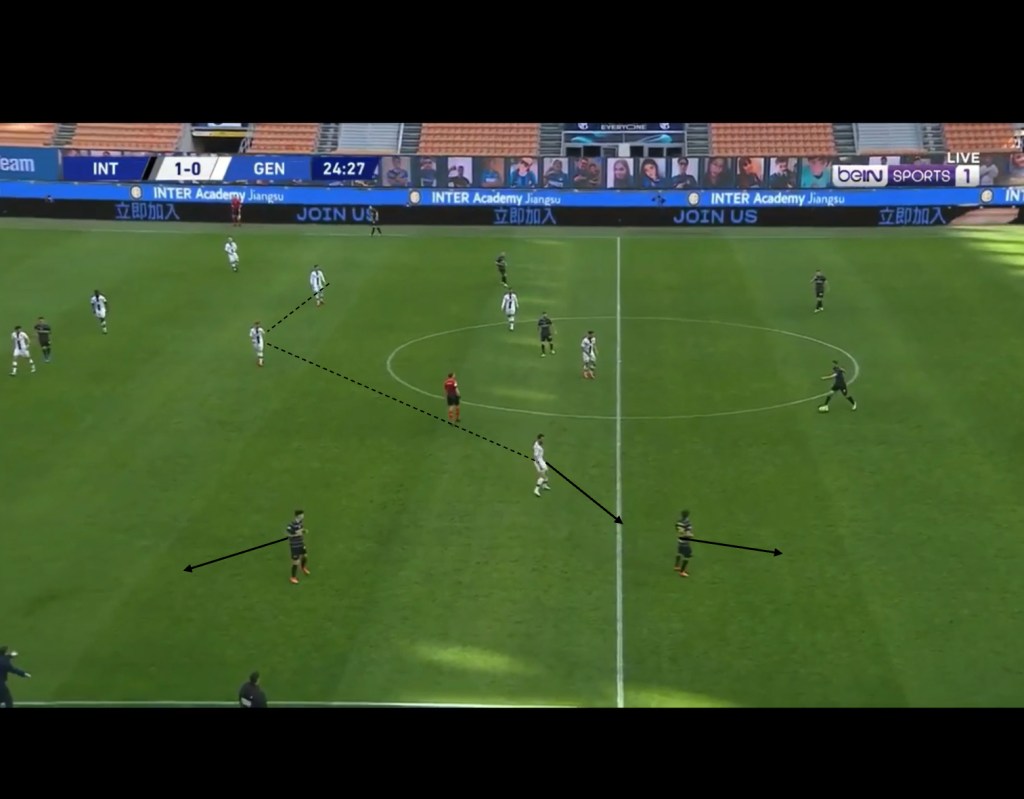
Perisic responded to Bastoni’s shift upwards by moving inwards into the half space, which allowed them to exploit the stretched midfield line.
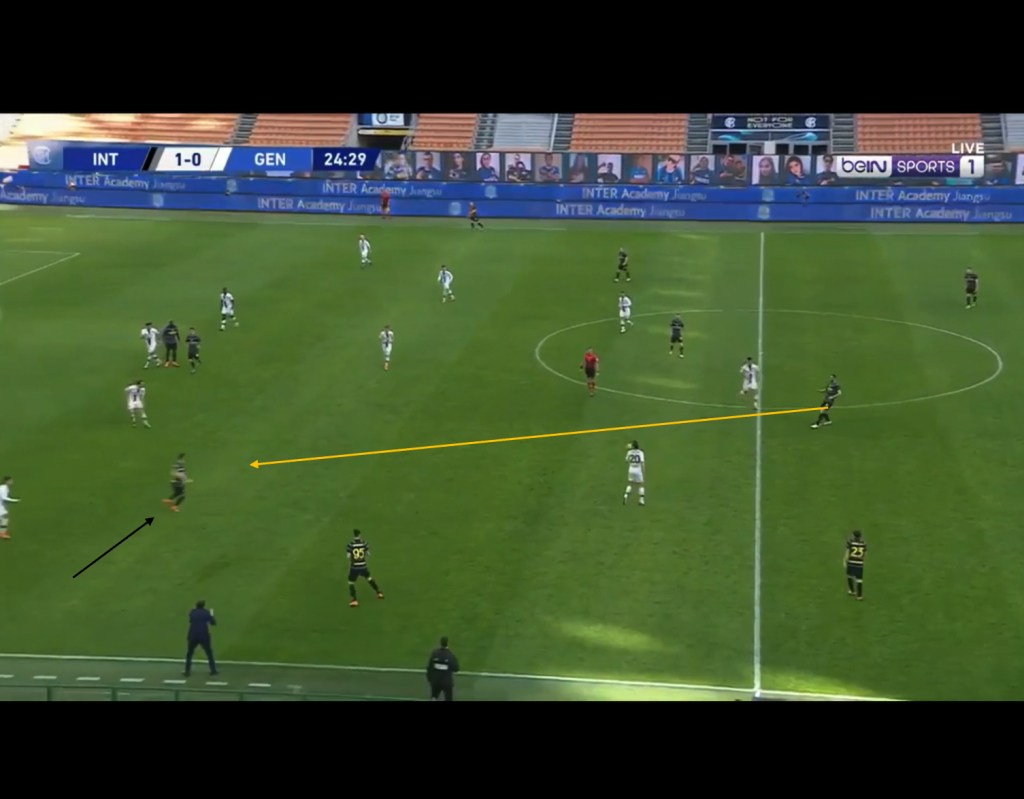
One feature that has been a regular occurrence on the left hand side of this Inter team, just like the right side has been the regular use of combinations to create the possibility of a pass to the 3rd man. The image below provides an example of this as Bastoni receives the ball with Karsdorp moving up the field to apply pressure. Karsdorp’s pressure means that Ashley young (the 3rd man) who is off screen was cast in the full-backs cover shadow preventing him from receiving the ball. As a result Vidal shifts towards the left hand side to offer Bastoni a passing option.
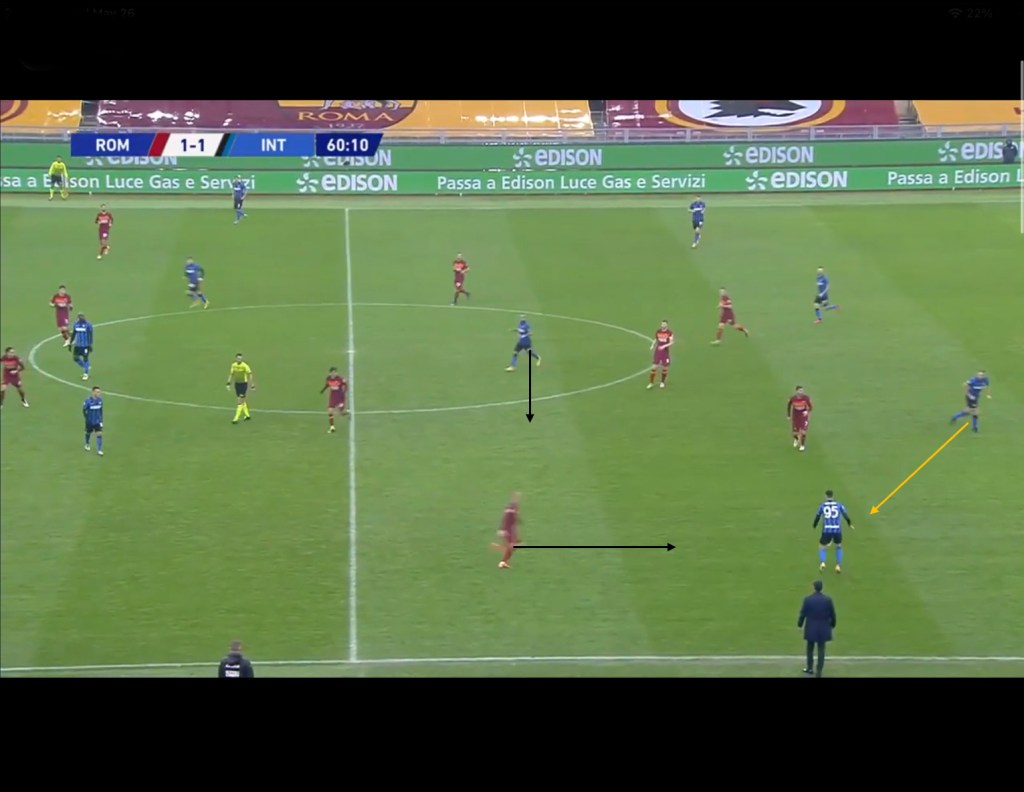
In the next image we can see how after a taking a touch, a pass to Ashley Young becomes possible, however, Vidal opted to play the pass to Lukaku.
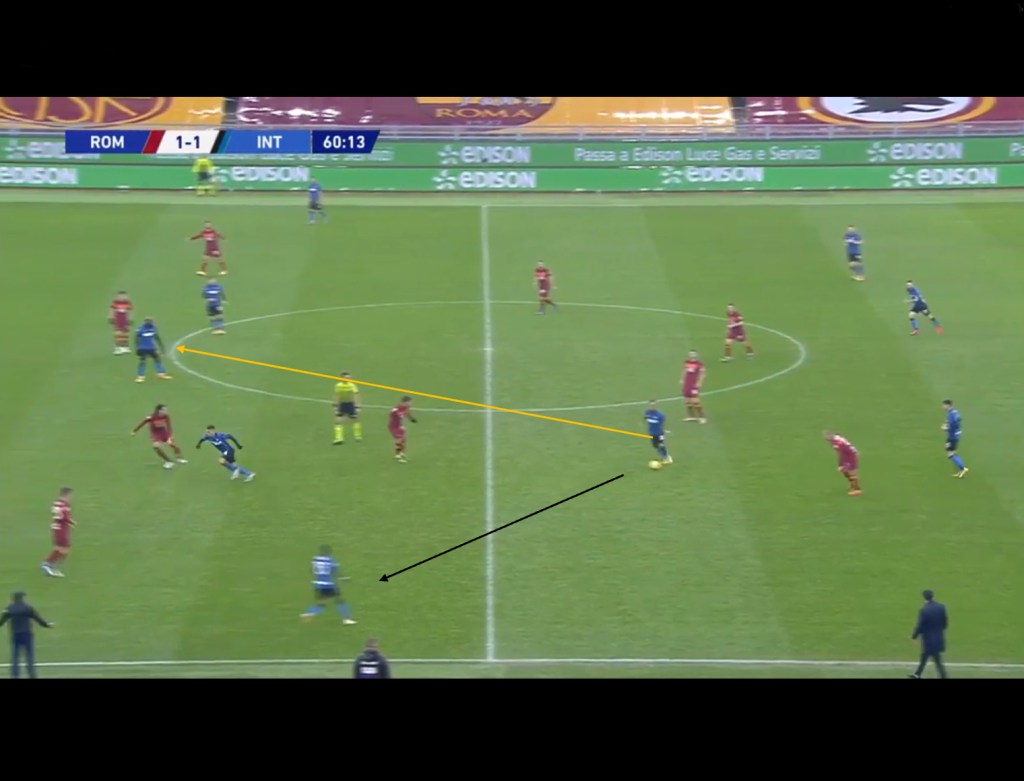
The same method was applied in the game against Genoa, however, this time using the left wing back to find the the third man in the left central midfielder, adding an element of unpredictability to inter’s build up. This time in the image below, we can see that Eriksen is in the cover shadow of Genoa’s right central midfielder and as a result, Perisic drops deeper to offer a passing option. Perisic would then play the ball first time to Eriksen who would also then play a first time pass to Lautaro Martinez in somewhat of an up back through.
Defensive structure.
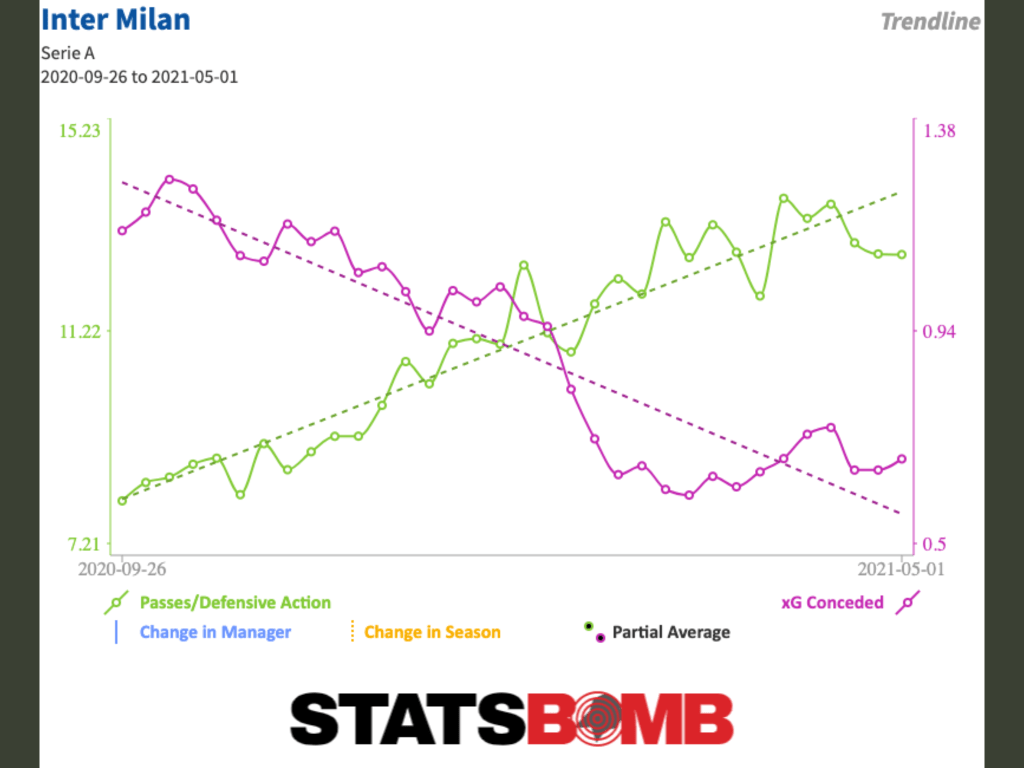
Throughout the 1st half of the season Antonio Conte’s men engaged in a high press,looking to win the the ball higher up the pitch allowing for quick transitions leading to goal scoring opportunities. This was reflected in the side’s passes per defensive action which in the early knockings of the season was at around 8 PPDA. However, throughout this period Conte’s side were conceding a high number of high quality chances which is not recommended for a side hoping to push for a title. As a result, as the image underneath shows, Conte changed his approach with the side becoming less aggressive and as the PPDA increased the sides xG conceded reduced.
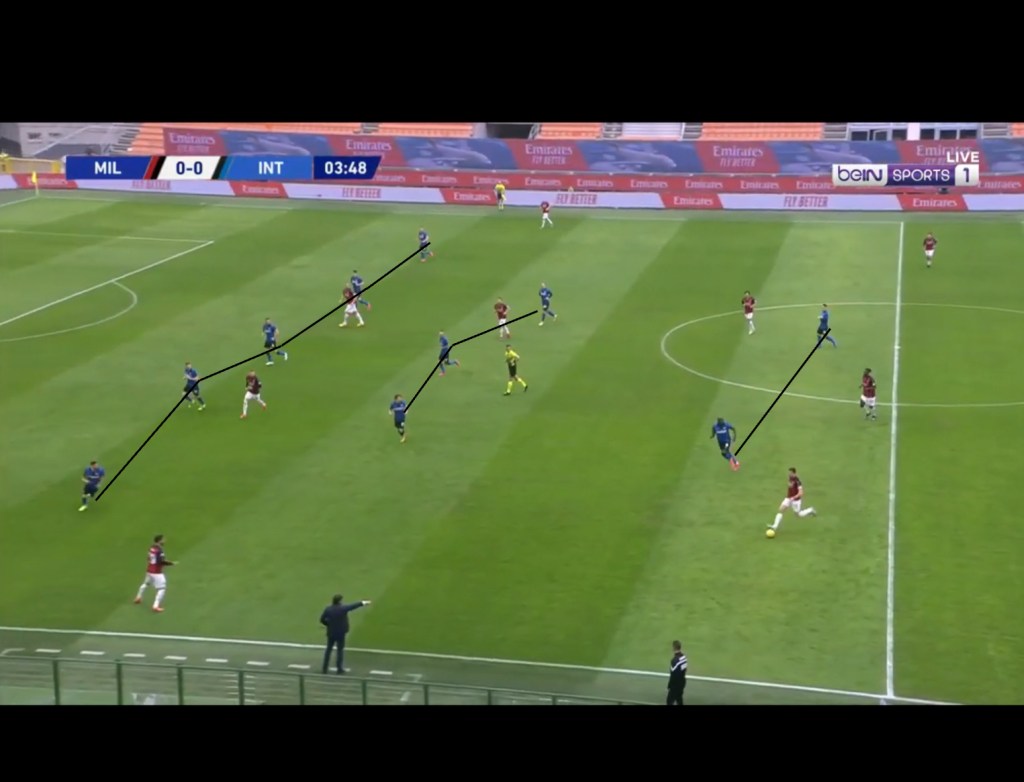
With the Comte’s side becoming less aggressive in a 5-3-2 mid block, there was more of an emphasis on protecting the half spaces and centre of the pitch. The intention of this is clearly to direct the opposition into playing the ball into wider areas, where depending on the state of the game, Inter became more aggressive in their efforts to win back the ball. Inter’s 5-3-2 mid-block can be seen below, with little spaces between the lines keeping the side vertically and horizontally compact, with the midfield 3 protecting the centre and ball near half space. This approach directed Milan out wide, which was a trigger for Achraf Hakimi to apply pressure to the recipient of the pass.
Nevertheless, Inter do not just sit in this shape only looking to win the ball in the channel, they can often force the opposition into making making mistakes through initial pressure from their right and left central midfielders and defenders. As seen in the image below, as Calabria receives the ball Eriksen begins to step out of the 3 man midfield in order to press the right back. Due to Eriksen’s pressure from infield to out and the general structure of the Inter defense, Calabria passes the ball out wide. Usually in situations like these the most central midfielder (Brozovic) would shift across to cover Tonali, the number 8, in order to attempt to intercept the ball or tackle the midfielder once he receives the ball. Brozovic on the other hand keeps his position and shifts to the left in order to protect the centre.
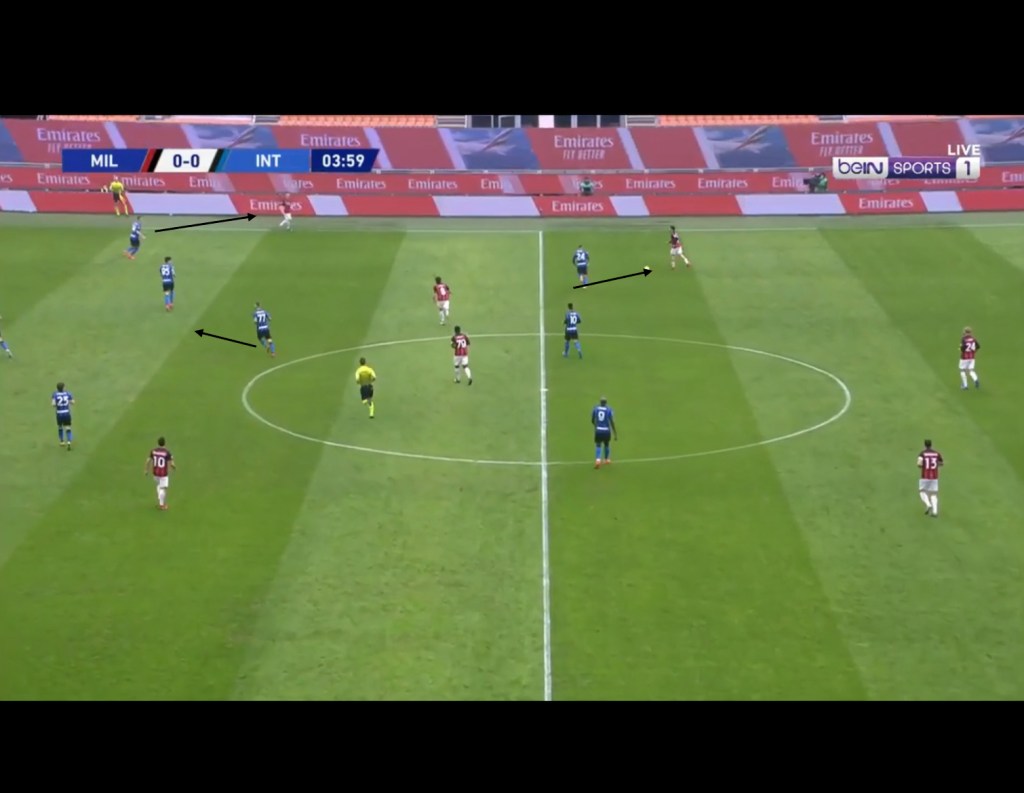
The logical assumption would be that if Brozovic doesn’t shift to cover Tonali then the Italian will have ample space and time to turn. However, in the example down below we see why Brozovic has the liberty of focusing on protecting the centre. In Conte’s Milan Bastoni and Skriniar, the left and right centre backs have been used to close down players in the half space while the remaining 2 midfielders left after Eriksen ,in this instance, pushes forward to press, focus on protecting the centre. With little time on the ball Tonali, like many teams have tried to do this season, attempts to play a ball over the top to Ibra. However, with DeVrij and Skriniar both comfortably above 6 foot, ariel balls are rarely not dealt with. Through this passage of play we can see the benefits of Inter’s defensive system as earlier on, if Brozovic began to move upwards and orient his position to Tonali, Barella would have been forced to shift across and cover the centre alone. This would have reduced control of the centre and ball far half spaces for Conte’s side. By using the centre backs to press individuals in the half space Conte strikes a balance between ball near compactness whilst still covering a fair amount of space across the pitch. Furthermore in the example below it is also to important point out the role of Lautaro Martinez who shifts downward’s in order to prevent passes to kessiè through the use of his cover shadow.

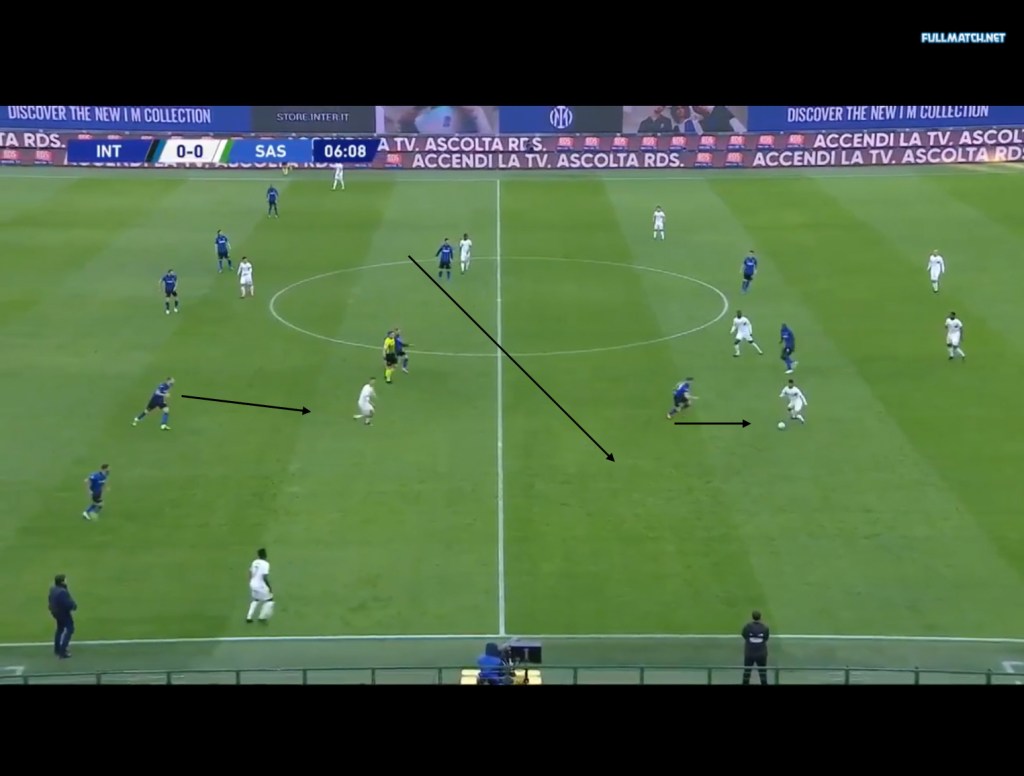
As seen below, in Inter’s game against Sassulo, the same scenario occurs this time, however, this time on the right hand side. The ball played to Rogerio triggers Barella, the right central midfielder, to press the ball carrier and once again we can see that Skriniar begins to orient his positioning to Duricic who began to drop deeper into the half space. As the ball is played out wide, Hakimi begins to press while Eriksen, who in this game was playing in the “Brozovic role”, shifted in order to prevent passes from wide into the half space/centre.
Conclusion
Through almost automatic passages of play in possession, using the positional and qualitative superiority that their structure on the ball facilitates as well as a compact defense focusing on preventing the ball from entering key areas, Inter were able to blow away their competition in the second half of the season. It has been an absolute pleasure to have watched Antonio Conte’s Inter Milan side this recent season. I must admit I am saddened by the recent news of Antonio Conte’s departure. Even though I have only seen the interaction of staff and squad members during the games on TV, I could still feel a strong sense of team spirit and togetherness radiating off of them. The execution of well drilled patterns and principles of play from players such as Bastoni and Hakimi to the transformation of Romelu Lukaku going from a striker who was ridiculed for his first touch to one of the best in the world at holding up the ball. A part of me wonders whether or not this Inter side under Antonio Conte with more resources allowing for a deeper squad could have gone on to win a few more Scudetti or even began to compete in the latter stages of the Champions league again but in the words of Kanye West “I guess we’ll never know”.

 Skmm-ftbl
Leave a comment