The 2020/21 season has seen Arsenal suffer many ups and downs as Mikel Arteta’s side have suffered from the teething problems that can be expected in the infancy of a club rebuild. Although Arsenal at the time of writing have booked their place in the semi final of the Europa league, their performances in the league have meant that Arsenal, with just 7 games to go, are currently 9th. Many fans will attribute this poor league form to the toothless attacking performances in the 1st half of the season and rightly so. But while Arsenal’s attacking performances have improved in the 2nd half of the season, issues with their structure defensively have been prevalent all season.
Fundamentals of pressing and defending
Before continuing any further it is important to highlight the “fundamentals” of defending or the different roles when defending to truly understand where Arsenal’s problems lie.
Pressure
Generally, unless told not to in order to protect a specific area or mark a passing option, the role of the player nearest to the ball is to press the ball carrier. The initial defender’s press may be triggered due to a variety of triggers, such as a poor touch, a backwards pass or if their opponents back is facing their own goal. After the trigger, the pressing player may try to win the ball back outright, delay the opponent, force the opponent backwards or direct the opponent to play the ball into less dangerous areas (the wing), by using his cover shadow to prevent passes into more dangerous ones (the centre).
Covering
The role of covering or supporting the initial defender is very important. I’m sure we’ve all been in or watched a scenario where a striker sprints forward in order to press a defender but is easily played around due to the fact that his teammates didn’t support him as he pressed the ball. This can be tremendously frustrating and in some cases will result in the striker being reluctant to press the ball carrier, as he feels his teammates will not provide cover when he does so. With initial pressure as well as effective support of the initial defender, the process of limiting penetration and winning the ball back becomes much easier.
Compactness and Balance
When talking about pressing and defensive structures, compactness(more specifically ball near compactness vertically and horizontally) and balance are of high importance. This is mainly due to the fact that they directly affect the aforementioned roles mentioned above, as compactness ties into the initial access that a player has when pressing the ball. When a team is compact and has access to the ball the initial defender will be able to press more effectively and his teammates will be able to support him as well. This is due to the fact that the defenders are in close proximity to one another and the shorter distances between these players prevents passes from penetrating the defensive shape more easily and limits passing lanes for the opposition. Ball near compactness ties directly into the balance of a side, as compactness can prevent sides from gaining overloads and other advantages of positional play in certain areas of the pitch. This is why when defending a team will shift their defence left or right, under loading the ball far side; the defending team will be covering less space but have control of more. I went over the importance of compactness and balance when attacking in my article on rest defence(shameless plug, I know).
Arsenals problems
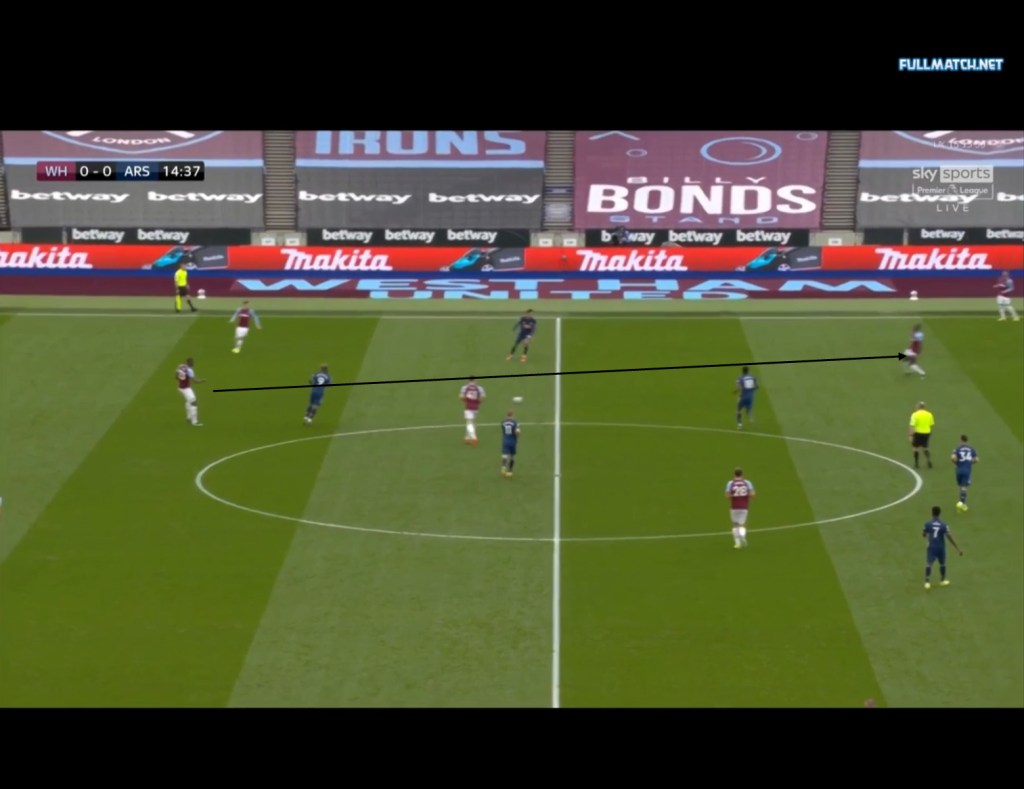
Arsenals main problems this season in their defensive structure have come from the side’s lack of compactness vertically and horizontally, and as mentioned earlier, this directly affects the other roles and fundamentals when defending. The first example of this could be seen in arsenals 3-3 draw against West Ham in which Mikel Arteta’s side pressed in a 4-4-2, a formation which Arsenal have used more often recently. West ham during build up played with a 4-1-2-3, with Rice either occasionally dropping between the CBs or operating as a single pivot, while Soucek would remain in central midfield, with Jesse Lingard occasionally dropping deeper from his attacking midfield position. As seen below, there is so much space between Arsenal’s 1st and 2nd defensive line an Evergeen container ship could fit between them, as Odegaard and Lacazette push higher up the pitch to press, but Arsenal’s 2nd line of defence did not follow suit.
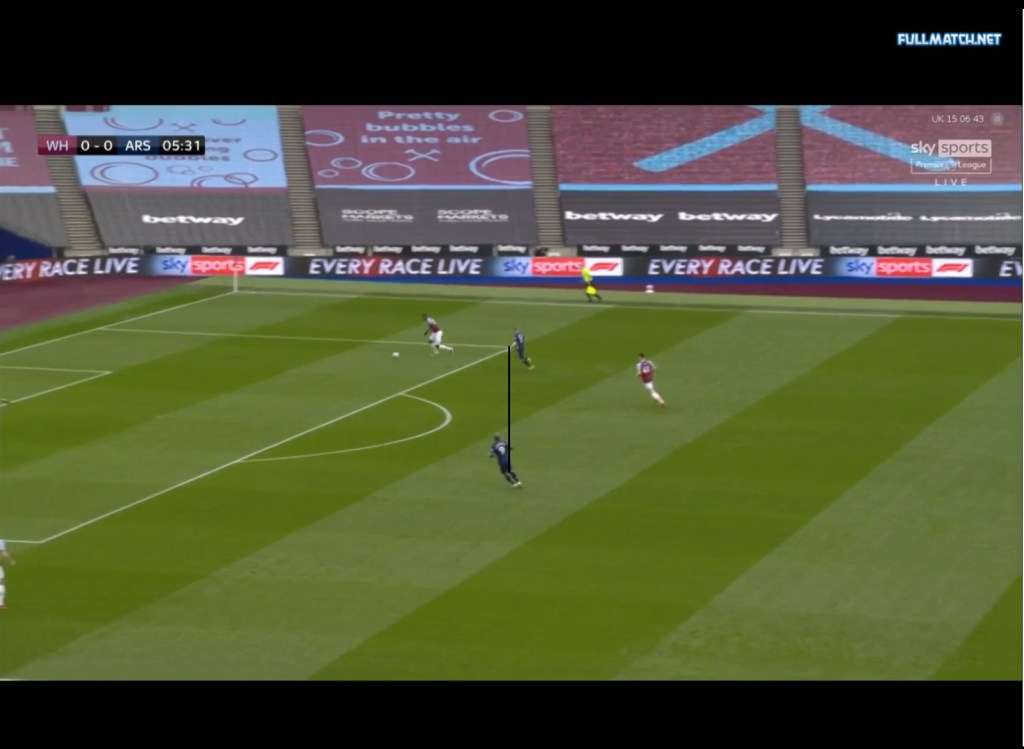
A few seconds later we can see how Aubameyang joins the front 2 but he is the only member of the 2nd line to do so and a clever pass by Cresswell between Odegaard and Aubameyang meant Rice had acres of space to run into. There were several mistakes in Arsenal’s approach, with the first one being the fact that the 2nd line didn’t push up to support and cover the front. This led to the creation of the gap between the lines and thus reduced the 2nd lines access to the ball carrier. The next mistake came from The fact that Partey decided to orient himself towards Benrahma on the left wing, even though Aubameyang’s cover shadow would have prevented a pass to the Algerian, and this gave rice even more space to run into when he received the ball. Although, in Partey’s defence it can be argued that had Chambers, the RB, marked Benrahma the Ghanaian may have pushed forwards and provided cover.

The next example below comes from the same game, this time in a high midfield press and is very similar to the first. Arsenal’s front 2 advance further up the pitch but once again the 2nd line does not push up to reduce space between the lines and improve access to Declan Rice in the pivot position. Odegaard can be seen pointing at Rice stressing the need for support from the 2nd line and due to the lack of support, Rice had time to take a touch turn take another touch and progress the ball.
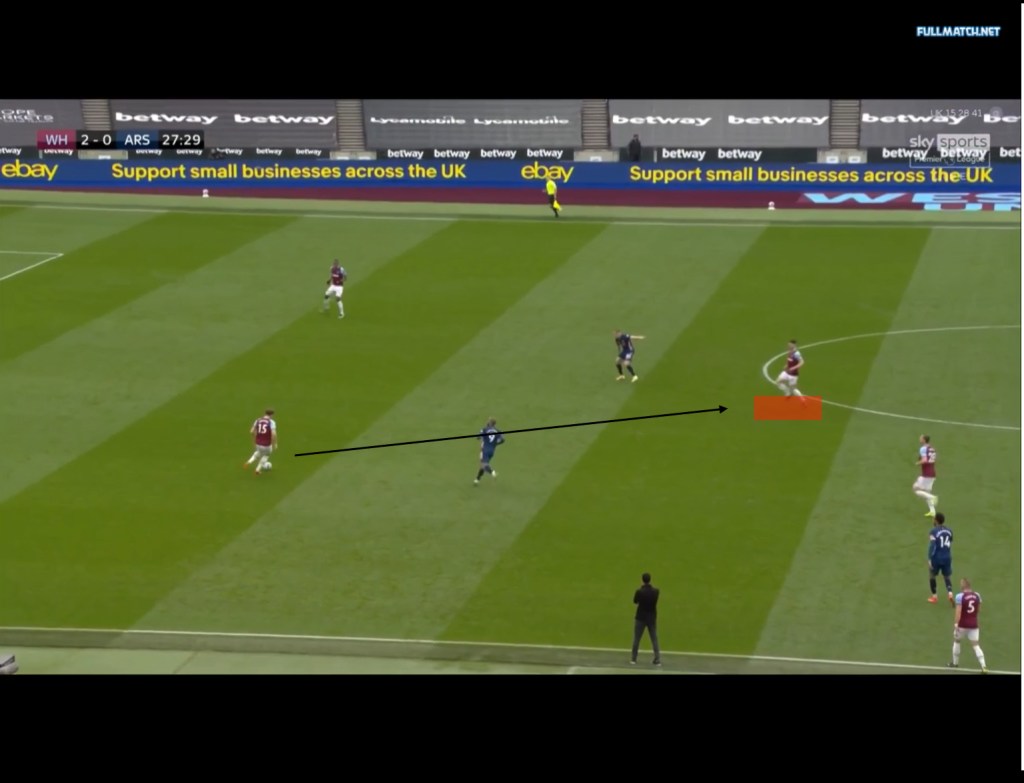
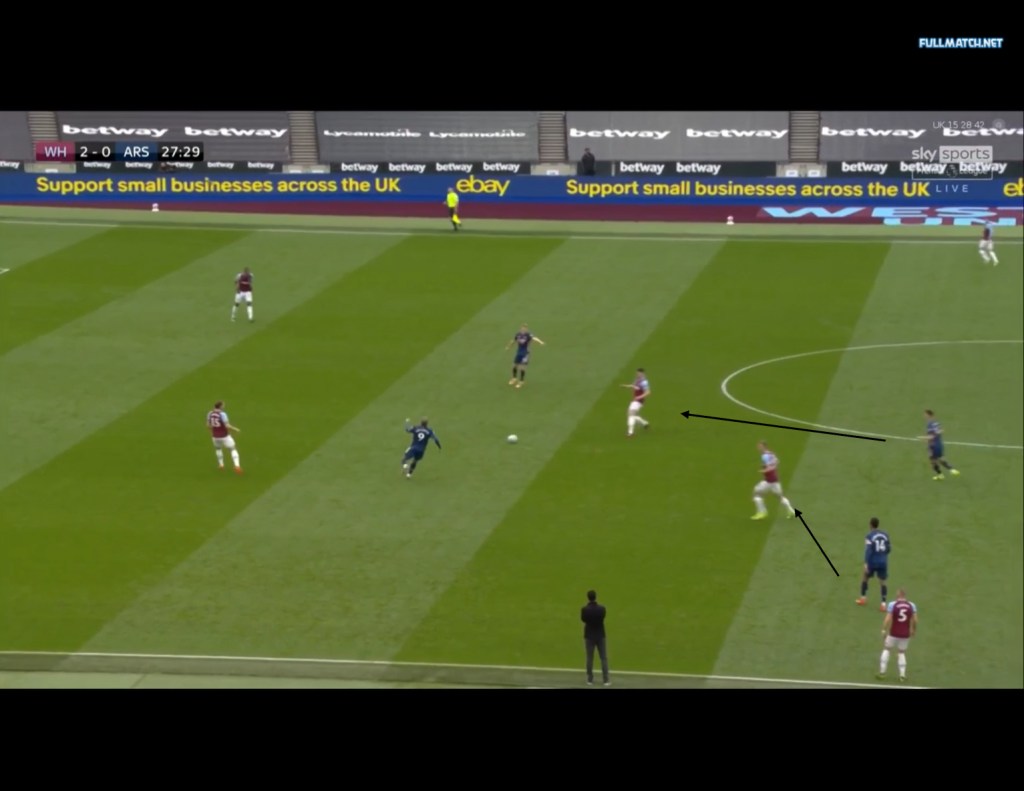
In this instance, progression of the ball through Rice could have been avoided in a number of ways such as better shifting from Arsenal’s second line. This would have enabled them to advance forward and support the front 2, with Aubameyang moving to his right, covering Soucek, allowing Xhaka to advance and press Rice from behind when he received the ball. Xhaka also oriented his positioning towards Soucek when the Czech was already covered by Lacazette’s cover shadow, meaning he could have pushed forward and pressed Rice. Another solution, would have been for Odegaard to orient his position towards rice, whilst Lacazette pressed Dawson. This would mean if Dawson played a pass back to Diop, Lacazette would then cover Rice in the pivot, whilst Odegaard pressed Diop as the rest of the defensive structure advanced forward.
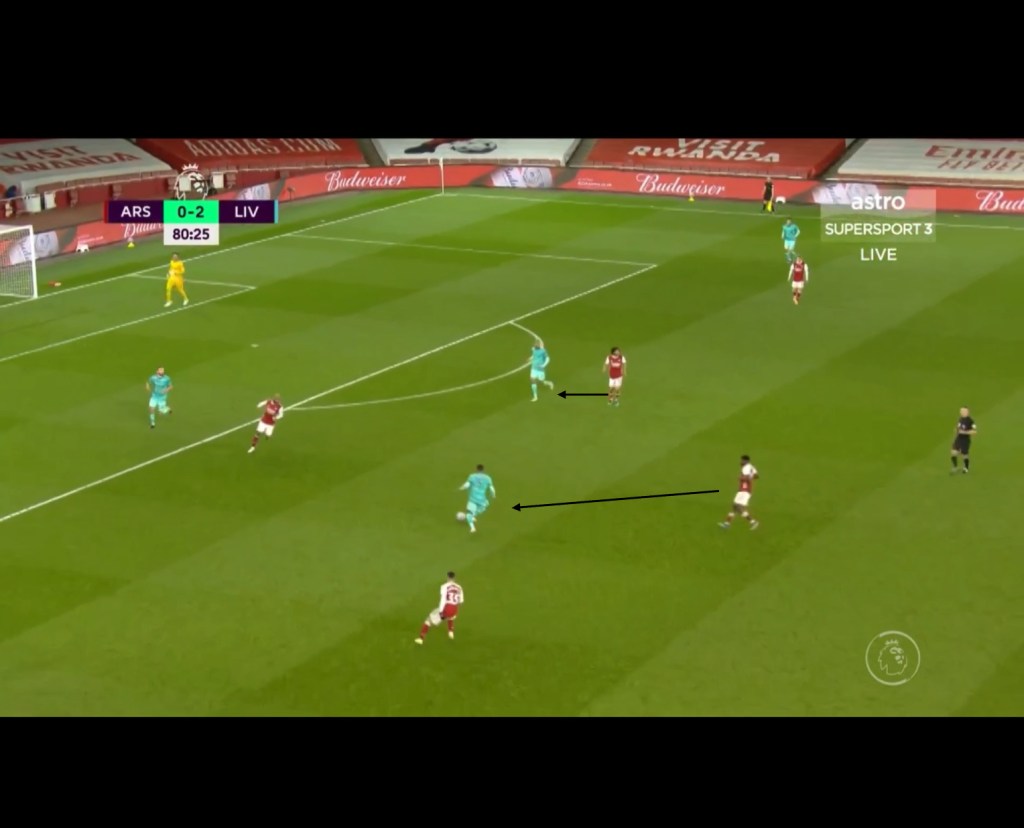
The situations described above have occurred often this season even in higher areas of the pitch as Mikel Arteta’s men don’t respond to common triggers consistently. Below is an example from the gunners recent loss to Liverpool, where Wijnaldum receives the ball with his back to goal and is given time to take a touch turn and pass, with Partey placing him under no pressure whatsoever. However, moments before, Elneney pressed Fabinho, who received the ball in the same manner as Wijnaldum.
Arsenal’s PPDA(passes per defensive action) at the turn of the year was just above 12.00 ranking them 14th in the premier league. This metric measures the intensity in which sides try to regain possession, lower PPDA’s indicating an aggressive pressing side as they allow fewer passes between each defensive action. If a side is less aggressive, it may be due to the fact that they aim to protect dangerous areas such as the half spaces and the centre. However, for Arsenal this is not the case.
Poor defending Of the half space.
Arsenal for the majority of the second half of the season have pressed using a 4-4-2. The formation has a lack of coverage due to only having 2 central midfielders. This means in order to defend dangerous areas of the pitch such as the centre, the defensive unit will need to shift with the ball, staying in close proximity with one another. This allows them to cover dangerous areas and be near enough to to provide cover for their teammate when pressing. Arsenals failure to defend these areas could be seen again in the Liverpool and West Ham game.
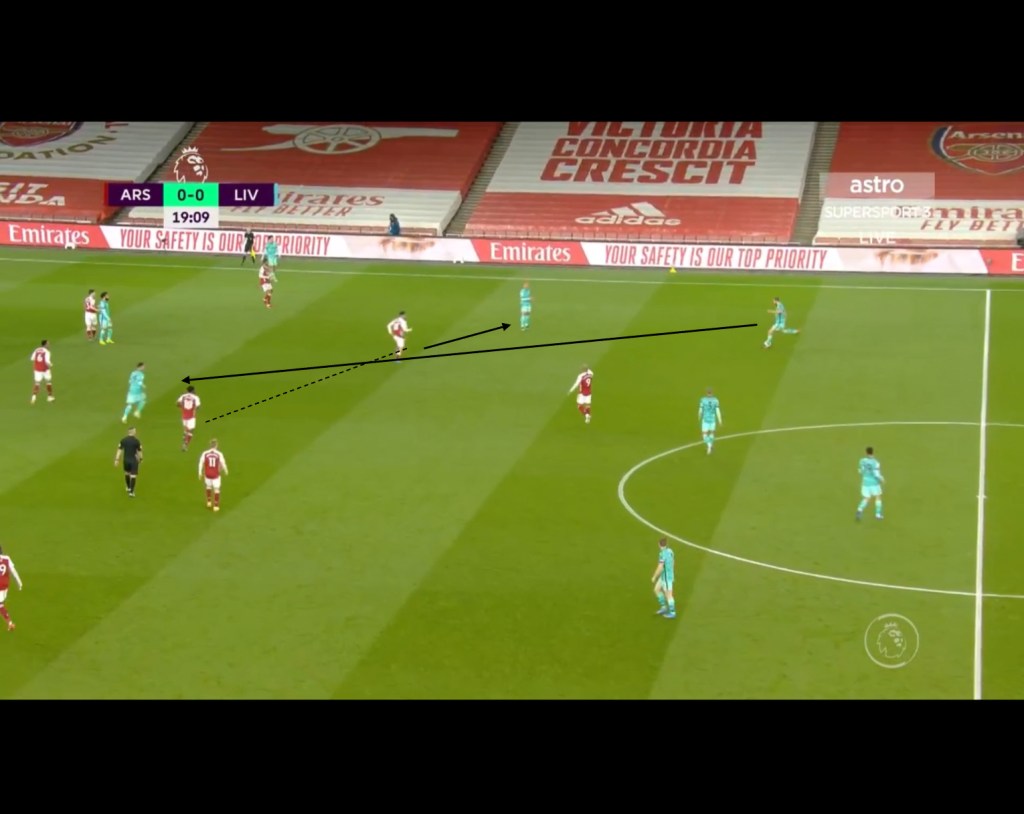
Arsenal’s problems in these games stem from poor shifting in the midfield as well as Aubameyang’s orientation towards the opposition full back. This results in a lack of horizontal compactness, leaving space either between the winger and the central midfielder or both midfielders. This can be seen below as Alexander-Arnold drops into the defensive line, Aubameyang pushes forward. But as we can see from the picture, this orientation towards the full back leaves a space between Ceballos and Aubameyang that can be exploited and bypass the 1st and 2nd line of Arsenal’s press.
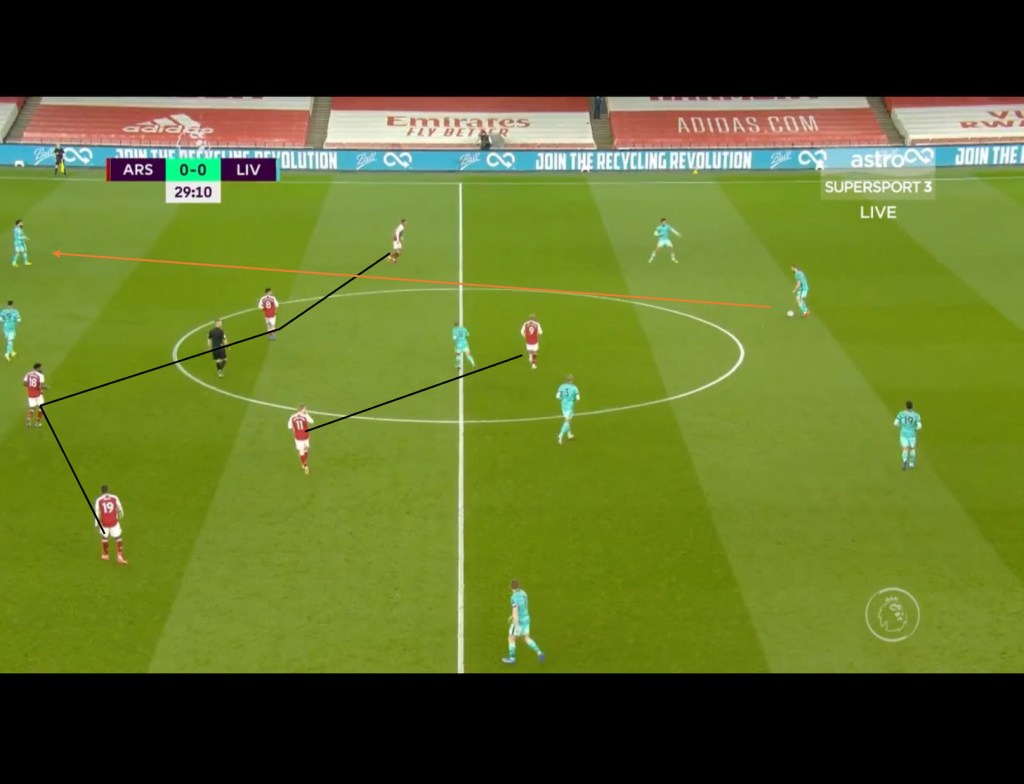
In the example below we can see how Aubameyang’s orientation towards the RB opens up a passing lane in the half space. Thiago from this position could then lay a pass of to Alexander-Arnold on the wing who was then able to create a quality chance for the reds.
Arsenal also had this problem against West Ham and it actually led to the opening goal. Cresswell dropped into the defensive line and Aubameyang began to orient himself to Cresswell’s position and as a result left a gap for Michail Antonio to receive the ball in the half space, seconds before the striker would set up Lingard. Arsenal’s wingers do consistently press full backs and adjust their position in accordance to the Full backs. However, in a 4-4-2, sometimes this is ill advised, as by pressing or adjusting ones position in preparation to press the full back, the half space can be left unprotected.
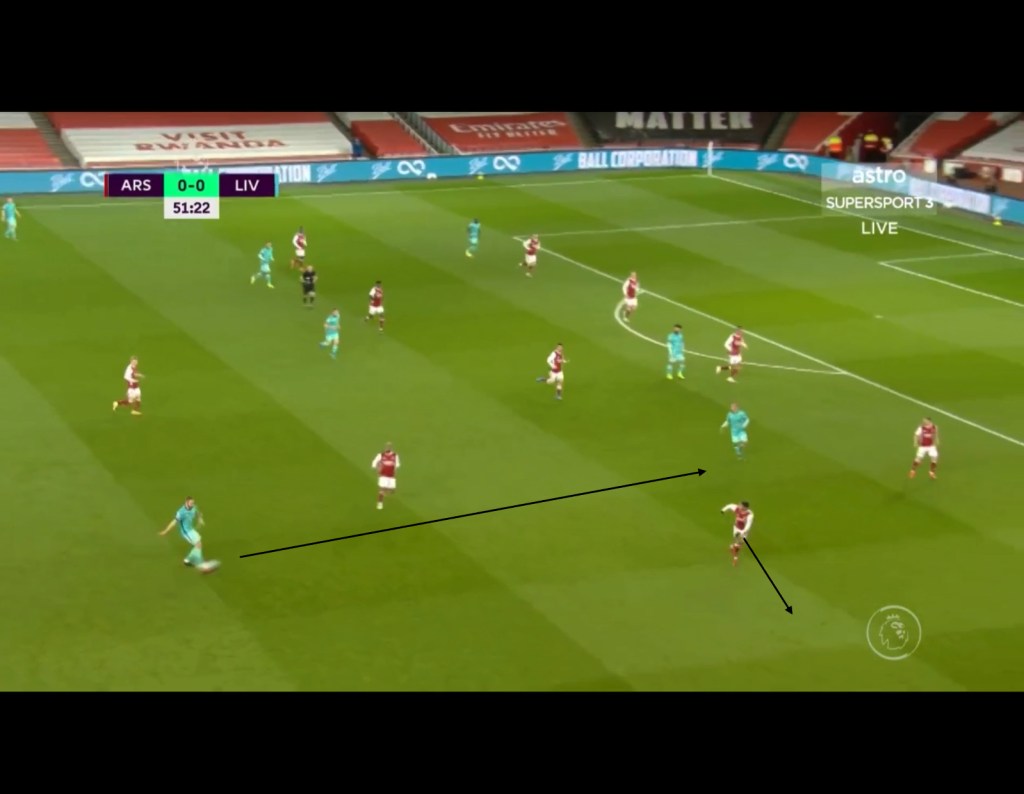
Liverpool exploited Aubameyang’s orientation to the full-back and the 2nd lines shifting to play balls into the half space. They did this through Roberto Firminio dropping deeper with Thiago shifting out wide as Trent would keep the width and occasionally advance forward. This manipulated the positioning of Dani Ceballos as whenever Thiago was in possession, Ceballos would press his compatriot. This combined with poor shifting from Partey created space for Firminio to receive the ball in the half space due to Arsenal’s lack of horizontal compactness.An example of this can be seen below.
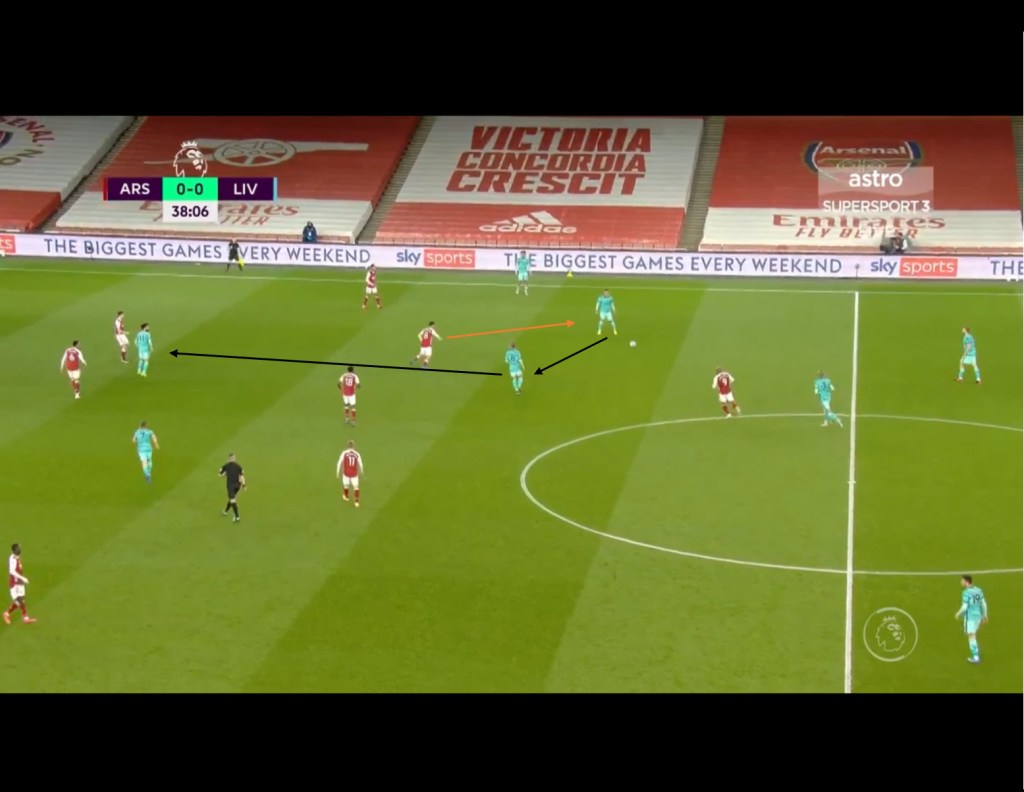
Underneath we can see another example, although this time Thiago and Firminio have rotated positions, with Firminio this time manipulating Ceballos’ position. We can see Ceballos pressing Firminio and pointing to Thiago indicating the need for support from his midfield partner. However, due to the distance between Thiago and Partey, Partey could not press the Spaniard, who had time to take a touch turn and exploit the gap between the two midfielders, taking advantage of the lack of compactness.
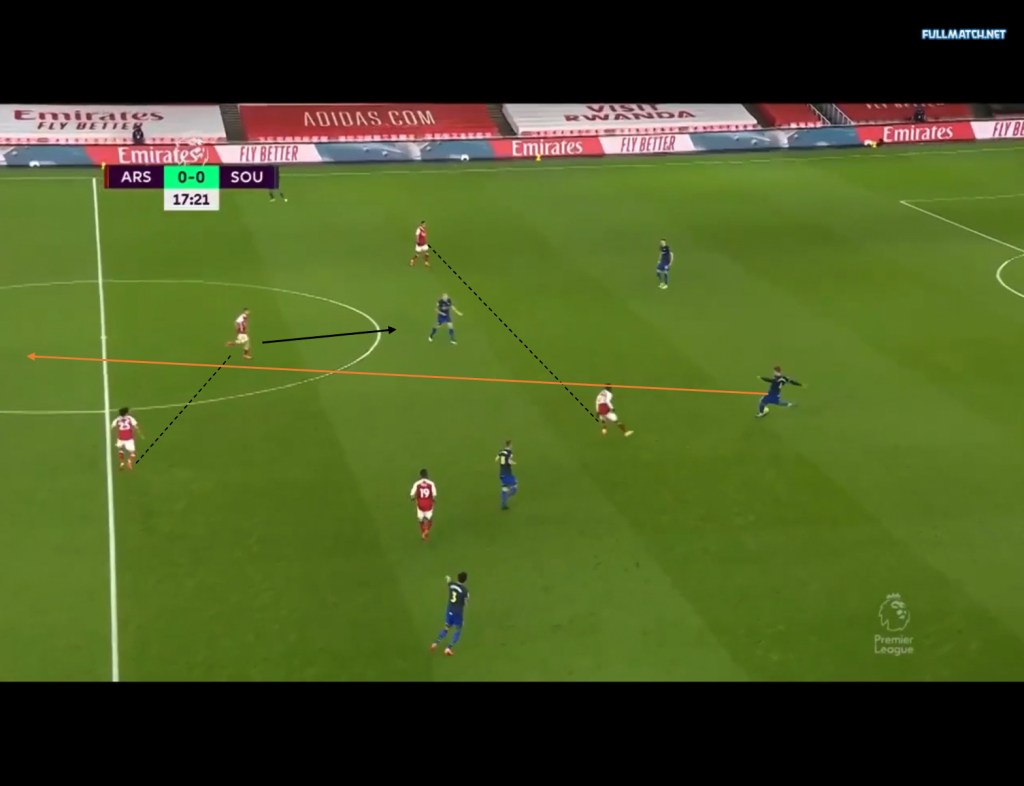
These issues of a lack of access to the ball hindering the press and failure to defend the half spaces are not symptoms of the 4-4-2 system. The same problems could bee seen when Arsenal played Southampton over the festive period, setting up with a 5-3-2 formation in defence. Theoretically the 5-3-2 should allow for better cover centrally and in the half space, giving up space on the wings. However, Arsenal experienced the same problems as they did against Liverpool and West Ham and many other teams during the course of the season. As seen in the image below, Arsenal’s 2nd line has shifted well, however, the front two of Nketiah and Aubameyang have not and are still on the opposite side of the pitch. Ceballos can be seen pointing towards Romeu as the Saints midfielder was unmarked.
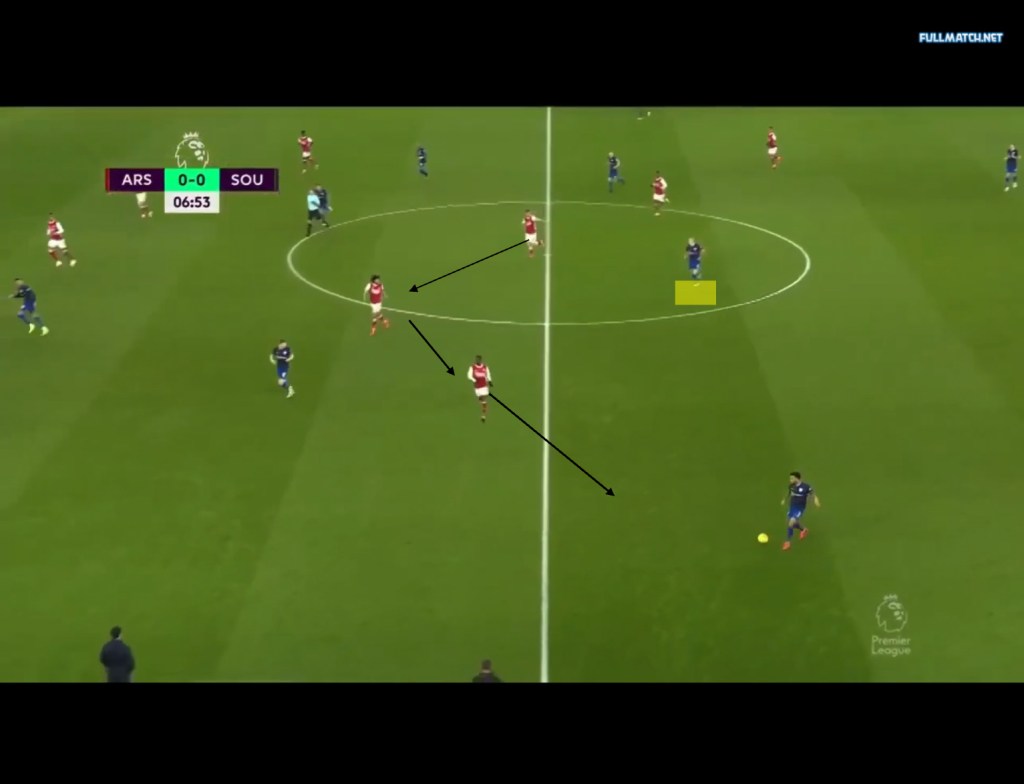
As a result of this, when Bertrand passed the ball to Romeu, Elneney was forced to press him due to the fact that Nketiah and Aubameyang had not shifted fast enough. As a result space opened up either side of Ceballos with Walcott and Ings overloading him laterally. Aubameyang may have been able to prevent Ward-Prowse taking a touch and turning but he didn’t shift inwards, and this resulted in creating a large gap between the front 2.
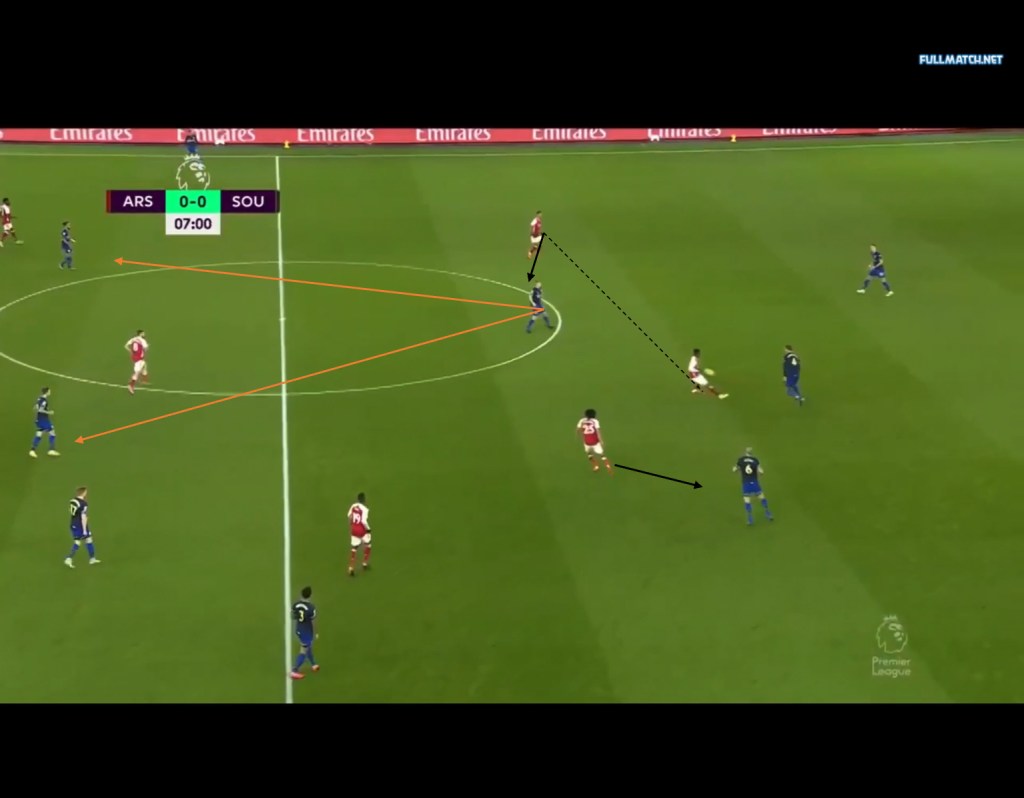
Aubameyang’s widened position meant Arsenal’s central midfielders had to press Southampton’s midfield pairing, creating gaps in the centre. This could be seen in the Southampton’s first goal, as Ceballos orients his position towards Romeu, thus increasing the gap between him and Elneney. This allowed Vestegaard to play a pass into Che Adams who would then play a pass to Walcott for the first goal of the game.
Conclusion
Throughout the examples, the symbiotic nature between some of the principles of defence can be clearly seen. A lack of compactness and balance, will give the opposition plenty of gaps to exploit, and because the players are not in close proximity to one another, pressing and covering become very difficult. As an Arsenal fan, the problems in Arsenal s defensive structure and the teams lack of aggression have been frustrating to watch this season. Despite some of the issues in some of Arsenal’s games this season, the side still has conceded 35 goals in the league at the time of writing, which isn’t terrible. We will have to wait and see if there are any signs that a better defence can be built with a much more functional defensive structure.
Feature photo credit: Arsenal.com


 Skmm-ftbl
Leave a comment