Progressing the ball through a man oriented zonal marking system
What is zonal marking
Zonal marking systems came to the forefront of football in the 90s where Arrigo Sacchi’s AC Milan dominated Italy and Europe for a brief period with there dynamic and revolutionary way of marking. Sacchi has famously stated that when marking AC Milan “players had four reference points: the ball, the space, the opponent and his own teammates. Every movement had to happen in relation to these reference points. Each player had to decide which of these reference points should determine his movements”. Over the years this has blossomed into a number of variations such as positional zonal marking marking systems(which I have written an article about), space oriented marking and the focus of today’s article man oriented zonal marking.
What exactly is man oriented zonal marking
Man oriented zonal marking systems see teams use the distance from their opponent and the space around them as their reference point which sees them move flexibly in order to cover the space around them. Further explanation can be provided best by an article written by Rene Maric which gave an illustration of a man oriented system in practice:
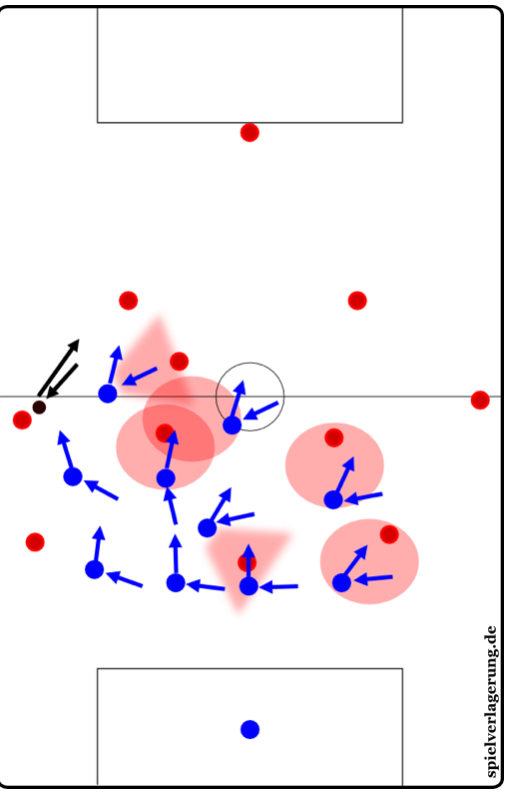
“The opposing right-back receives the ball, so our team shifts to the left. It is striking that our sixes behave differently: one is based on the opponent’s right eight, one on their center forward. Our striker is also man-oriented, however not in the classic sense, but in space: he cuts off the passing lane for the opposing six, who is playing behind the other eight.
Alternatively, our other six could have oriented to the opposing left-half eight and the winger would have remained in space. So all the pass routes and options are blocked directly (by cover shadows or even situational man coverages) or indirectly (through access and narrowness).
The opposing full-back does not risk the line pass, but plays back. Our team therefore pushes out. The striker separates from the space around his opponent and begins to press. The far winger pushes out and, until the opposing center back handles the ball and continues playing, our winger is again near the opponent’s left-back. Our left six runs past the opposing right eight and is now “suddenly” oriented on the six of the opposing team.
In a way, one could say that man-oriented zonal marking, in contrast to position-oriented zonal marking, does not wait for access and pressing, but seeks it. The difference to man-marking is that the opponent will not be tracked or handed over to another teammate, but left to stand in space, and one can reorient themselves at any time. Furthermore, one does not focus on the opponent, but the action space and the access distance”.
Progressing the ball through a man oriented system.
For the sake of the article, we’ll assume that the opposing team is defending in a 4-4-2 system and we’re using a 3-4-3; Using the 3-4-3 we will aim to create positional, numerical and qualitative superiorities, which will help create spaces and exploit them through vertical and diagonal passes as well as third man runs aiding progression. (The creation of the superiorities is one of the many components of positional play which Adin Osmanbasic has written a detailed article about
https://spielverlagerung.com/2014/12/25/juego-de-posicion-under-pep-guardiola/). First it is important to distinguish the differences between the superiorities we are trying to create.
Qualitative superiority.
Usually teams aim to create a 1v1 situation where your players attacking ability is clearly superior to the defensive abilities of the opposing player, so for example imagine Lionel Messi vs Kolasinac on the right wing. However this does not always need to to be a winger vs a full back or involve dribbling at all, qualitative superiority can be achieved through physical abilities such as height strength and speed as well.
Numerical superiority
This involves teams positioning themselves in certain areas of the pitch to create a numerical advantage where there will be more players in a certain area aiding the attack, than defenders. This allows for quick combinations and can help to create space. Numerical superiority is more commonly referred to as an overload.
Positional superiority
Positional superiority is tricky to spot as it is much more subtle than the others but obviously entails that one team is or wants to aim to take up better positions than the other. This, however , depends on the context of the attack and example of a certain scenario is given by Tobias Hahn who stated in his article on the positional play of Dynamo Dresden that “On an individual level, one could imagine the following scene. The team in possession has the ball on the left side, trying to cross it into the box. While the defender has to observe the ball and his opponent constantly, the striker can create a positional advantage by moving on the blind side of the defender, forcing him to either watch the ball or follow his movement. Consequently, once the cross arrives in the box, the striker is in the more advantageous position because he can see his opponent and the ball simultaneously”. (Full article: https://thefalsefullback.de/2019/09/21/dynamo-dresden-analysis-positional-play/)
Using the 3-4-3
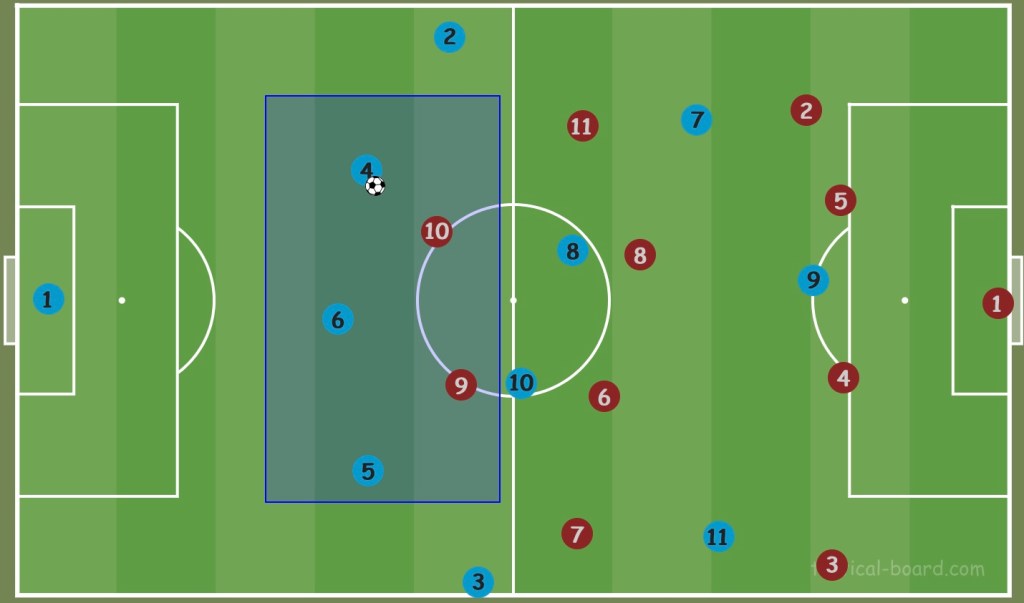
The first thing to do in order to maximize the chance of ball progressing is to use numerical superiority in the build up and since the opposition is defending with a 2 man front line, playing with a 3 centre backs will help bypass the first line of pressure. That being said, it is not impossible to progress the ball without numerical superiority as Tim Walter’s Stuttgart in 2019 as well as Glawogger’s 19/20 U19 Holstein Kiel have clearly shown, however that is an article for another day. Nevertheless, using 3 CBS in the build up won’t just automatically result in the progressing the ball, as seen in the picture above. The opposition 8 and 6 will be able to apply direct pressure from behind whenever our midfielders receive the ball most likely resulting in them just passing the ball back and the opposition 11 is blocking the pass to our winger in the half space and if the ball is passed to our LB he would orient his pressing to our LB and still maintain his cover shadow. In order to bypass the opposition pressure the CBs can circulate the ball quickly and make the use of third man runs which is also highlighted in Tobias Hahn’s article.
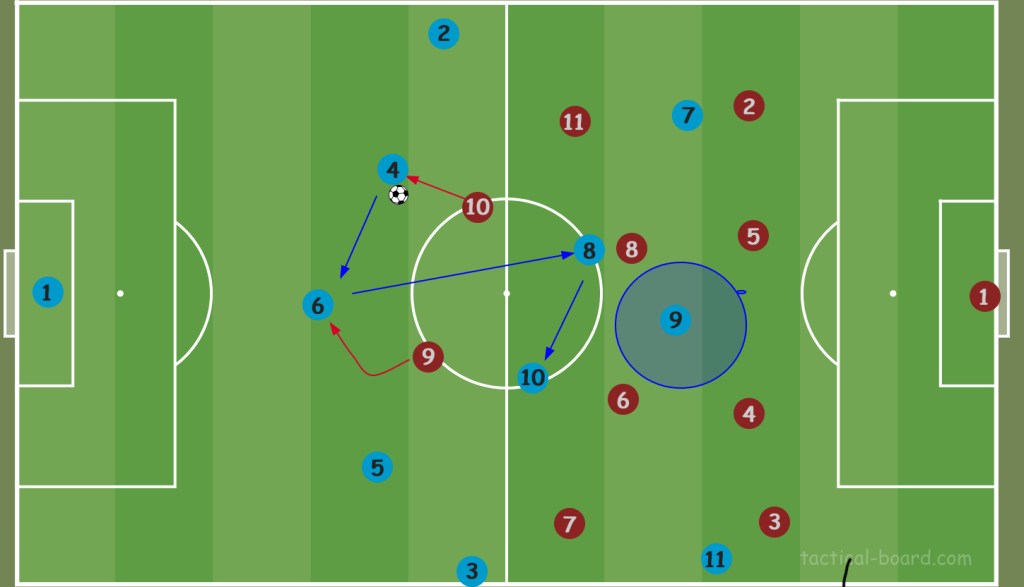
In the example above the no.4 is pressed by the opposition striker and plays the ball quickly to the 6 as the opposition striker blocks the pass to the midfield 8, but this is where the benefit of the back 3 comes in as after the ball is passed to our no.6 the left opposition striker will begin to press him and curve his run slightly to prevent an easy pass to our RCB who could drive the ball forward and help create a 3v2 on the wing. Because of this the previously covered pass to our 8 is now free, who can play a pass to our 10, the third man; due to this, the opposition 6 is left with a difficult decision to make, if he decides to press our 10 and he’s late in doing so he leaves space open for our 9 but if he remains where he is he gives our 10 time and space to dribble or pass. In order for this to work, it is imperative that the CBs and the midfield circulate the ball quickly, if this is done the first line of pressure can easily be played through and potentially the second as well.
Using overloads in wide areas.
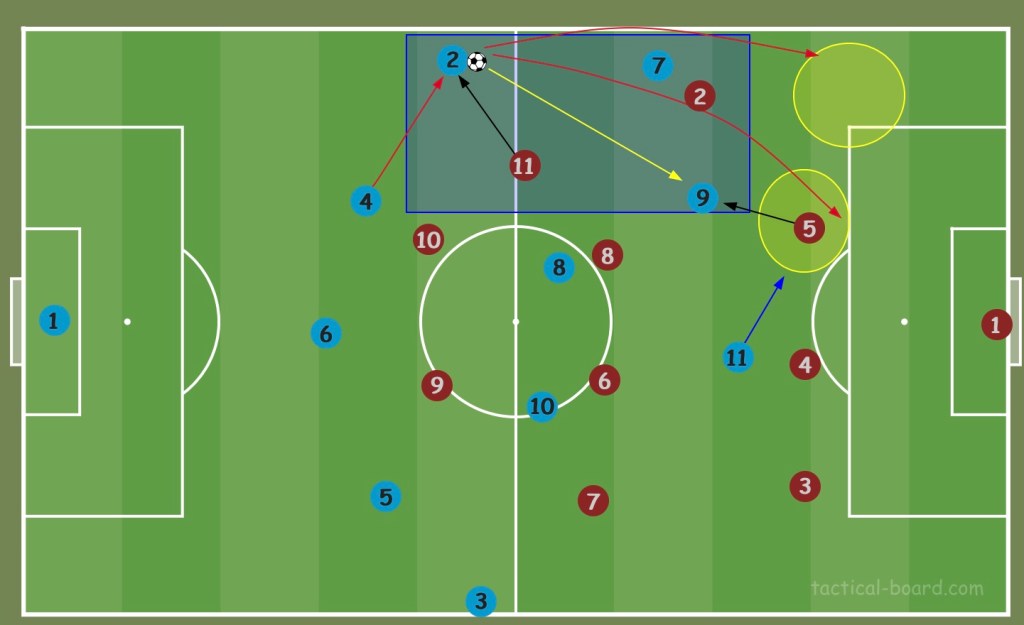
In the situation above there is a possibility that all superiorities can be achieved as the LCB plays the ball to our wing back which causes the opposition to shift to their right and the opposition 11 to press or LWB. Our 7 who was originally operating in the half space moves out wide which draws the opposition RB towards him as the right back wants to reduce the distance between him and our 7 so that he can effectively press him if he receives the ball. Our 9 moves into the half space that was previously occupied by our 7, this creates a 3v2 overload on the wing, which gives our LWB two options: if our winger is significantly faster(qualitative superiority) than the opposition RB our 2 can play a ball over the top into the space that has been somewhat vacated by the opposition RB as he attempts to reduce the access distance between him and our winger. Our 2 could also play a pass to our 9, who is free in the half space, if the opposition centre back does not press him, the numerical superiority can further be exploited, as there will be a 2v1 situation with our winger and striker vs their RB which can result in a crossing opportunity. in this scenario, one of the opposition players is once again forced to make a choice. If the opposition CB steps up to press our 9 before he receives the ball, which is a very likely option, the numerical superiority will be lost as there will now be a 3v3 in the area, however, there is an opportunity for positional superiority to be achieved. If the CB steps out to press our 9 our right winger can make a run into the vacant space and be found with a long ball into this area, which could result in a shooting opportunity and if the CB decides to stay there could be a 2v1 on the wing or our 9 could drive forward and attempt to dribble past the 5.
Increasing width
Through increasing the horizontal distance between the back 3, the front two will have a larger distance to cover in order to press our defenders ,However, this does mean ball circulation has to be fast and extremely accurate as by increasing the distance between our players the distance the ball has to travel also increases, this is what makes this approach somewhat risky, But like anything, if it is done well it will yield great results.
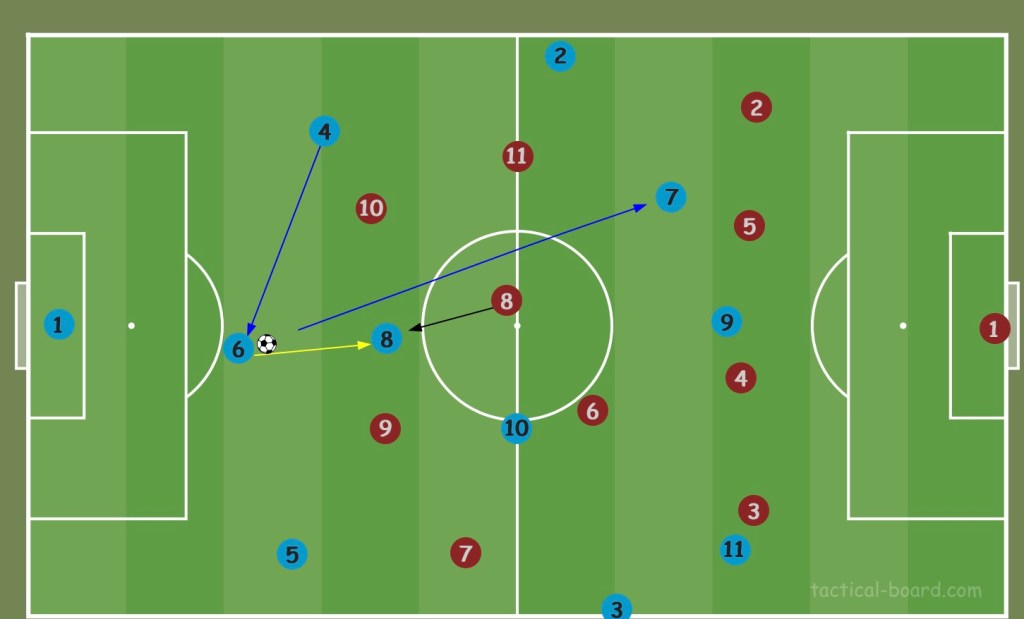
After the opposition number 10 applies pressure to our LCB, he would pass the ball to our 6 but now, with the increased distance between the centre backs, the opposition 10 would not be able to easily begin to press our 6 . During the course of the pass our 8 would drop in the space between the 2 strikers, forcing the opposition 8 into making a choice; if he does not press our 8 he gives an opportunity for our 8 to receive the ball on the half turn and easily beat the first line of pressure but if he does press and the opposition 11 does not shift across to his left, our 6 could play a diagonal ball to our 7 in the half space. The opposition 9 in this situation could shift and press our 8 but it would lead to an easy pass to our 5 who could drive with the ball into space.
There may be a situation where the opposition 8 decides to press and the 11 does shift across preventing central progression and pushing us to the right wing.
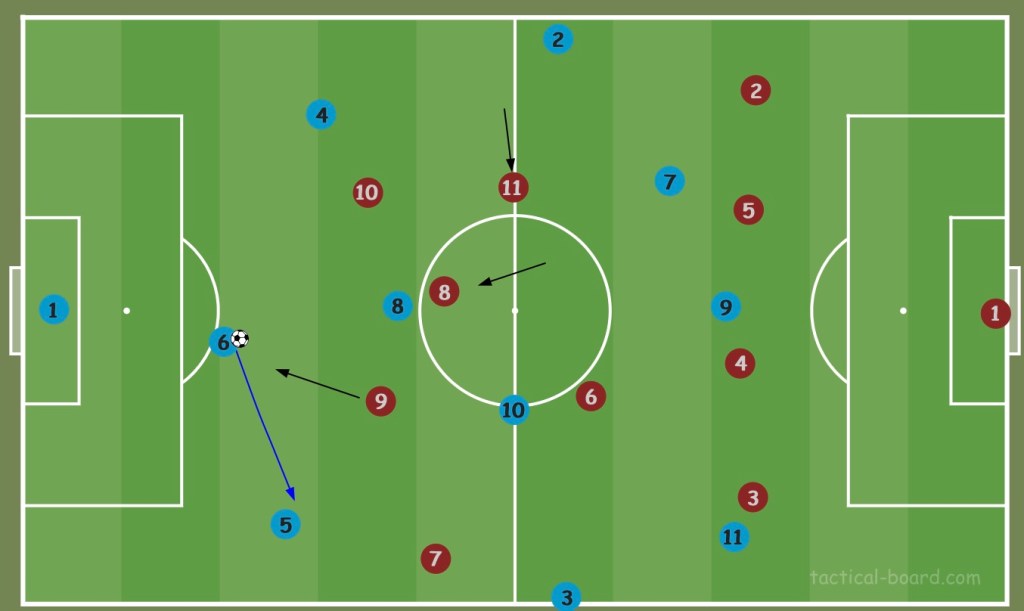
The pressure from their 8 and their 11 shifting inwards as well as the opposition 9 applying some pressure would result in our 6 playing a pass to our RCB.
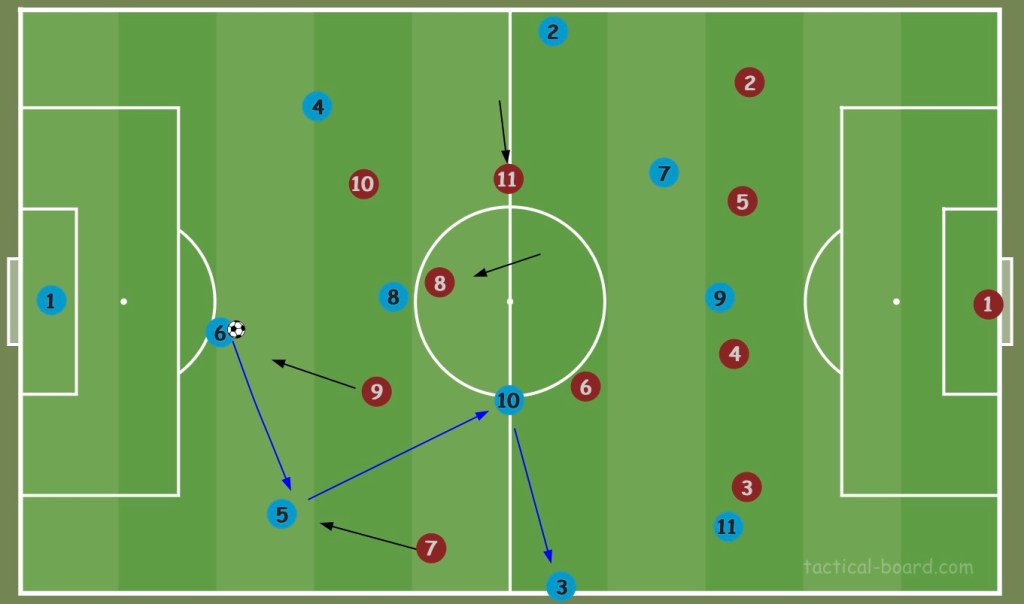
But as their 7 applies pressure to or RCB, he can play a quick pass to our 10 who can play a one touch pass to the 3 who can drive forwards and potentially create a 2v1 on the wing.
Conclusion
Overall there are still many ways in which the ball can be progressed through a man oriented marking system using a 3-4-3 formation or any formation. Ideally for possession based sides progression would occur through the creation of space as a result of moving the opposition around and this for some is done through creating superiorities across the pitch, giving ones team the advantage from their own box, to the oppositions.





 Skmm-ftbl
Leave a comment