During the early years of association football up until the 1990s, man marking was the dominant defensive system used throughout European football as it provided a simple and effective way to nullify the attack of the opposition. However, as time progressed, the deficiencies of man marking began to be increasingly obvious due to the fact that when one player in the attacking team moved away from their positions they dragged their defender with them, creating space for other members of their team to exploit. Eventually, more teams progressed from man marking to zonal man marking and finally to zonal marking.One of the “pioneers” of the zonal marking system, was none other than Arrigo Sacchi, who broke away from the typical Italian style of Catenaccio and implemented an innovative style of defense and attack that resulted in AC Milan’s domination in Italy and across Europe for a number of years. Defensively, Sacchi’s team had four reference points, the ball, the space, the opponent and their team mates, every one of their movements revolved around these points.
Zonal marking systems aim to defend space rather than man marking a specific player and sees teams move collectively from one side of the pitch to the other as they aim to retain vertical and horizontal compactness and this has resulted in many variations of zonal marking such as man orientated positional, space and option orientated zonal marking. Even though zonal marking has become the main defensive system used by teams, like any other system there are still weaknesses that can be exploited and can allow for ball progression. In this article I will be focusing on how to take advantage of the weaknesses in positional oriented marking, allow for progression of the ball to take place but first it would be important to explain the aims of a positional zonal marking system.
positional oriented zonal marking
The goal of position oriented marking sees teams aim to keep horizontal and vertical compactness as they sit in 3 clearly defined banks of midfield defense and attack moving as a collective unit, from one side of the pitch to the other in an attempt to close down space, especially on the wings. This system is usually used by Favre with a very recent example being the Dortmund and PSG game in Paris and was Regularly used by Sampaoli’s sampdoria as well as Antonio Conte. René Marić discussed in his article on zonal marking/zonal coverage how position oriented zonal marking would work in a game, stating
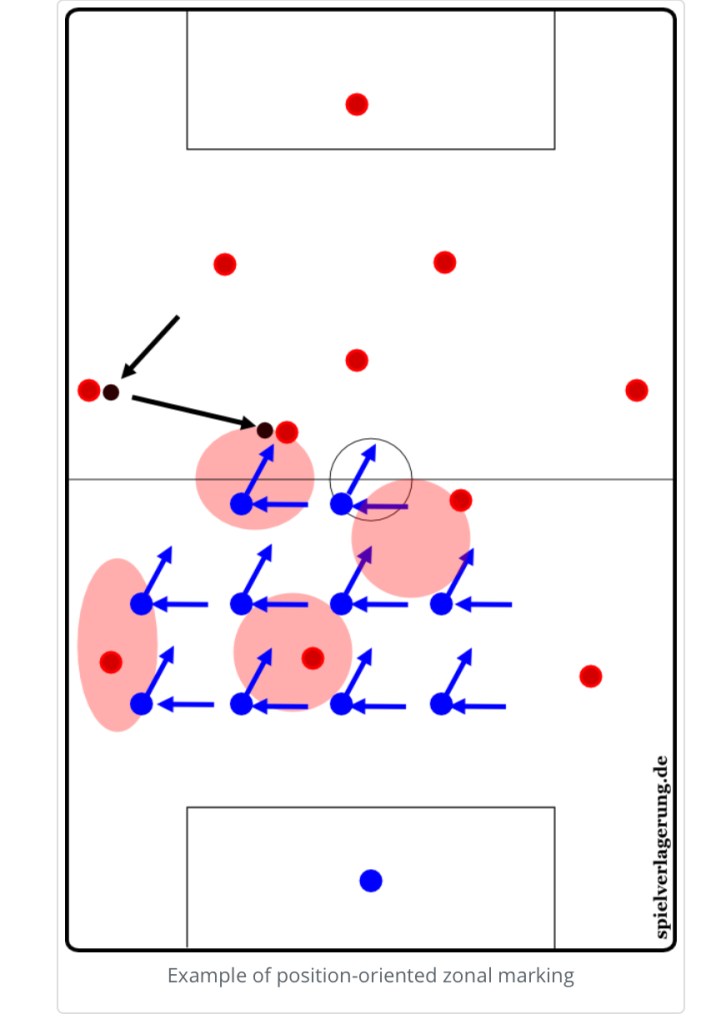
“The opponent builds play on their right side, with what seems to be a 4-1-2-3 as a variation of the 4-3-3 with wide wingers. For illustrative reasons, we (blue team) are standing in an ultra-defensive formation.
The opponent plays to the right and the team moves as a group to that side of the pitch. The space that appeared to be open on the side for the winger is suddenly very tight and can not be safely played. The ball goes into the center and our (semi) left striker gets access and moves to press. The team follows his example and take the same running paths.
The opponent is approached slowly and step by step, which sometimes seems a bit laid-back. Despite the passivity and reduced access, however, the block remains stable and compact. Passes into the space between the lines are difficult and can be compressed by narrowing the team’s spacing.” – from zonal marking/zonal coverage article by Rene Maric Spielverlagerung.com
Ways to exploit the zonal system:
Vertical build up play and use of the half space.
In some instances where a positional marking system is too “flat”, passing into the half spaces can be used to penetrate the defensive block created by the positional zonal marking system as it gives the receiver the chance to play diagonal passes to the striker, to the wings, facilitating a cross or to play a pass in behind the defence.
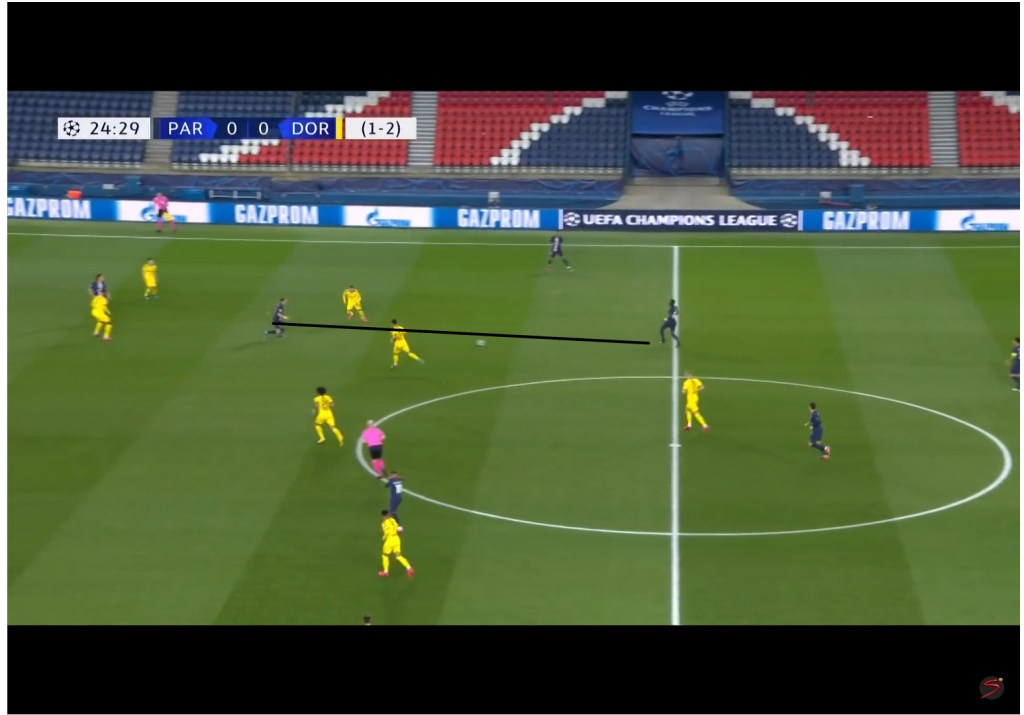
Dimaria is able to receive the ball between the lines and plays a pass in behind Dortmund’s defence, creating a scoring chance for Cavani. Positioning players in the half space can also draw defenders out of their positions, creating space for the attacking team to run into
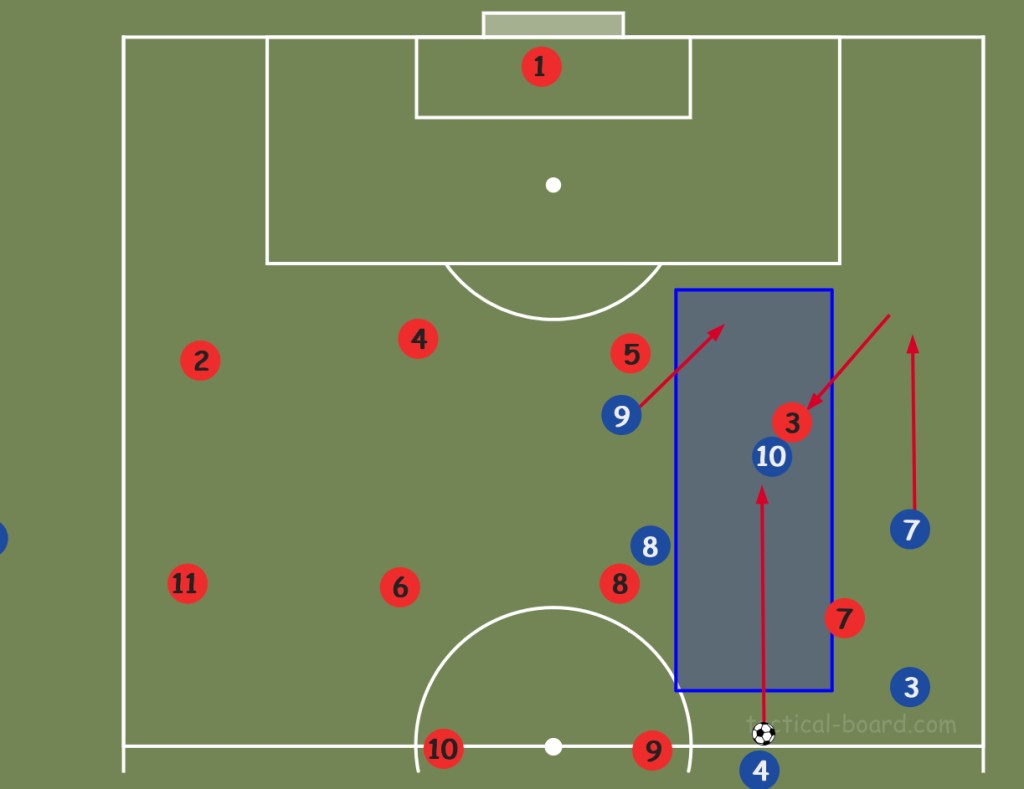
The example of the PSG vs Dortmund game shows Dimaria receiving the ball in the half space which highlights another way to exploit the weaknesses in a position oriented system, the use of vertical passes. The aim of all football teams when attacking is to progress the ball into the attacking third in order to create scoring chances. When playing against a positional oriented zonal marking teams, an effective way to do this is to use vertical passes to exploit the space behind the oppositions line that occurs due to the clearly defined blocks of attack, defense and midfield. PSG used this extremely effectively against Favre’s Dortmund, who deployed a 5-4-1 formation which allowed Neymar and Dimaria to positions himself in the space behind Dortmund’s midfield block.
Vertical passes can also advantageous as they allow the attacking team to potentially break two lines of the oppositions formation allowing them to progress the ball over a large or small distance in a short space of time. Although it must be stated that this may only be effective if the oppositions structure is not as compact as it should be, like the Dortmund example above. For the pass to be effective as it can be, the attacking team must be structured in a way that allows them to retain possession, which can be done by positioning players in close proximity to each other allowing for lay-offs and quick inter play, or the attacking team could make use of 3rd man runs.
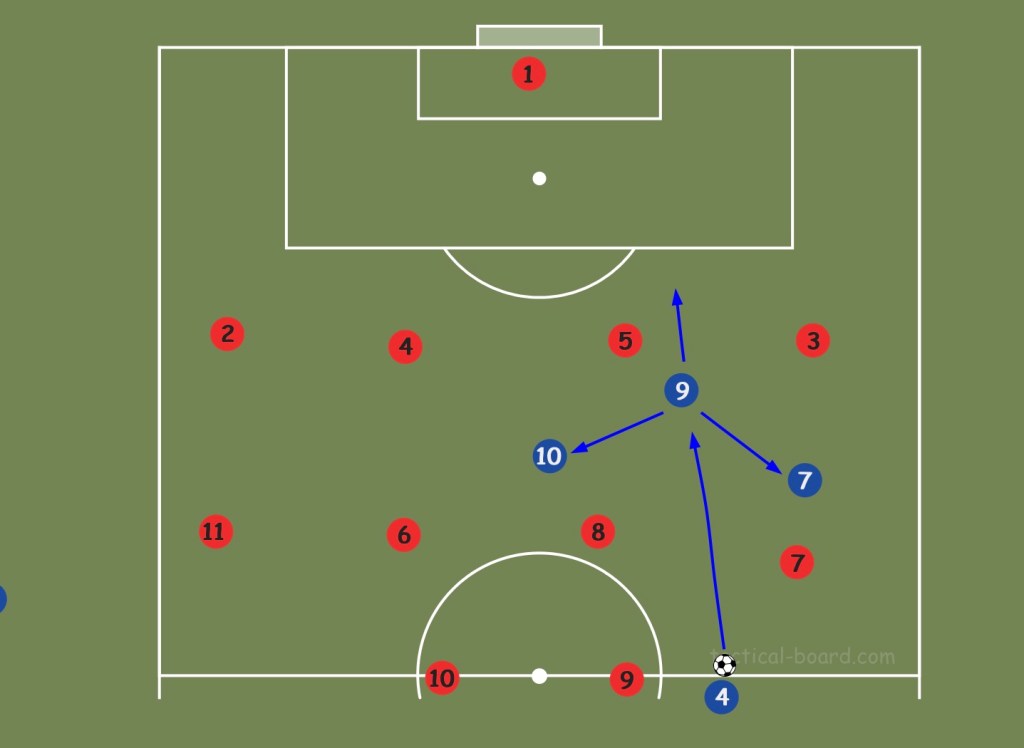
The number 9 in the example above can either receive the ball and turn or pass to either the blue number 7 or 10, who were previously unable to receive the all due to cover shadows of the red 7 and the red 8. Furthermore for the pass to be effective other factors such as the timing of the pass body positioning of the player and speed of the pass also play a part in effectiveness of the pass. Usually with zonal marking the opposition will, as mentioned before, aim for compactness vertically and horizontally which may mean the space between the lines is very small. To combat this the attacking team should use their striker/strikers to pin the oppositions defensive line and create space between the lines, that the inside forwards can take advantage of.
In order to create space the attacking team could also circulate the ball deep in their own half to incite a higher press from the opposition creating more space between the lines, in which vertical and diagonal passes can be used to progress the ball into the final third
Overloads
It must be said, nevertheless, that each position oriented system is different and not every team plays a “flat” formation with two clear midfield and defensive banks, some teams stagger their formations to nullify the threat of large space between the lines. A perfect example of team that staggered their pressing lines was Sampaoli’s sampdoria, playing a 4-3-1-2
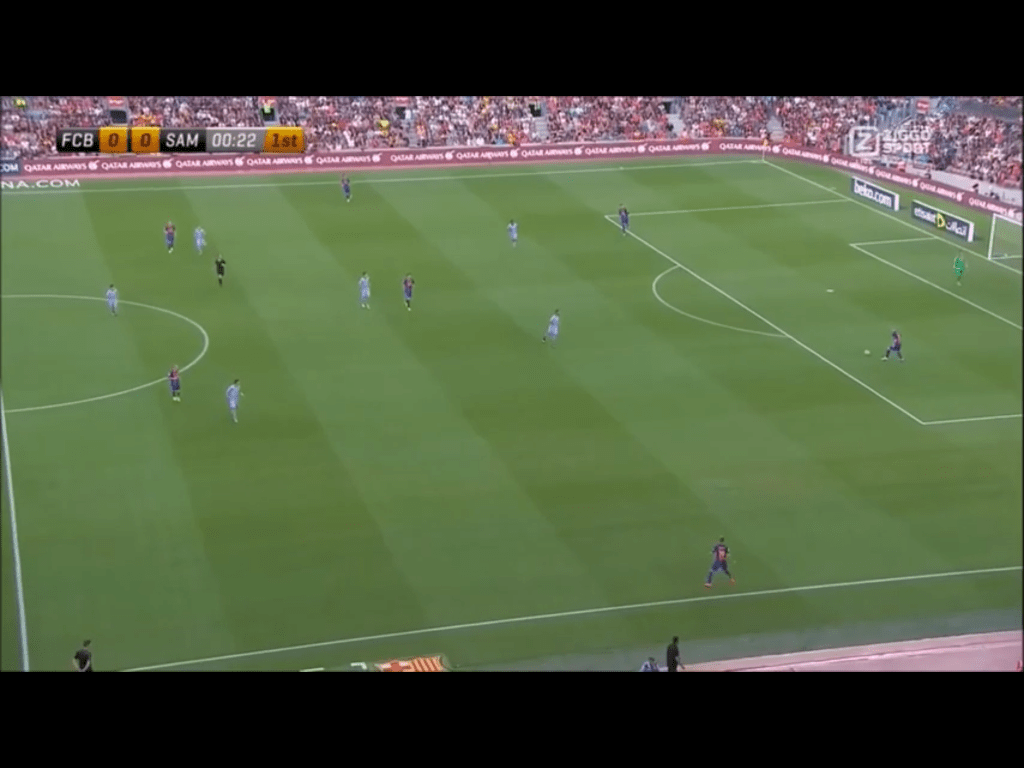
Quagiarella, sampdoria’s Right striker prevents a pass to Iniesta from the defence into the midfield, forcing the defender to play the pass to the full back. Here the aim of Sampdoria is to protect the middle and force Barcelona out wide, where they would then attempt to win the ball back.

As Arda Turan(off screen) maintained a high position, pinning sampdoria’s right back high up the pitch allowing Iniesta to drift to the left flank creating a short but effective 2v1 overload, which helped them progress the ball through sampdoria’s first 2 lines of pressure
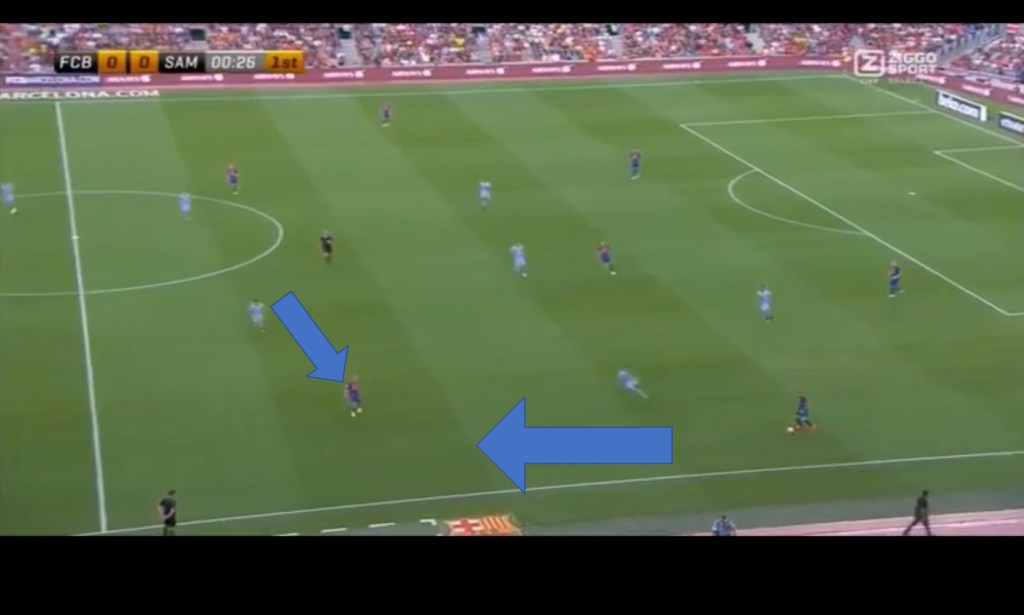
This example shows how overloads can be used to progress the ball, whether they are used in the opposition’s half or in the attacking teams half. Overload is a term that refers to a number of players entering a specific zone of the pitch, resulting in numerical superiority. For anyone that has had the unfortunate pleasure of being part of the 2 in a 5v2 rondo, you’ll know how although it is not impossible to win the the ball back, it can be very difficult if the 5 pass accurately and move effectively. Overloads aim to attain numerical superiority to progress the ball further up the pitch or into the final third due to the fact that one of the attacking players will always have an option who is not being marked.
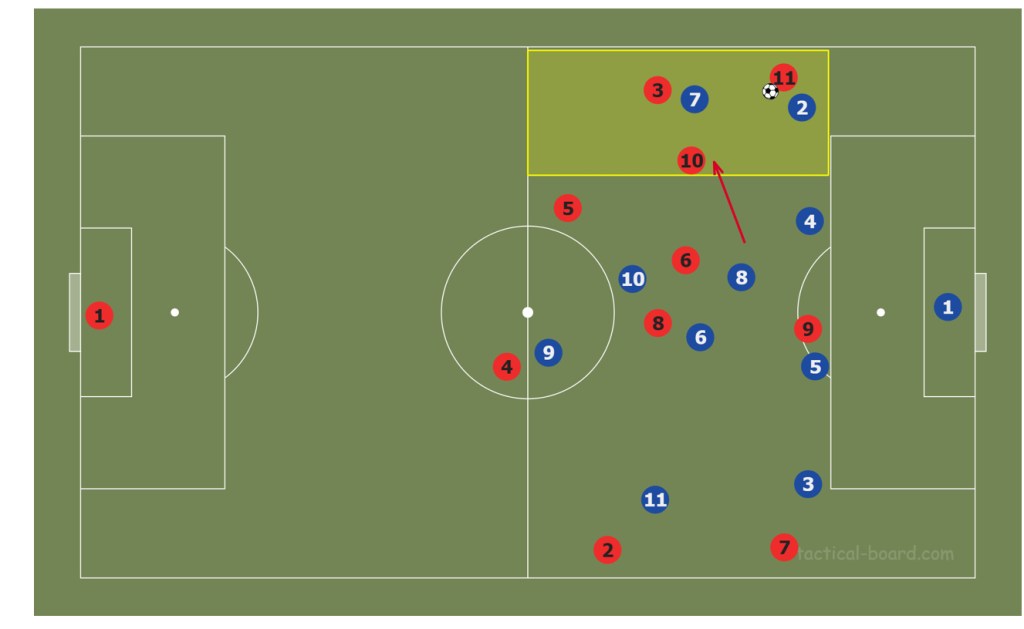
From Cain smith’s article – “Tactical Theory: Creating overloads with a roaming playmaker” on footballbh.net
The number ten drifts to the left of the pitch to create 3v2, giving the number 11 an option for a pass and therefore allowing the number 10 to receive turn and find another pass.
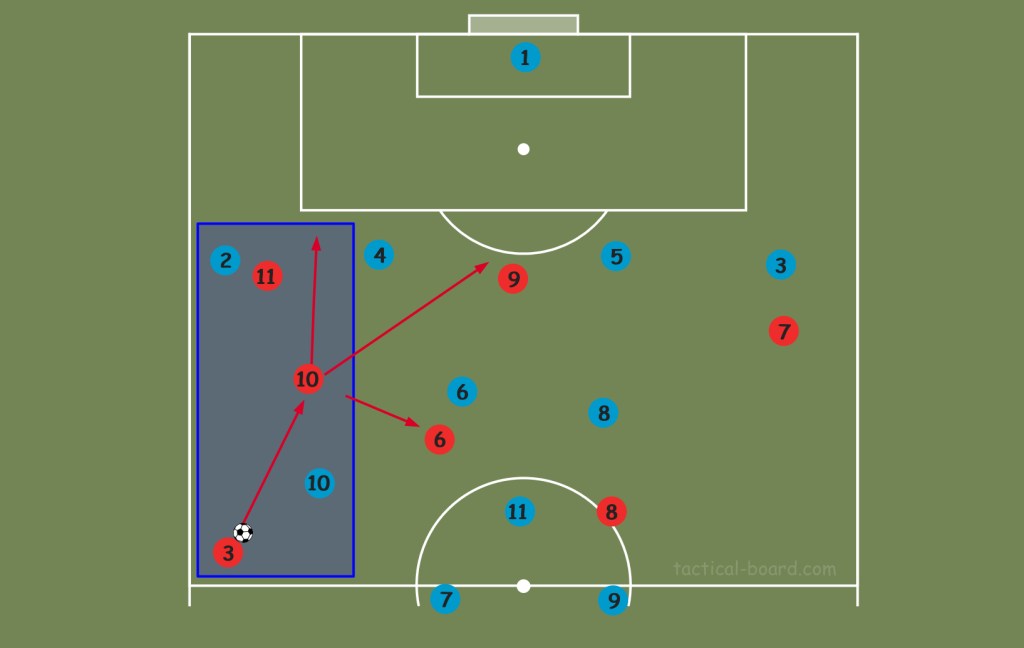
This example combines the use of both overloads and playing through the half space to progress the ball, with the use of overloads making the pass into the half space a possibility.
Position oriented zonal marking systems have become a mainstay in modern football amongst some teams in “top” leagues as through it, players can use their teammates as reference points, allowing them to press the opponent while protecting due to the vertical and horizontal compactness created by the system. However, the use of vertical passes playing through the half spaces and creating overloads are just a few of the ways the weaknesses in position oriented zonal marking systems can be exploited, allowing for progression of the ball.




 Skmm-ftbl
Leave a comment